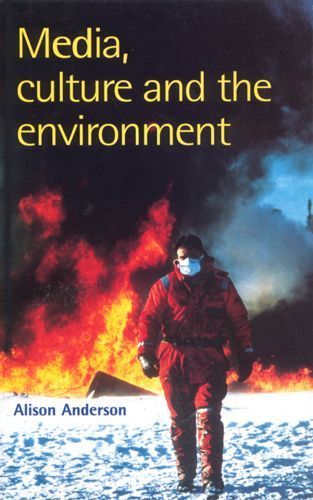
Are you getting the real news on environmental issues? Or are the reports you are hearing slanted to meet the special interests of the reporters? The government? A lobbying group? How are our views on the Torrey Canyon oil spill, the demise of Brazilian rain forests, or the Chernobyl disaster shaped by individuals or organizations that know how to use the media to best deliver their message? Media, Culture and the Environment provides an accessible introduction to key issues and debates surrounding the media politics of risk assessment and the environment. Anderson looks at nature as contested terrain and reveals how news sources use it to compete for our emotions and attention. She shows how framings of risk in relation to the environment are influenced by social, political, and cultural factors, but she also rejects extreme versions of social constructionism.
The book moves beyond traditional disciplinary boundaries by synthesizing recent debates in cultural theory and media studies with key developments in human geography. It offers an in-depth analysis of pressure politics and environmental lobbying groups, while examining the production, transmission and negotiation language of news discourse. The examples, drawn from both Europe and North America, include the tremendous headline controversies over oil spills and killing of baby seals. Difficult issues, clearly surveyed and incisively presented, make this book essential reading for anyone interested in how and why journalists handle environmental news in the ways they do.
Inhaltsverzeichnis
Acknowledgments< BR> < BR> Introduction< BR> Environmental issues< BR> Ecology and social theory< BR> Environmentalism and the news media< BR> Cultural, spatial and temporal contexts< BR> Social constructionism< BR> Structure of the book< BR> Further reading< BR> < BR> 1. Pressure politics and the news media< BR> Introduction< BR> Media theory< BR> Conceptualizing the role of the media< BR> Public arenas and issue entrepreneurs< BR> Source strategies< BR> Summary< BR> Suggested furter reading< BR> < BR> 2. News production< BR> Introduction< BR> News production perspectives< BR> Biases and constraints< BR> Summary< BR> Suggested further reading< BR> < BR> 3. The environmental lobby< BR> Introduction< BR> Defining social movements< BR> Two competing traditions< BR> The rise of the green movement in Western Europe and the USA< BR> A new politics? < BR> Evidence for the rise of a broad-based environmental movement< BR> Explanations for the rise of environmentalism< BR> Summary< BR> Suggested further reading< BR> < BR> 4. News and the social construction of the environment< BR> Introduction< BR> Risk and the environment as a social construct< BR> Media framing of risk and the environment< BR> Explanations of story selection< BR> Summary< BR> Suggested further reading< BR> < BR> 5. Contested ground: news sources and the media< BR> Introduction< BR> A convergence of approaches< BR> The background< BR> The agenda-setting role of the popular press < BR> The seals story as an issue threshold for environmental awareness< BR> The agenda-building role of sources< BR> Summary< BR> Suggested further reading< BR> < BR> 6. Mediating the environment< BR> Introduction< BR> Live Aid< BR> Media practitioners' views of the audience< BR> Public opinion and news media representations of environmental issues< BR> Texts and readers< BR> Circuit of communication< BR> Competing discourses about nuclear power< BR> Environmental education and cultural values< BR> Summary< BR> Suggested further reading< BR> < BR> Conclusion< BR> < BR> References< BR> Index