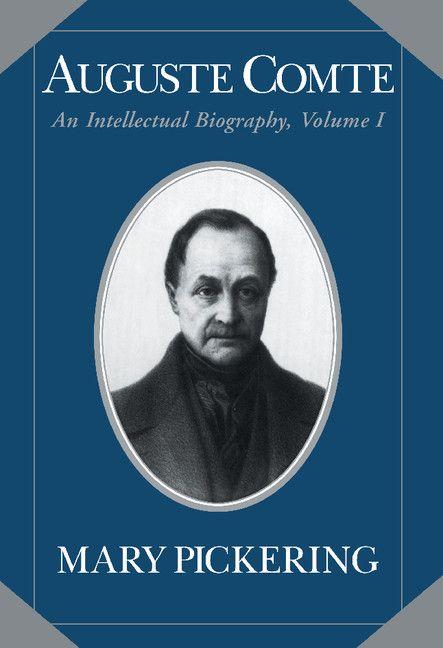
As the founder of sociology, positivism, and the history of science, Auguste Comte was arguably the most important nineteenth century French philosopher. Yet he has been curiously neglected. Based upon ten years of research, including three years of archival work in Paris, Mary Pickering's projected two-volume study constitutes the first comprehensive intellectual biography of this thinker. This first volume covers the period from his birth to the completion of the seminal Cours de philosophie positive and places Comte's evolution within the context of post-revolutionary France. It shows that Comte, reacting to the cataclysmic upheavals of his time, developed sociology as a way to unify society. He conceived the new doctrine of positivism to serve as its basis and to eliminate the questionable abstractions of conventional philosophy. The book examines the interplay between Comte's controversial intellectual development and the vicissitudes of his personal and professional life. It highlights his struggles with poverty and mental illness, his failed marriage to a so-called prostitute and his violent confrontations with the government and the scientific community. At the same time, it investigates his volatile relationships with his family, friends, and disciples, as well as with such famous contemporaries as Saint-Simon, the Saint-Simonians, Guizot, and John Stuart Mill. Pickering challenges the traditional view of Comte as an arid, simplistic thinker. According to her, he always emphasized the importance of the emotions and distrusted the scientistic approach that now is paradoxically associated with positivism. She thus demonstrates that his later religious direction did not constitutea break with his early beliefs but represented their logical outcome.
Inhaltsverzeichnis
Acknowledgments; Introduction; 1. The early years; 2. The life and works of Saint-Simon up to 1817; 3. Comte's first works for Saint-Simon; 4. Comte's growing independence, 1819-21; 5. The fundamental opuscule and Comte's rupture with Saint-Simon; 6. The aftermath of the rupture; the search for connections; 7. Comte's efforts to establish himself; 8. Intellectual and mental crises; 9. The road to recovery, 1828-30; 10. Years of success and confrontation, 1830-8; 11. Comte's changing psyche and aberrant behavior, 1838-40; 12. The encounter between two luminaries: Comte and Mill; 13. 1842: a turning point; 14. Cours de philosophie positive: positivism and the natural sciences; 15. Cours de philosophie positive; sociology; Conclusion; Bibliography; Index.