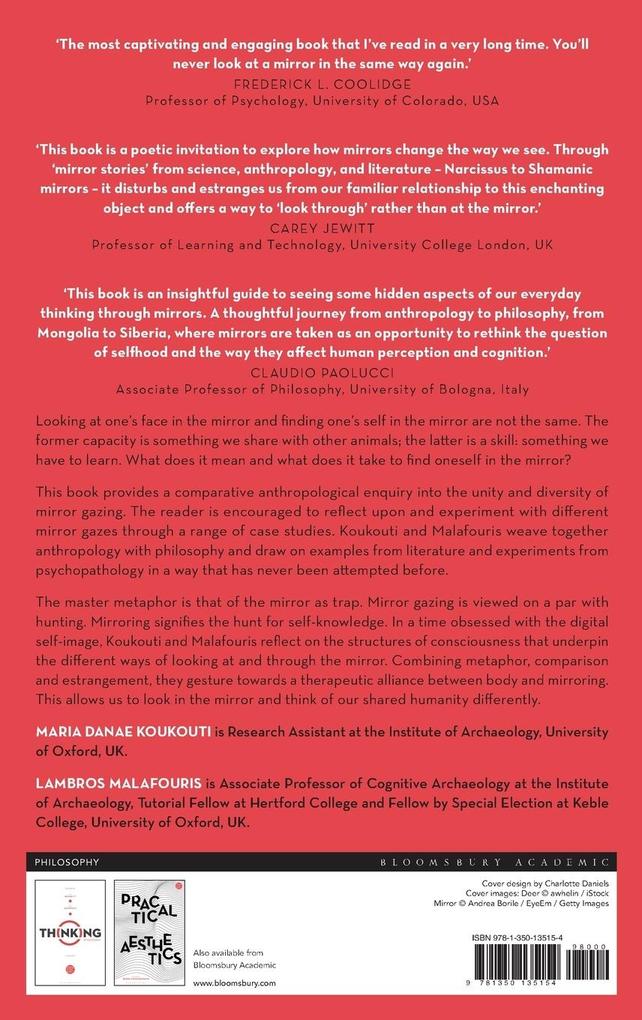
Looking at one's face in the mirror and finding one's self in the mirror are not the same. The former capacity is something we share with other animals; the latter is a skill: something we have to learn. What does it mean and what does it take to find oneself the mirror?
This book provides a comparative anthropological enquiry into the unity and diversity of mirror gazing. The reader is encouraged to reflect upon and experiment with different mirror gazes through a range of case studies. Koukouti and Malafouris weave together anthropology with philosophy and draw on examples from literature and experiments from psychopathology in a way that has never been attempted before.
The master metaphor is that of the mirror as trap. Mirror gazing is viewed on a par with hunting. Mirroring signifies the hunt for self-knowledge. In a time obsessed with the digital self-image, Koukouti and Malafouris reflect on the structures of consciousness that underpin the different ways of looking at and through the mirror. Combining metaphor, comparison and estrangement, they gesture towards a therapeutic alliance between body and mirroring. This allows us to look in the mirror, and think of our shared humanity differently.
Inhaltsverzeichnis
Image and Imagination: A Prolegomenon< BR> < BR> Chapter 1: About Mirroring: An Introduction < BR> < BR> PART I: Dis-enchantment < BR> < BR> Chapter 2: The Image Thief < BR> < BR> Chapter 3: Beautiful Scars< BR> < BR> PART II: Re-enchantment< BR> < BR> Chapter 4: Looking Through the Looking-Glass< BR> < BR> Chapter 5: The Other in the Mirror < BR> < BR> Chapter 6: The Gaze of the Shaman< BR> < BR> PART III Hunters and Prey< BR> < BR> Chapter 7: The Mirror Trap< BR> < BR> Chapter 8: How to Look in The Mirror< BR> < BR> Epilogue< BR> < BR> Bibliography< BR> Index