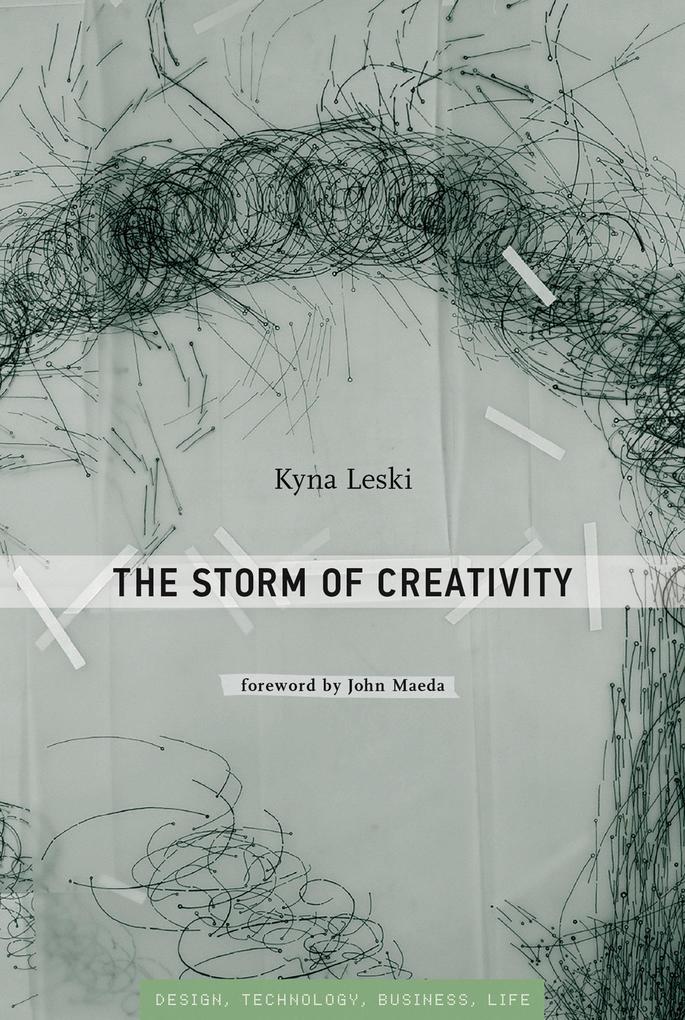
The stages of the creative process—from “unlearning” to beginning again—seen through examples from the practice of artists, architects, poets, and others. Although each instance of creativity is singular and specific, Kyna Leski tells us, the creative process is universal. Artists, architects, poets, inventors, scientists, and others all navigate the same stages of the process in order to discover something that does not yet exist. All of us must work our way through the empty page, the blank screen, writer's block, confusion, chaos, and doubt. In this book, Leski draws from her observations and experiences as a teacher, student, maker, writer, and architect to describe the workings of the creative process.
Leski sees the creative process as being like a storm; it slowly begins to gather and take form until it overtakes us—if we are willing to let it. It is dynamic, continually in motion; it starts, stops, rages and abates, ebbs and flows. In illustrations that accompany each chapter, she maps the arc of the creative process by tracing the path of water droplets traveling the stages of a storm.
Leski describes unlearning, ridding ourselves of preconceptions; only when we realize what we don't know can we pose the problem that we need to solve. We gather evidence—with notebook jottings, research, the collection of objects—propelling the process. We perceive and conceive; we look ahead without knowing where we are going; we make connections. We pause, retreat, and stop, only to start again. To illustrate these stages of the process, Leski draws on examples of creative practice that range from Paul Klee to Steve Jobs, from the discovery of continental drift to the design of Antoni Gaudí's Sagrada Familia.
Creativity, Leski tells us, is a path with no beginning or end; it is ongoing. This revelatory view of the creative process will be an essential guide for anyone engaged in creative discovery.
The Creative Process
Unlearning
Problem Making
Gathering and Tracking
Propelling
Perceiving and Conceiving
Seeing Ahead
Connecting
Pausing
Continuing
Inhaltsverzeichnis
CHAPTER 1. Creativity as Storm< BR> Noumena and phenomena in creativity< BR> CHAPTER 2. Unlearning< BR> Abolishing the preconceptions of brainstorming< BR> Uncertainty< BR> CHAPTER 3. Problem Making< BR> Defining a problem< BR> Framing a problem< BR> Crafting problems< BR> Successful problem making< BR> CHAPTER 4. Gathering and Tracking< BR> CHAPTER 5. Propelling< BR> Propelled to perception and conception< BR> CHAPTER 6. Perceiving and Conceiving< BR> "Come to your senses"< BR> An example from medicine< BR> The other way around< BR> The roots of discovery and invention< BR> Investing in what doesn't yet exist< BR> CHAPTER 7. Seeing Ahead< BR> Glyphs< BR> Insight plans< BR> A lesson from Paul Klee< BR> Reiterative cycles< BR> More on imagining and imagination< BR> CHAPTER 8. Connecting< BR> CHAPTER 9. Pausing< BR> CHAPTER 10. Continuing< BR> Beginnings< BR> Beginning again, or re-beginning< BR> The beginner's mind and non-attachment< BR> Giving up completely< BR> Part of a continuum