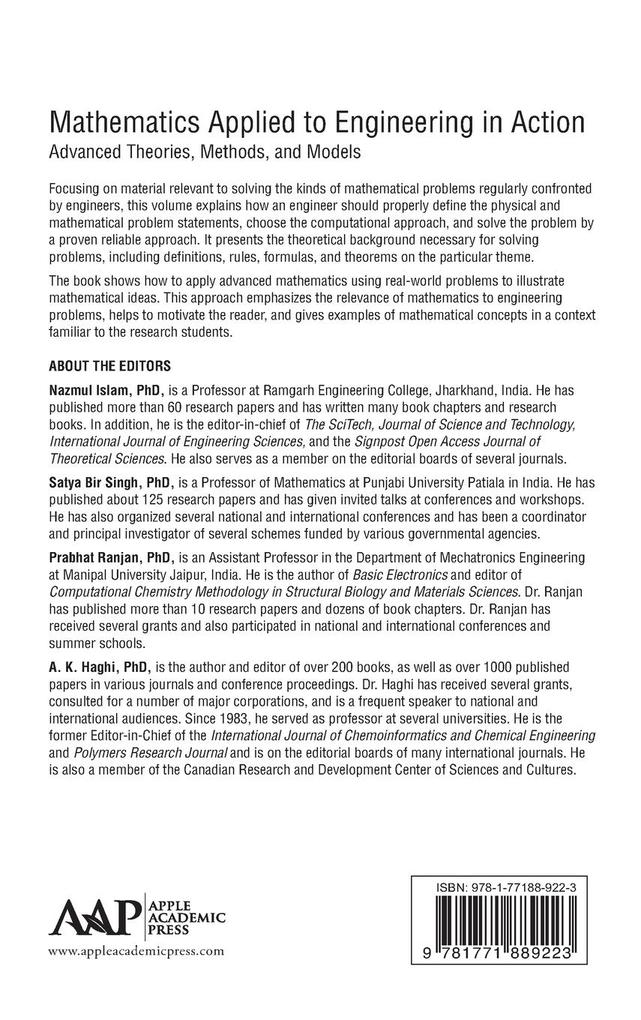
This new volume explains how an engineer should properly define the physical and mathematical problem statements, choose the computational approach, and solve the problem by a proven reliable approach. It presents the theoretical background necessary for solving problems, including definitions, rules, formulas, and theorems.
Inhaltsverzeichnis
1. Quantum Information Perspective on Chemical Reactivity 2. A Computational Modeling of the Structure, Frontier Molecular Orbital (FMO) Analysis, and Global and Local Reactive Descriptors of a Phytochemical 'Coumestrol' 3. Theoretical Analysis of CuTiS2and CuTise2 Invoking Density Functional Theory Based Descriptors 4. Synergistic Effect of E. crassipes Biomass/Chitosan for As(III) Remediation from Water 5. Computational Investigations on Metal Oxide Clusters and Graphene-Based Nanomaterials for Heterogeneous Catalysis 6. Effect of Dye Concentration on Series Resistance of Thionin Dye-Based Organic Diode 7. On Gower's Inverse Matrix 8. Noether's Theorem 9. Mathematical Modeling of Elastic-Plastic Transitional Stresses in Human Femur and Tibia Bones Exhibiting Orthotropic Macro Structural Symmetry 10. Lorentz Transformations, Dirac Matrices, and 3-Rotations via Quaternions 11. Multiscale Approach toward the Modeling and Simulation of Carbon Nanotubes Networks 12. When Perovskites Memorize