
This book examines under what circumstances, and with which techniques, one can reasonably infer cause and effect in a business setting, and use the insight to drive business decisions. It is written at a level accessible to anyone with a master's degree in analytics, business, economics, statistics, computer science, or a related field.
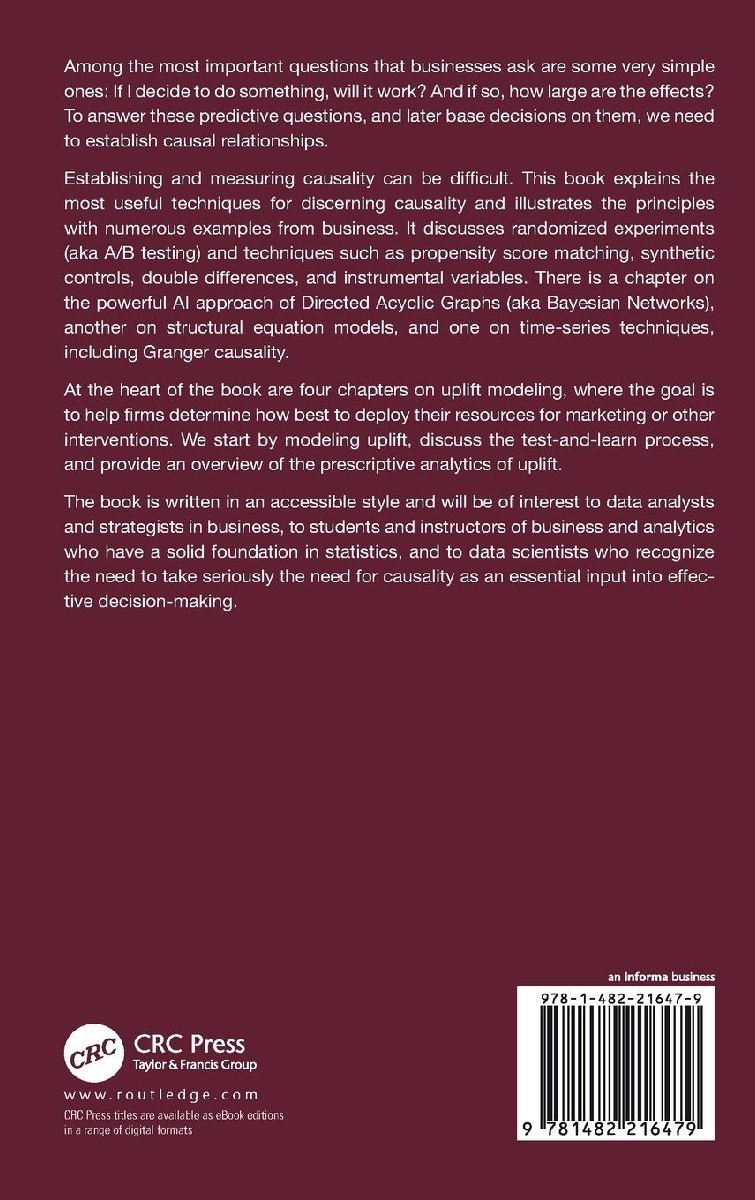
Among the most important questions that businesses ask are some very simple ones: If I decide to do something, will it work? And if so, how large are the effects? To answer these predictive questions, and later base decisions on them, we need to establish causal relationships.
Establishing and measuring causality can be difficult. This book explains the most useful techniques for discerning causality and illustrates the principles with numerous examples from business. It discusses randomized experiments (aka A/B testing) and techniques such as propensity score matching, synthetic controls, double differences, and instrumental variables. There is a chapter on the powerful AI approach of Directed Acyclic Graphs (aka Bayesian Networks), another on structural equation models, and one on time-series techniques, including Granger causality.
At the heart of the book are four chapters on uplift modeling, where the goal is to help firms determine how best to deploy their resources for marketing or other interventions. We start by modeling uplift, discuss the test-and-learn process, and provide an overview of the prescriptive analytics of uplift.
The book is written in an accessible style and will be of interest to data analysts and strategists in business, to students and instructors of business and analytics who have a solid foundation in statistics, and to data scientists who recognize the need to take seriously the need for causality as an essential input into effective decision-making.
Inhaltsverzeichnis
"The book is valuable for data scientists and business strategists for actual applications of the causal modeling. It also is helpful for instructors and students for courses on the capabilities of modern statistical causality modeling explained with multiple examples on business data."
Stan Lipovetsky, Technometrics, 2026.
Es wurden noch keine Bewertungen abgegeben. Schreiben Sie die erste Bewertung zu "Cause and Effect Business Analytics and Data Science" und helfen Sie damit anderen bei der Kaufentscheidung.











