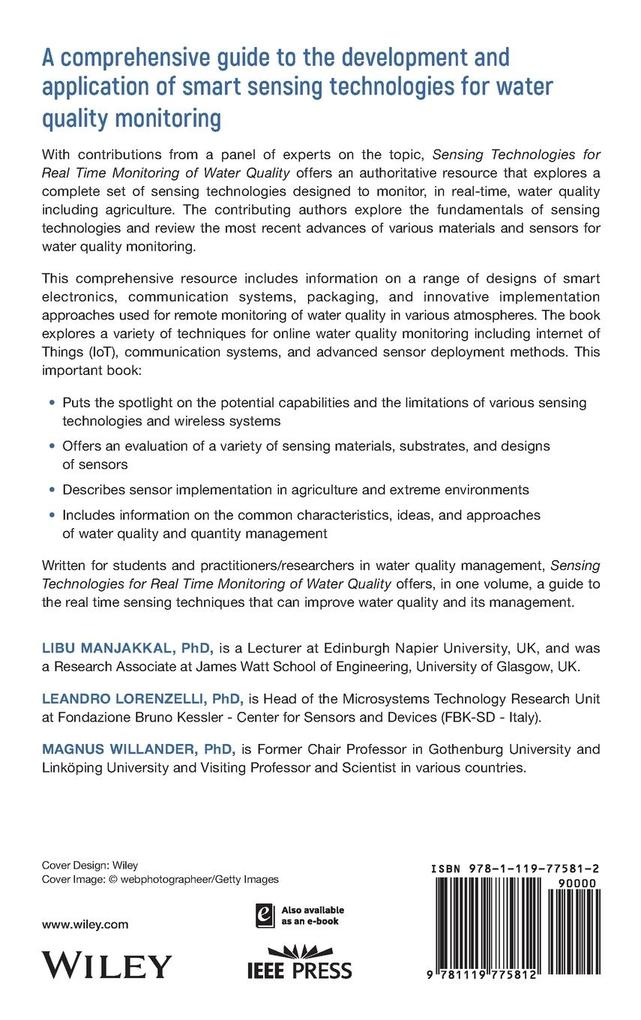
Sensing Technologies for Real Time Monitoring of Water Quality
A comprehensive guide to the development and application of smart sensing technologies for water quality monitoring
With contributions from a panel of experts on the topic, Sensing Technologies for Real Time Monitoring of Water Quality offers an authoritative resource that explores a complete set of sensing technologies designed to monitor, in real-time, water quality including agriculture. The contributing authors explore the fundamentals of sensing technologies and review the most recent advances of various materials and sensors for water quality? ? monitoring.
This comprehensive resource includes information on a range of designs of smart electronics, communication systems, packaging, and innovative implementation approaches used for remote monitoring of water quality in various atmospheres. The book explores a variety of techniques for online water quality monitoring including internet of Things (IoT), communication systems, and advanced sensor deployment methods. This important book:
* Puts the spotlight on the potential capabilities and the limitations of various sensing technologies and wireless systems
* Offers an evaluation of a variety of sensing materials, substrates, and designs of sensors
* Describes sensor implementation in agriculture and extreme environments
* Includes information on the common characteristics, ideas, and approaches of water quality and quantity management
Written for students and practitioners/researchers in water quality management, Sensing Technologies for Real Time Monitoring of Water Quality offers, in one volume, a guide to the real time sensing techniques that can improve water quality and its management.
Inhaltsverzeichnis
About the Editors xiii
List of Contributors xv
Preface xix
Section I Materials and Sensors Development Including Case Study 1
1 Smart Sensors for Monitoring pH, Dissolved Oxygen, Electrical Conductivity, and Temperature in Water 3
Kiranmai Uppuluri
1. 1 Introduction 3
1. 2 Water Quality Parameters and Their Importance 4
1. 2. 1 Impact of pH on Water Quality 4
1. 2. 2 Impact of Dissolved Oxygen on Water Quality 5
1. 2. 3 Impact of Electrical Conductivity on Water Quality 5
1. 2. 4 Impact of Temperature on Water Quality 5
1. 3 Water Quality Sensors 6
1. 3. 1 pH 7
1. 3. 1. 1 pH Sensors: Principles, Materials, and Designs 7
1. 3. 1. 2 Glass Electrode 7
1. 3. 1. 3 Solid- State Ion- Selective Electrodes 8
1. 3. 1. 4 Metal Oxide pH Sensors 8
1. 3. 2 Dissolved Oxygen 10
1. 3. 2. 1 DO Sensors: Principles, Materials, and Designs 10
1. 3. 2. 2 Chemical Sensors 10
1. 3. 2. 3 Electrochemical Sensors 11
1. 3. 2. 4 Optical or Photochemical Sensors 12
1. 3. 3 Electrical Conductivity 13
1. 3. 3. 1 Conductivity Sensors: Principles, Materials, and Designs 13
1. 3. 4 Temperature 15
1. 3. 4. 1 Temperature Sensors: Principles, Materials, and Designs 16
1. 3. 4. 2 Thermocouples 17
1. 3. 4. 3 Resistance Temperature Detector 17
1. 3. 4. 4 Thermistor 17
1. 3. 4. 5 Integrated Circuit 18
1. 4 Smart Sensors 18
1. 5 Conclusion 18
Acknowledgment 19
References 19
2 Dissolved Heavy Metal Ions Monitoring Sensors for Water Quality Analysis 25
Tarun Narayan, Pierre Lovera, and Alan O'Riordan
2. 1 Introduction 25
2. 2 Sources and Effects of Heavy Metals 26
2. 3 Detection Techniques 26
2. 3. 1 Analytical Detection: Conventional Detection Techniques of Heavy Metals 26
2. 3. 2 Electrochemical Detection Techniques of Heavy Metals 26
2. 3. 2. 1 Nanomaterial- Modified Electrodes 29
2. 3. 2. 2 Metal Nanoparticle- Based Modification 29
2. 3. 2. 3 Metal Oxide Nanoparticle- Based Modification 33
2. 3. 2. 4 Carbon Nanomaterials- Based Modification 34
2. 3. 3 Biomolecules Modification for Heavy Metal Detection 35
2. 3. 3. 1 Antibody- Based Detection 35
2. 3. 3. 2 Nucleic Acid- Based Detection 37
2. 3. 3. 3 Cell- Based Sensor 38
2. 4 Future Direction 40
2. 5 Conclusions 40
Acknowledgment 41
References 42
3 Ammonia, Nitrate, and Urea Sensors in Aquatic Environments 51
Fabiane Fantinelli Franco
3. 1 Introduction 51
3. 2 Detection Techniques for Ammonia, Nitrate, and Urea in Water 53
3. 2. 1 Spectrophotometry 53
3. 2. 2 Fluorometry 54
3. 2. 3 Electrochemical Sensors 54
3. 3 Ammonia 59
3. 3. 1 Ammonia in Aquatic Environments 59
3. 3. 2 Ammonia Detection Techniques 62
3. 4 Nitrate 65
3. 4. 1 Nitrate in Aquatic Environments 65
3. 4. 2 Nitrate Detection Techniques 65
3. 5 Urea 67
3. 5. 1 Urea in Aquatic Environment 67
3. 5. 2 Urea Detection Techniques 69
3. 6 Conclusion and Future Perspectives 71
Acknowledgment 71
References 71
4 Monitoring of Pesticides Presence in Aqueous Environment 77
Yuqing Yang, Pierre Lovera, and Alan O'Riordan
4. 1 Introduction: Background on Pesticides 77
4. 1. 1 Types and Properties 77
4. 1. 2 Risks 78
4. 1. 3 Regulation and Legislation 79
4. 1. 4 Occurrence of Pesticide Exceedance 80
4. 2 Current Pesticides Detection Methods 80
4. 2. 1 Detection of Pesticides Based on Electrochemical Methods 82
4. 2. 1. 1 Brief Overview of Electrochemical Methods 82
4. 2. 1. 2 Detection of Pesticides by Electrochemistry 82
4. 2. 2 Detection of Pesticides Based on Optical Methods 83
4. 2. 2. 1 Detection of Pesticides Based on Fluorescence 87
4. 2. 3 Detection of Pesticides Based on Raman Spectroscopy 89
4. 2. 3. 1 Introduction to SERS 89
4. 2. 3. 2 Fabrication of SERS Substrates 91
4. 2. 3. 3 Detection of Pesticide by SERS 92
4. 2. 3. 4 Challenges and Future Perspectives 95
4. 3 Conclusion 96
Acknowledgment 96
References 96
5 Waterborne Bacteria Detection Based on Electrochemical Transducer 107
Nasrin Razmi, Magnus Willander, and Omer Nur
5. 1 Introduction 107
5. 2 Typical Waterborne Pathogens 108
5. 3 Traditional Diagnostic Tools 108
5. 4 Biosensors for Bacteria Detection in Water 110
5. 4. 1 Common Bioreceptors for Electrochemical Sensing of Foodborne and Waterborne Pathogenic Bacteria 110
5. 4. 1. 1 Antibodies 111
5. 4. 1. 2 Enzymes 111
5. 4. 1. 3 DNA and Aptamers 111
5. 4. 1. 4 Phages 112
5. 4. 1. 5 Cell and Molecularly Imprinted Polymers 112
5. 4. 2 Nanomaterials for Electrochemical Sensing of Waterborne Pathogenic Bacteria 112
5. 4. 2. 1 Metal and Metal Oxide Nanoparticles 113
5. 4. 2. 2 Conducting Polymeric Nanoparticles 114
5. 4. 2. 3 Carbon Nanomaterials 114
5. 4. 2. 4 Silica Nanoparticles 114
5. 5 Various Electrochemical Biosensors Available for Pathogenic Bacteria Detection in Water 115
5. 5. 1 Amperometric Detection 115
5. 5. 2 Impedimetric Detection 121
5. 5. 3 Conductometric Detection 123
5. 5. 4 Potentiometric Detection 124
5. 6 Conclusion and Future Prospective 126
Acknowledgment 127
References 127
6 Zinc Oxide- Based Miniature Sensor Networks for Continuous Monitoring of Aqueous pH in Smart Agriculture 139
Akshaya Kumar Aliyana, Aiswarya Baburaj, Naveen Kumar S. K. , and Renny Edwin Fernandez
6. 1 Introduction 139
6. 2 Metal Oxide- Based Sensors and Detection Methods 140
6. 3 pH Sensor Fabrication 141
6. 3. 1 Detection of pH: Materials and Method 141
6. 3. 2 Detection of pH: Surface Morphology of the Nanostructured ZnO and IDEs 144
6. 3. 3 Detection of pH: Electrochemical Sensing Performance 145
6. 3. 4 Detection of Real- Time pH Level in Smart Agriculture: Wireless Sensor Networks and Embedded System 149
6. 4 Conclusion 151
Acknowledgment 152
References 152
Section II Readout Electronic and Packaging 161
7 Integration and Packaging for Water Monitoring Systems 163
Muhammad Hassan Malik and Ali Roshanghias
7. 1 Introduction 163
7. 2 Advanced Water Quality Monitoring Systems 167
7. 2. 1 Multi- sensing on a Single Chip 167
7. 2. 2 Heterogeneous Integration 169
7. 2. 3 Case Study: MoboSens 169
7. 3 Basics of Packaging 171
7. 4 Hybrid Flexible Packaging 173
7. 4. 1 Interconnects 174
7. 4. 2 Thin Die Embedding 176
7. 4. 3 Encapsulation and Hermeticity 178
7. 4. 4 Roll to Roll Assembly 180
7. 5 Conclusion 181
References 181
8 A Survey on Transmit and Receive Circuits in Underwater Communication for Sensor Nodes 185
Noushin Ghaderi and Leandro Lorenzelli
8. 1 Introduction 185
8. 2 Sensor Networks in an Underwater Environment 186
8. 2. 1 Acoustic Sensor Network 186
8. 2. 1. 1 Energy Sink- Hole Problem 187
8. 2. 1. 2 Acoustic Sensor Design Problems 188
8. 2. 1. 3 The Underwater Transducer 189
8. 2. 1. 4 Amplifier Design 190
8. 2. 1. 5 Analog- to- Digital Converter 194
8. 2. 2 Electromagnetic (EM) Waves Underwater Sensors 197
8. 2. 2. 1 Antenna Design 198
8. 2. 2. 2 Multipath Propagation 198
8. 3 Conclusion 199
Acknowledgment 199
References 200
Section III Sensing Data Assessment and Deployment Including Extreme Environment and Advanced Pollutants 203
9 An Introduction to Microplastics, and Its Sampling Processes and Assessment Techniques 205
Bappa Mitra, Andrea Adami, Ravinder Dahiya, and Leandro Lorenzelli
9. 1 Introduction 205
9. 1. 1 Properties of Microplastics 208
9. 1. 2 Microplastics in Food Chain 209
9. 1. 3 Human Consumption of Microplastics and Possible Health Effects 209
9. 1. 4 Overview 210
9. 2 Microplastic Sampling Tools 212
9. 2. 1 Non- Discrete Sampling Devices 212
9. 2. 1. 1 Nets 212
9. 2. 1. 2 Pump Tools 213
9. 2. 2 Discrete Sampling Devices 215
9. 2. 3 Surface Microlayer Sampling Devices 215
9. 3 Microplastics Separation 215
9. 3. 1 Separating Microplastics from Liquid Samples 215
9. 3. 1. 1 Filtration 215
9. 3. 1. 2 Sieving 216
9. 3. 2 Separating Microplastics from Sediments 218
9. 3. 2. 1 Density Separation 218
9. 3. 2. 2 Elutriation 218
9. 3. 2. 3 Froth Floatation 219
9. 4 Microplastic Sample Digestion Process 220
9. 4. 1 Acidic Digestion 221
9. 4. 2 Alkaline Digestion 221
9. 4. 3 Oxidizing Digestion 221
9. 4. 4 Enzymatic Degradation 222
9. 5 Microplastic Identification and Classification 222
9. 5. 1 Visual Counting 222
9. 5. 2 Fluorescence 223
9. 5. 3 Destructive Analysis 223
9. 5. 3. 1 Thermoanalytical Methods 224
9. 5. 3. 2 High- Performance Liquid Chromatography 225
9. 5. 4 Nondestructive Analysis 225
9. 5. 4. 1 Fourier Transform Infrared Spectroscopy 225
9. 5. 4. 2 Raman Spectroscopy 226
9. 6 Conclusions 228
Acknowledgment 229
References 229
10 Advancements in Drone Applications for Water Quality Monitoring and the Need for Multispectral and Multi- Sensor Approaches 235
Joao L. E. Simon, Robert J. W. Brewin, Peter E. Land, and Jamie D. Shutler
10. 1 Introduction 235
10. 2 Airborne Drones for Environmental Remote Sensing 237
10. 3 Drone Multispectral Remote Sensing 239
10. 4 Integrating Multiple Complementary Sensor Strategies with a Single Drone 241
10. 5 Conclusion 242
Acknowledgment 243
References 243
11 Sensors for Water Quality Assessment in Extreme Environmental Conditions 253
Priyanka Ganguly
11. 1 Introduction 253
11. 2 Physical Parameters 255
11. 2. 1 Electrical Conductivity 255
11. 2. 2 Temperature 258
11. 2. 3 Pressure 260
11. 3 Chemical Parameters 262
11. 3. 1 pH 262
11. 3. 2 Dissolved Oxygen and Chemical Oxygen Demand 265
11. 3. 3 Inorganic Content 268
11. 4 Biological Parameters 271
11. 5 Sensing in Extreme Water Environments 273
11. 6 Discussion and Outlook 276
11. 7 Conclusion 278
References 278
Section IV Sensing Data Analysis and Internet of Things with a Case Study 283
12 Toward Real- Time Water Quality Monitoring Using Wireless Sensor Networks 285
Sohail Sarang, Goran M. Stojanovi , and Stevan Stankovski
12. 1 Introduction 285
12. 2 Water Quality Monitoring Systems 286
12. 2. 1 Laboratory- Based WQM (LB- WQM) 286
12. 2. 2 Wireless Sensor Networks- Based WQM (WSNs- WQM) 287
12. 2. 2. 1 Solar- Powered Water Quality Monitoring 289
12. 2. 2. 2 Battery- Powered Water Quality Monitoring 291
12. 3 The Use of Industry 4. 0 Technologies for Real- Time WQM 296
12. 4 Conclusion 297
References 298
13 An Internet of Things- Enabled System for Monitoring Multiple Water Quality Parameters 305
Fowzia Akhter, H. R. Siddiquei, Md. E. E. Alahi, and S. C. Mukhopadhyay
13. 1 Introduction 305
13. 2 Water Quality Parameters and Related Sensors 306
13. 3 Design and Fabrication of the Proposed Sensor 310
13. 3. 1 Sensor's Working Principle 312
13. 4 Experimental Process 312
13. 5 Autonomous System Development 313
13. 5. 1 Algorithm for Data Classification 315
13. 6 Experimental Results 318
13. 6. 1 Sensor Characterization for Temperature, pH, Nitrate, Phosphate, Calcium, and Magnesium Measurement 319
13. 6. 2 Repeatability 323
13. 6. 3 Reproducibility 325
13. 6. 4 Real Sample Measurement and Validation 327
13. 6. 5 Data Collection 330
13. 6. 6 Power Consumption 330
13. 7 Conclusion 333
Acknowledgment 333
References 333
Index 339