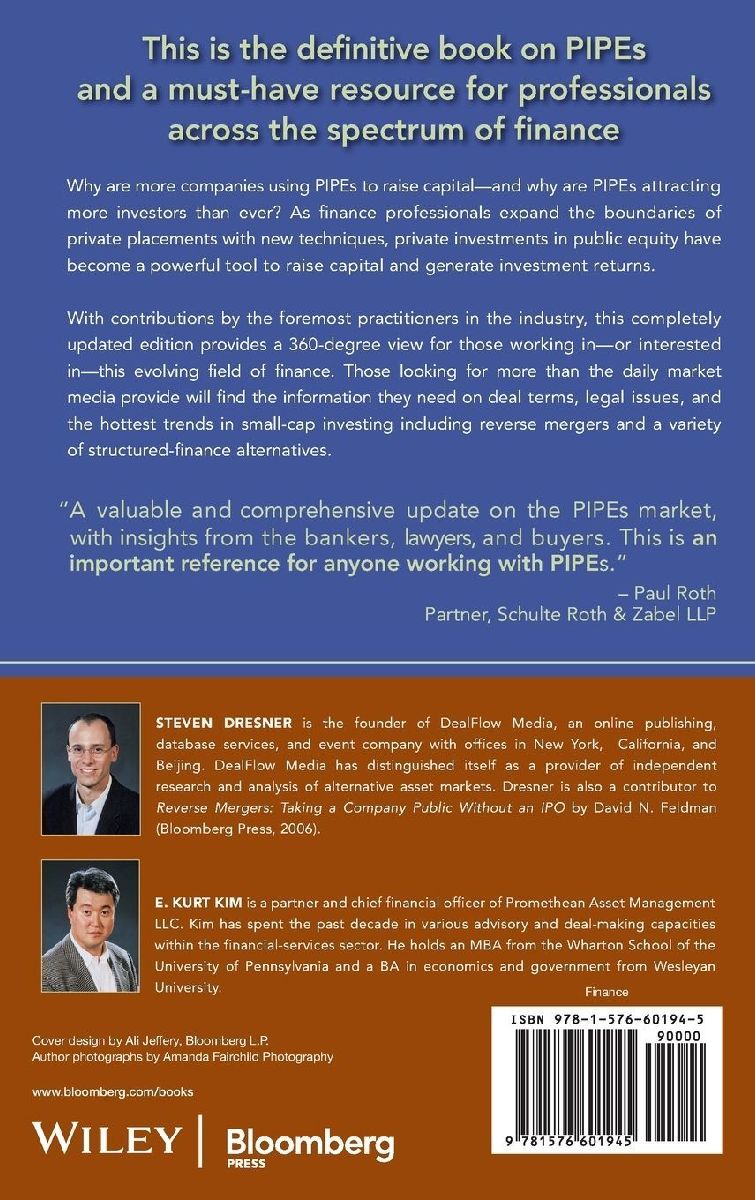
In PIPE (Private Investments in Public Equity) transactions, public companies issue stock and bonds directly, and often discreetly, to large institutional investors, rather than raising capital in the stock and bond markets. "PIPEs" details how these deals are done, for what reasons, and with what caveats.
Inhaltsverzeichnis
About the Editors. About the Contributors.
Acknowledgments.
Introduction (Steven Dresner).
Part 1. The Business of PIPEs.
1. Overview: An Emerging Market (Richard E. Gormley).
2. The Marketplace: A Statistical Summary (E. Kurt Kim).
3. A Historical Perspective: The Bubble, Converts, and the Birth of Structured PIPEs (James F. O'Brien Jr.).
4. The Players: Issues, Investors, Agents and Regulators (Steven Dresner and Brett Goetschius).
Part 2. Regulatory Landscape and Structural Alternatives.
5. The Law: Legand and Regulatory Framework (James R. Tanenbaum and Anna T. Pinedo).
6. Fundamental PIPEs: Typical Structures and Transactions (Eleazer Klein).
7. Registered PIPEs: Registered Direct Transactions (Joseph Smith).
8. Litigation Strategies: Manageing Litigation Risk and Addressing Other Investor Concerns (Perrie Weiner and Edward Totino).
Part 3. Deal Flow.
9. managing Risk: Securities Structures, Trading, and Deal Documentation (Steve Winters).
10. Due Deligence and Valuation Policy: Caveat Emptor Squared (Stewart Flink).
11. Reverse Mergers and PIPEs: The New Small-Cap IPO (David Feldman).
Afterword.
Glossary.
Index.