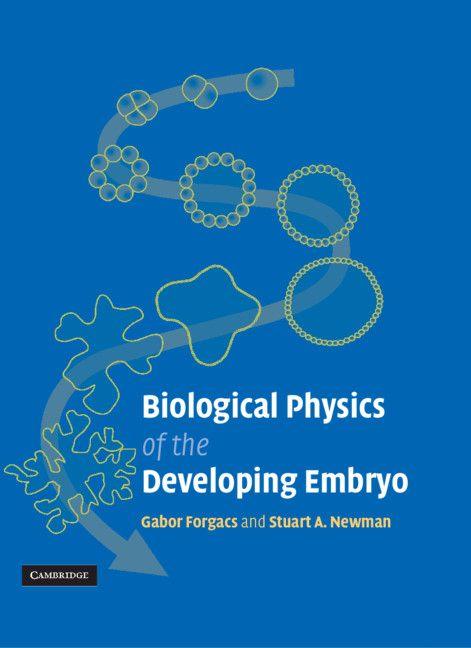
Advanced textbook that uses physics to analyze stages and components of the biological development process.
Written to be accessible to both biologists and physicists, this book shows how physics can be used to analyze the changes in pattern and form that cells and tissues undergo during development. Major stages and components of the biological development process are introduced and then analyzed from the viewpoint of physics. Concepts introduced include diffusion, viscosity and elasticity, adhesion, dynamical systems, electrical potential, percolation, fractals, reaction-diffusion systems, and cellular automata. With full-color figures throughout, this comprehensive textbook is suitable for graduate and upper-undergraduate courses in physics and biology.
Inhaltsverzeichnis
Introduction; 1. The cell: fundamental unit of developmental systems; 2. Cleavage and blastula formation; 3. Cell states: stability, oscillation, differentiation; 4. Cell adhesion, compartmentalization and lumen formation; 5. Epithelial morphogenesis: gastrulation and neurulation; 6. Mesenchymal morphogenesis; 7. Pattern formation: segmentation, axes and asymmetry; 8. Organogenesis; 9. Fertilization: generating one living dynamical system from two; 10. Evolution of developmental mechanisms; Glossary; References; Index.