
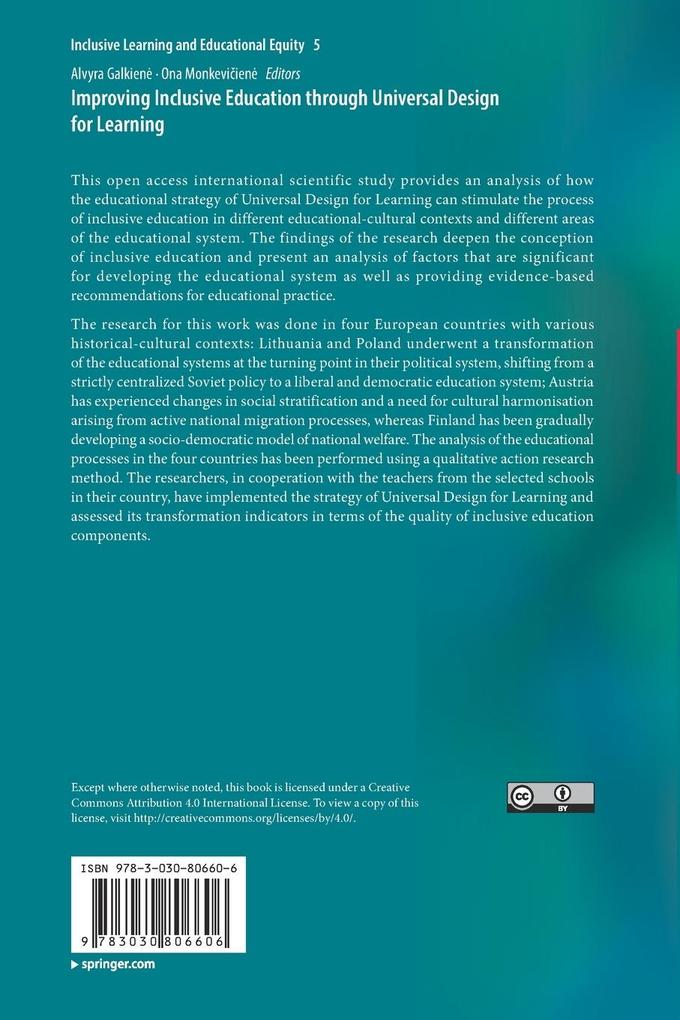
This open access international scientific study provides an analysis of how the educational strategy of Universal Design for Learning can stimulate the process of inclusive education in different educational-cultural contexts and different areas of the educational system. The findings of the research deepen the conception of inclusive education and present an analysis of factors that are significant for developing the educational system as well as providing evidence-based recommendations for educational practice.
The research for this work was done in four European countries with various historical-cultural contexts: Lithuania and Poland underwent a transformation of the educational systems at the turning point in their political system, shifting from a strictly centralized Soviet policy to a liberal and democratic education system; Austria has experienced changes in social stratification and a need for cultural harmonisation arising from active national migration processes, whereas Finland has been gradually developing a socio-democratic model of national welfare. The analysis of the educational processes in the four countries has been performed using a qualitative action research method. The researchers, in cooperation with the teachers from the selected schools in their country, have implemented the strategy of Universal Design for Learning and assessed its transformation indicators in terms of the quality of inclusive education components.
Inhaltsverzeichnis
Preface. - Chapter 1. Preconditions of Transforming the Educational Process by Applying Inclusive Education Strategies: Theoretical Background (Alvyra Galkien and Ona Monkevi ien ). - Chapter 2. The Goal of the Universal Design for Learning: Development of All to the Expert Leaners (Julita Navaitien and Egl Stasi naitien ). - Chapter 3. Theoretical and Methodological Validation of the Action Research: Methodology of the Scientific Study (Ona Monkevi ien and Alvyra Galkien ). - Chapter 4. Traditional Teaching-Learning Process in the Class of Polish School through Lens of UDL Approach (Jolanta Baran, Tamara Cierpia owska and Ewa Dyduch). - Chapter 5. The transformations of the teaching-learning process towards inclusive education as a result of the UDL approach implementation (Jolanta Baran, Tamara Cierpia owska and Ewa Dyduch). - Chapter 6. The use of the UDL approach as a factor in the success of inclusive education despite the pandemic period (Jolanta Baran, Tamara Cierpia owska and Ewa Dyduch). - Chapter 7. Development of Knowledgeable and Resourceful Learners (Alvyra Galkien and Ona Monkevi ien ). - Chapter 8. A Strategic and Goal-Directed Student: Expectations vs. Reality (Rasa Nedzinskait -Ma i nien and Gerda Šimien ). - Chapter 9. Implementing UDL: Development of Purposeful and Motivated Students (Egl Stasi naitien and Julita Navaitien ). - Chapter 10. Teaching for Diversity with UDL: Analysing Teacher Competence (Suvi Lakkala, Outi Kyrö-Ämmälä). - Chapter 11. Good practice in inclusive education: Participatory reinterpretation of already existing elaborate classroom practices under a UDL perspective (Michelle Proyer, Gertraud Kremsner and Gottfried Biewer). - Chapter 12. The Model of UDL Implementation Enabling the Development of Inclusive Education in Different Educational Contexts: ConclusionsAlvyra Galkien and Ona Monkevi ien .
Es wurden noch keine Bewertungen abgegeben. Schreiben Sie die erste Bewertung zu "Improving Inclusive Education through Universal Design for Learning" und helfen Sie damit anderen bei der Kaufentscheidung.









