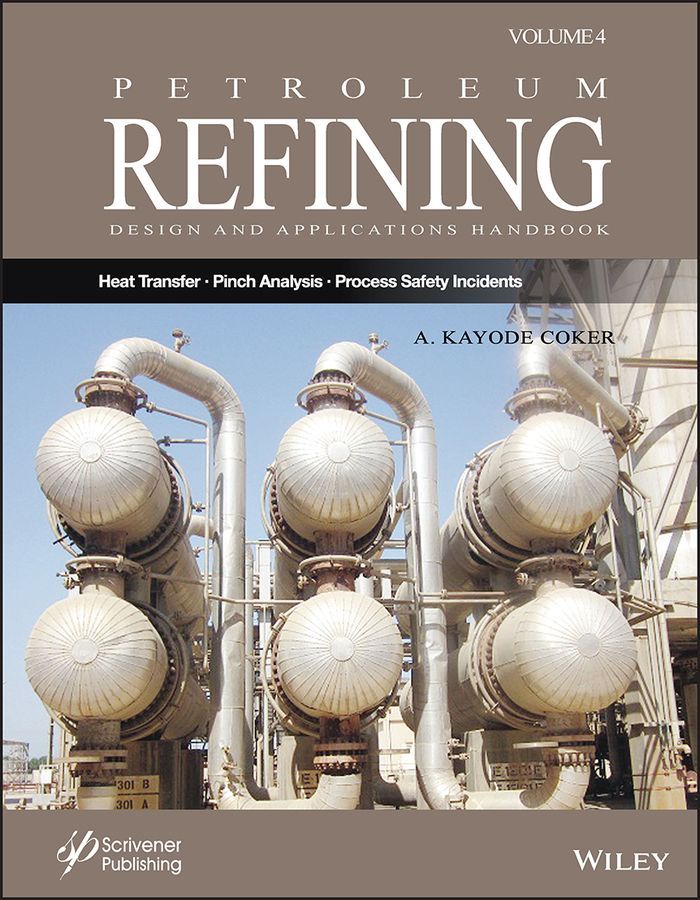
PETROLEUM REFINING
This fourth volume in the Petroleum Refining set, this book continues the most up-to-date and comprehensive coverage of the most significant and recent changes to petroleum refining, presenting the state-of-the-art to the engineer, scientist, or student.
This book provides the design of heat exchanger equipment, crude oil fouling in pre-heat train exchangers, crude oil fouling models, fouling mitigation and monitoring, prevention and control of liquid and gas side fouling, using the Excel spreadsheet and UniSim design software for the design of shell and tube heat exchangers, double pipe heat exchangers, air-cooled exchangers, heat loss tracing for process piping, pinch analysis for hot and cold utility targets and process safety incidents involving these equipment items and pertinent industrial case studies.
Use of UniSim Design (UniSim STE) software is illustrated in further elucidation of the design of shell and tube heat exchangers, condensers, and UniSim ExchangerNet R470 for the design of heat exchanger networks using pinch analysis. This is important for determining minimum cold and hot utility requirements, composite curves of hot and cold streams, the grand composite curve, the heat exchanger network, and the relationship between operating cost index target and the capital cost index target against "Tmin.
Useful as a textbook, this is also an excellent, handy go-to reference for the veteran engineer, a volume no chemical or process engineering library should be without. Written by one of the world's foremost authorities, this book sets the standard for the industry and is an integral part of the petroleum refining renaissance. It is truly a must-have for any practicing engineer or student in this area.
This groundbreaking new volume:
* Assists engineers in rapidly analyzing problems and finding effective design methods and select mechanical specifications
* Provides improved design manuals to methods and proven fundamentals of process design with related data and charts
* Covers a complete range of basic day-to-day petroleum refining operations topics with new materials on significant industry changes
* Extensive Excel spreadsheets for the design of process vessels for mechanical separation of two-phase and three-phase fluids, double-pipe heat exchanger, air-cooled exchanger, pinch analysis for hot and cold utility targets.
* Provides UniSim (r)-based case studies for enabling simulation of key processes outlined in the book
* Helps achieve optimum operations and process conditions and shows how to translate design fundamentals into mechanical equipment specifications
* Has a related website that includes computer applications along with spreadsheets and concise applied process design flow charts and process data sheets
* Provides various case studies of process safety incidents in refineries and means of mitigating these from investigations by the US Chemical Safety Board
* Includes a vast Glossary of Petroleum and Technical Terminology
Inhaltsverzeichnis
Preface xix
Acknowledgments xxii
21 Heat Transfer 1
21.1 Introduction 1
21.2 Details of Exchange Equipment 19
21.3 Factors Affecting Shell Selection 24
21.4 Common Combinations of Shell and Tube Heat Exchangers 26
21.5 Bending of Tubing 56
21.6 Shell-Side Baffles and Tube Supports 57
21.7 Tube Counts in Shells 73
21.8 Exchanger Surface Area 93
21.9 Tube Vibration 107
21.10 Types of Heat Exchange Operations 112
21.11 The Effectiveness-NTU Method 148
21.12 Pressure Drop, ¿p 158
21.13 Heat Balance 173
21.14 Transfer Area 174
21.15 Fouling of Tube Surface 175
21.16 Exchanger Design 223
References 612
22 Energy Management and Pinch Technology 621
22.1 Introduction 621
22.2 Waste Heat Recovery 624
22.3 Process Integration and Heat Exchanger Networks 631
22.4 Pinch Technology 639
22.5 Energy Targets 649
Example 22.1: Setting Energy Targets and Heat Exchanger Network 650
Solution 650
22.6 The Heat Recovery Pinch and Its Significance 655
22.7 The Significance of the Pinch 656
22.8 A Targeting Procedure: The Problem Table Algorithm 658
22.9 The Grand Composite Curve 661
22.10 Stream Matching at the Pinch 665
22.11 Heat Exchanger Network Design 666
Example 22.2 673
Solution 673
Example 22.3 (Source: Seider et al., Product and Process Design Principles-Synthesis, Analysis, and Evaluation 3rd Ed. Wiley 2009 [26]) 679
Solution 680
Example 22.4 [Source: Manufacture of cellulose acetate fiber by Robins Smith (Chemical Process Design and Integration, John Wiley 2007 [34])] 681
Solution 687
22.12 Heat Exchanger Area Targets 693
Example 22.5 (Source: R. Smith, Chemical Process Design, Mc Graw-Hill, 1995 [20]) 695
Solution 696
Example 22.6 703
Solution 703
22.13 HEN Simplification 703
Example 22.7: Test Case 3, TC3 Linnhoff and Hindmarch 703
Solution 704
22.14 Number of Shell Target 710
22.15 Capital Cost Targets 712
22.16 Energy Targeting 714
Example 22.8: Cost Targeting 714
Solution 715
Example 22.9: HEN for Maximum Energy Recovery (Warren D. Seider et al. [26]) 722
Solution 722
22.17 Targeting and Design for Constrained Matches 725
22.18 Heat Engines and Heat Pumps for Optimum Integration 726
22.19 Pressure Drop and Heat Transfer in Process Integration 732
22.20 Total Site Analysis 732
22.21 Applications of Process Integration 736
22.22 Sitewide Integration 741
22.23 Flue Gas Emissions 741
22.24 Pitfalls in Process Integration 744
Glossary of Terms 789
Summary and Heuristics 795
Nomenclature 796
References 796
Bibliography 800
Appendix D 801
Appendix G 877
Appendix H 919
Glossary of Petroleum and Petrochemical Technical Terminologies 927
About the Author 1053
Index 1055