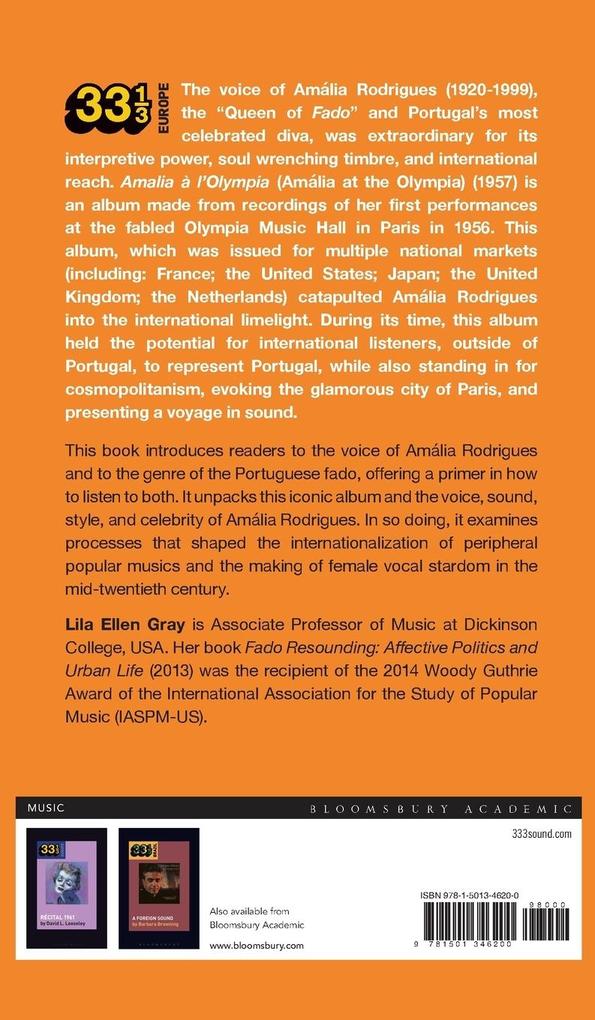
The voice of Amália Rodrigues (1920-1999), the "Queen of Fado" and Portugal's most celebrated diva, was extraordinary for its interpretive power, soul wrenching timbre, and international reach. Amalia à l'Olympia (1957) is an album made from recordings of her first performances at the fabled Olympia Music Hall in Paris in 1956. This album, which was issued for multiple national markets (including: France; USA; Japan; Britain; the Netherlands) catapulted Amália Rodrigues into the international limelight. During its time, this album held the potential for international listeners, outside of Portugal, to represent Portugal, while also standing in for cosmopolitanism, the glamorous city of Paris, and to present a sonorous voyage in sound. This book introduces readers to the voice of Amália Rodrigues and to the genre of the Portuguese fado, offering a primer in how to listen to both. It unpacks this iconic album and the voice, sound, style, and celebrity of Amália Rodrigues. It situates this album within a historical context marked by cold war Atlanticist diplomacy, Portugal's dictatorial regime, and the emergence of new forms of media, travel, and tourism. In so doing, it examines processes that shaped the internationalization of peripheral popular musics and the making of female vocal stardom in the mid-20th century.
Inhaltsverzeichnis
Acknowledgments < BR> Notes on the Text < BR> Track List < BR> Preface: A Yearning for Liveness< BR> Part I: Setting the Stage< BR> 1. Dresses, Acrobats, and the Sound of Moonlight< BR> 2. Biographies of Her Voice< BR> 3. A Fado Primer< BR> 4. Listening to Amália< BR> Interlude I: Mid-century Representations: NATO: "Introducing Portugal"< BR> Part II: Listening to Amalia à l'Olympia< BR> Prelude: On Love and Longing< BR> 5. Presentation and "Uma Casa Portuguesa"< BR> 6. "Perseguição"< BR> 7. "Barco Negro"< BR> 8. Fados about Fado: "Tudo Isto É Fado" and "Que Deus me Perdoe"< BR> Interlude II: Mid-Century Representations: Simone de Beauvoir's Les Mandarins< BR> 9. Diva Constellations< BR> Coda: "Fado Amália"< BR> Notes< BR> References< BR> Index