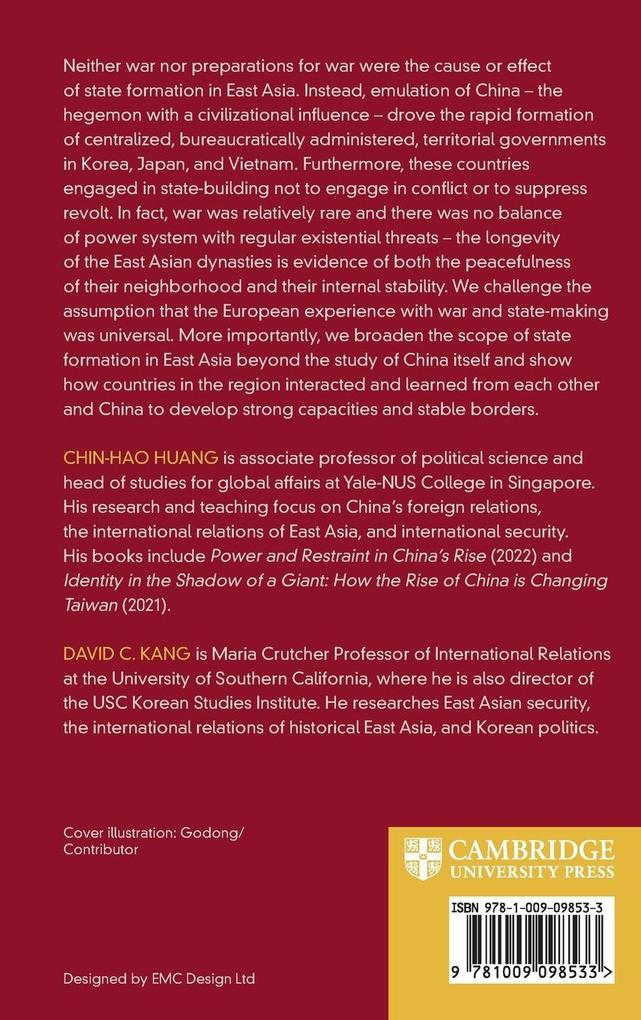
"This book began with an observation - an observation so obvious that it is usually overlooked, or simply taken for granted: Korea, Japan and Vietnam and copied an enormous amount from China. Over the years, and in conversations between the two of us, that observation slowly turned into an idea. That idea was turned into an actual research agenda at the prompting of Anna Grzymala-Busse, when she presented a paper as part of the USC Center for International Studies working paper series that Dave ran while he directed that center. Encouraged by her new approach to European state formation, we began to pursue our idea about state formation in East Asia. The result is this book. Thanks to Didac Cerault, Ben Graham, Tanner Greer, Jacques Hymans, Pat James, Saori Katada, Ellen Kim, Sun Joo Kim, Na Young Lee, Jonathan Markowitz, Sebastian Mazzucca, Gerardo Munck, John Park, Kyuri Park, and Sixiang Wang for thoughtful comments on earlier drafts. Thanks to Hendrik Spruyt for his careful comments and for suggesting the title of this book. We particularly thank Anna Grzymala-Busse, R. Bin Wong, and all the participants of a manuscript review hosted by the USC Korean Studies Institute on January 8, 2021, for reading the entire manuscript and for so generously giving of their time and energy to help make the final product better. We also thank the careful reviewers at Cambridge University Press, and John Haslam for his usual superb editorial advice on this project"--
Inhaltsverzeichnis
1. Introduction: The East Asian Model of State Formation; 2. Theories of State Formation and Diffusion; 3. Phase 1 and Onwards: Hegemony, Bureaucracy, and Confucianism; 4. The Absence of Bellicist Pressures in State Formation, 400 - 800 CE; 5. Phase II: State Formation in Korea and Japan, 400 - 800 CE; 6. Korea and Japan over the Centuries; 7. Vietnam emerges, 10th - 14th Centuries; 8. Epistemic Communities and Regional Connections; 9. Who Doesn't Emulate? The Borderlands of the Central Asian Steppe; 10. Conclusion: East Asian Developmental States in the 20th Century. Appendix; References; Index.