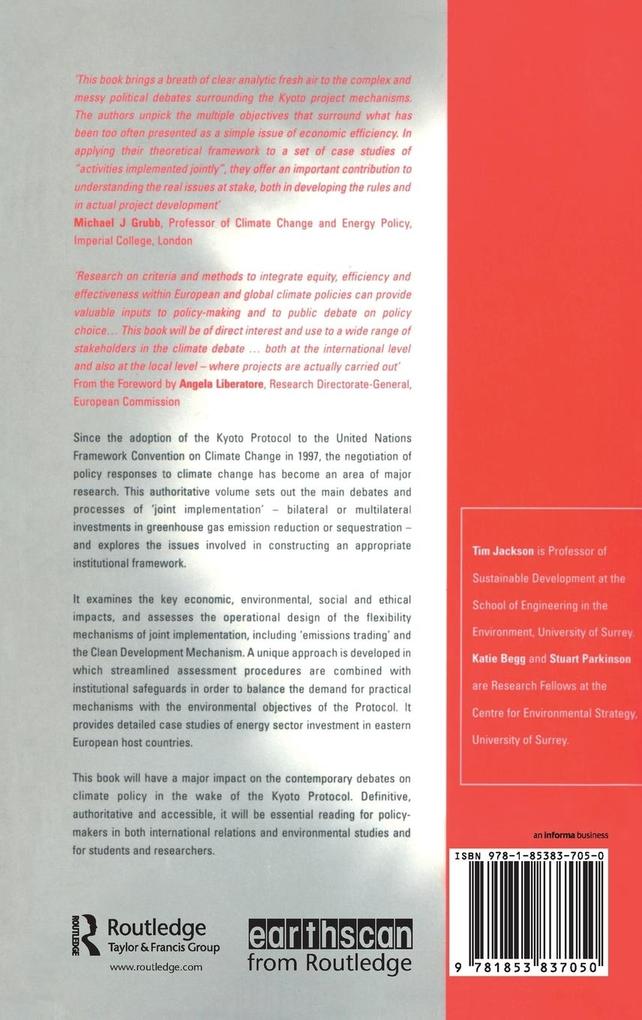
Since the unanimous adoption of the Kyoto Protocol to the UN Framework Convention on Climate Change (FCCC) in 1997, the negotiation of policy responses to climate change has become an area of major research. This authoritative volume sets out the main debates and processes of joint implementation--bilateral or multilateral investments in greenhouse gas emission reduction or sequestration--and explores the issues involved in constructing an appropriate institutional framework.It examines the key economic, environmental, social and ethical impacts, and assesses the operational design of the flexibility mechanisms of joint implementation, including 'emissions trading'. It provides detailed case studies of energy sector investment in eastern European host countries with donor countries considered in northern Europe. This book will have a major impact on the contemporary debates on climate policy in the wake of the Kyoto Protocol.
Inhaltsverzeichnis
Preface * Beyond Joint Implementation: an Overview and Summary of the Argument * The Language of Flexibility: Operational Forms of Joint Implementation * Objectives of Joint Implementation: Towards a Multicriteria Evaluation Framework * The Baseline Question: Dealing with the Problem of Counterfactuality * Case Study Projects * Environmental ad Social Aspects of Joint Implementation: Methodologies and Case Study Results * Uncertainty and Sensitivity Analysis: Methodology and Case Study Results * Measures for Managing Flexibility: Dealing with Complexity and Uncertainty * Evaluating Joint Implementation Options: an Illustrative Analysis * Appendix 1: Analysis of Crediting Regimes * Notes * References * Index