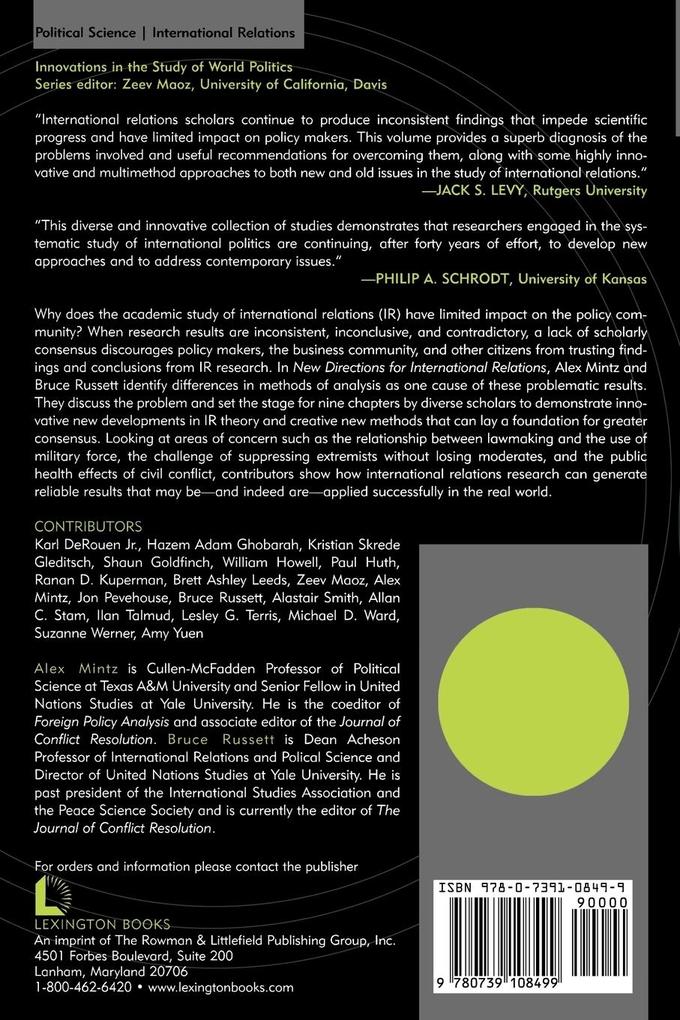
Why does the academic study of international relations have limited impact on the policy community? In New Directions for International Relations, Mintz and Russett identify differences in methods of analysis as one cause of problematic, unreliable results. They discuss the problem and set the stage for nine chapters by diverse scholars to demonstrate innovative new developments in IR theory and creative new methods that can lay the basis for greater consensus.
Inhaltsverzeichnis
Part 1 Introduction
Chapter 2 The Method-of-Analysis Problem in International Relations
Chapter 3 Four Methods and Five Revolutions
Part 4 New Directions
Chapter 5 International Relations: A Network Approach
Chapter 6 Visualization in International Relations
Chapter 7 The Postwar Public Health Effects of Civil Conflict
Chapter 8 Alliances and the Expansion and Escalation of Militarized Interstate Disputes
Chapter 9 Separation of Powers, Lawmaking, and the Use of Military Force
Chapter 10 Democracies Prefer to Negotiate: Institutionalized Democracy, Diversion, and Statecraft during International Crises
Chapter 11 When Likely Losers Choose War
Chapter 12 Enforcing Peace: Suppressing Extremists without Losing the Moderates
Chapter 13 Are Leaders Susceptible to Negative Political Advice? An Experimental Study of High-Ranking Military Officers