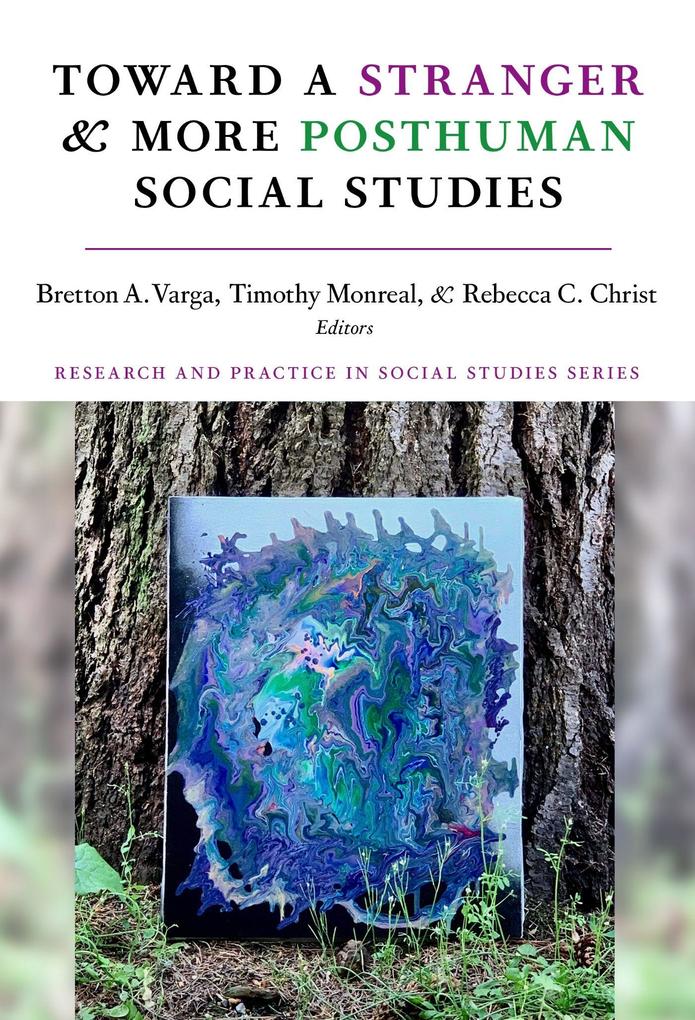
Challenges the field of social studies education to think differently about the precarious status of the world (climate crisis, racial equity, Indigenous sovereignty). By cultivating a greater sense of attunement to the more-than-human, educators and scholars can foster more ethical ways of teaching, learning, researching, being, and becoming.
Posthumanism has seen a surge across the humanities and offers a unique perspective, seeking to illuminate the role that more-than-human actors (e. g. , affect, artifacts, objects, flora, fauna, other materials) play in the human experience . This book challenges the field of social studies education to think differently about the precarious status of the world (i. e. , climate crisis, ongoing fights for racial equity, and Indigenous sovereignty). By cultivating a greater sense of attunement to the more-than-human, educators and scholars can foster more ethical ways of teaching, learning, researching, being, and becoming. In an effort to push the boundaries of what constitutes social studies, chapter authors engage with a wide range of disciplines and offer unique perspectives from various locations across the globe. This volume asks: How can thinking with posthumanism disrupt normative approaches to social studies education and research in ways that promote imaginativeness, speculation, and nonconformity? How can a posthumanist lens be used to interrogate neoliberal, systemic, and oppressive conditions that reproduce and perpetuate in-humanness?
Book Features:
- A collection of essays that explore the phenomenon of posthuman approaches to social studies scholarship.
- Contributions by many prominent social studies education scholars representing seven countries-Canada, Norway, Russia, Spain, Sweden, the United Kingdom, and the United States.
- A foreword by Boni Wozolek and an afterword by Nathan Snaza, both of who have made significant contributions to critical posthumanism in education.
- Provocation chapters that push readers' thinking about the various ways that posthumanism connects to teaching and learning social studies.
- Images of more-than-human entanglements (i. e. , artwork, photography, poetry).
Inhaltsverzeichnis
- Contents (Tentative)
- Foreword. Becoming Posthuman Social Studies
- Introduction. Be(com)ing Strange(r): Toward a Posthuman Social Studies
- Bretton A. Varga, Timothy Monreal, and Rebecca C. Christ
- 1. Life Lessons: Posthuman Ideas About Life for an Enlivened Social Studies Education
- Mark E. Helmsing
- 2. A Thousand Deaths: Current Events and Racial Reproductions of the Dead and Dying
- Asilia Franklin-Phipps
- 3. Unsettling the "Social" in Social Studies
- Cathryn van Kessel
- 4. Toppling the (Hu)Man: Posthumanism and the Mattering of Historical Spaces
- Francisco A. Medina, Karen Zaino, and Debbie Sonu
- 5. Lives in/of Things
- Sandra J. Schmidt
- 6. Cities as Pedagogues: Materiality in Paris' Public Sphere as a Teacher of Consciousness
- Avner Segall
- 7. Mattering the Research
- 8. Set in Stone? : Social Studies Teacher Candidates' Conceptions of Matter
- Morgan P. Tate and Amelia H. Wheeler
- 9. Following for the Community
- Polina Golovátina-Mora
- 10. "I'm a Monster Now": The Construction of Spacetimemattering Through Intra-Action in Childhood
- Fernando Guzmán-Simón and Alejandra Pacheco-Costa
- 11. Arboreal Methodologies: The Promise of Getting Lost (With Feminist New Materialism and Indigenous Ontologies) for Social Studies
- Jayne Osgood and Suzanne Axelsson
- 12. Into the Sea: A Fictive Speculation on How to Cope at the End of the World
- Peter M. Nelson
- 13. Not as Strange as Dying: Reimagining U. S. Social Studies as Place-Based and Decolonialized
- Janice Kroeger and Christine Widrig
- 14. Possibilities for Knowing Differently With a More-Than-Human Ladybird-Pedagogue
- Karen E. Barr and Hannah Seat
- 15. (In)Separatable: Social Studies With/out the Human
- Sarah B. Shear
- 16. The (Self/Re)generating Sacred Energy Called Teotl: Using Nahua Philosophy to Introduce Posthumanist Thinking
- Timothy Monreal and Jesús Tirado
- 17. Beading Shkodé
- 18. Re/Membering Ethical Relationality: Re/Telling Stories of Dis/citizenship as Lived
- Muna Saleh
- 19. Non-Human Alliances
- Polina Golovátina-Mora
- 20. Youth Are Already Queer: Agentive Possibilities Amongst Queer TikTok Creators