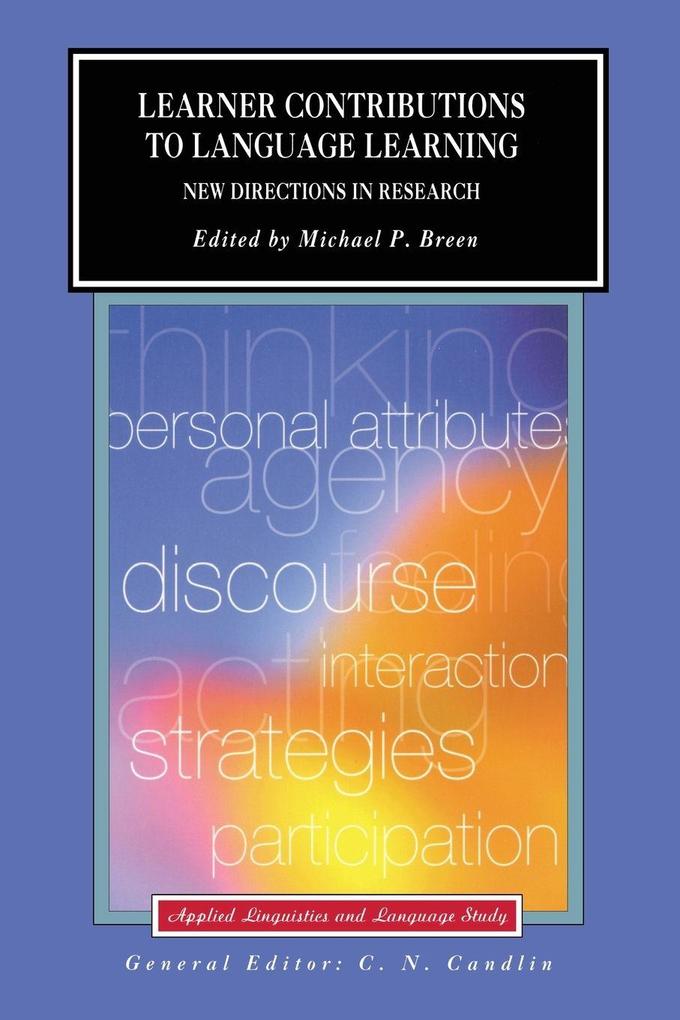
An active area of study and debate in Second Language Acquisition is 'learner contribution' which is what a learner can bring to the learning process e.g. his or her experience of prior (language) learning, expectancies about the learning process, knowledge of language and of learning and expectations of effectiveness of instruction. Plus their own personal and social characteristics i.e. age, gender, status, role, group membership, affiliations etc - all these factors are presumed to impact favourably or unfavourably on language learning in particular environments. What the learner contributes is therefore central to the language learning process. This book presents a uniquely comprehensive account of learners' personal attributes, their thinking, their feelings, and their actions that have been shown to have an impact upon language learning.
Inhaltsverzeichnis
Introduction: Conceptualisation, affect, and action in context
- Individual cognitive/ affective learner contributions and differential success in second langugae acquisition Diana Larsen-Freeman
- The role of learning strategies in second language acquisition Anna Uhli Chamot
- Metacognitive knowledge in SLA: the neglected variable Anita L. Wenden
- The metaphorical constructions of second language learners Rod Ellis
- 'The bleached bones of a story': learners' constructions of language teachers Rebecca L. Oxford
- Overt participation and covert acquisition in the language classroom Micahel P. Breen
- (S)econd (L)anguage (A)ctivity theory: understanding second language learners as people James P. Lantolf and Aneta Pavlenko
- Non-participation, imagined communities and the language classroom Bonny Norton
Postscript: New directions for reasearch on learner contributions