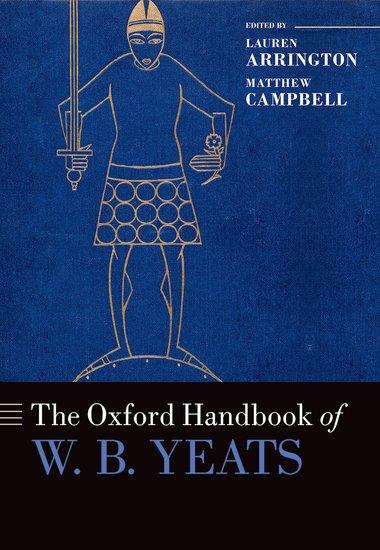
The forty-two chapters in this book consider Yeats's early toil, his practical and esoteric concerns as his career developed, his friends and enemies, and how he was and is understood. This Handbook brings together critics and writers who have considered what Yeats wrote and how he wrote, moving between texts and their contexts in ways that will lead the reader through Yeats's multiple selves as poet, playwright, public figure, and mystic.
It assembles a variety of views and adds to a sense of dialogue, the antinomian or deliberately-divided way of thinking that Yeats relished and encouraged. This volume puts that sense of a living dialogue in tune both with the history of criticism on Yeats and also with contemporary critical and ethical debates, not shirking the complexities of Yeats's more uncomfortable political positions or personal life. It provides one basis from which future Yeats scholarship can continue to participate in the fascination of all the contributors here in the satisfying difficulty of this great writer.
Inhaltsverzeichnis
- Preface
- Part 1. Such Friends: Predecessors and Collaborators
- 1: Claire Lynch: Self-Making
- 2: Seán Hewitt: Fairy and Folk Tales of Bedford Park
- 3: Peter McDonald: 'Never to leave that valley': Sligo
- 4: Francis O'Gorman: Among the Victorians
- 5: Nicholas Grene: Lady Gregory: Patronage, Collaboration, Mythopoeia
- 6: Joseph Hassett: John Quinn and the Literary Marketplace
- 7: Margaret Mills Harper: George Yeats
- 8: Nicholas Allen: The Writings of Jack Yeats
- Part 2. In and Through History
- 9: Geraldine Parsons: Ancient Ireland
- 10: R.F. Foster: The Ghost of Parnell
- 11: Edna Longley: Renaissance Italy: 'courtly images'
- 12: Hugh Haughton: Tradition and Phantasmagoria: Dante and Shakespeare
- 13: Geraldine Higgins: Talking back to history: From 'September 1913' to 'Easter, 1916'
- 14: Fran Brearton: 'Knights of the Air': Flight and Modernity
- 15: David Dwan: Revolution and Counter-Revolution
- 16: Lauren Arrington: Fascist Italy
- 17: Alan Gillis: The Thirties: 'The day brings round the night'
- 18: Adam Hanna: The Senate and the Stage
- 19: Adam Piette: 'Cast a cold eye': Death in Wartime
- Part 3. From the Global to the Interplanetary
- 20: Justin Quinn: Tagore, Pound and World English
- 21: Nathan Suhr-Sytsma: Africa
- 22: Jahan Ramazani: Asias
- 23: Katherine Ebury: 'The Scientific Revolution'
- 24: Cóilín Parsons: Planets
- 25: Neil Mann: Visionary Poetics
- Part 4. Genres and Medias
- 26: Charles Armstrong: Romanticism and Aestheticism
- 27: Claire Nally: Rites and Rhymes
- 28: Tom Walker: The most characteristic poet of modern Europe': Modernist Accommodations
- 29: Jack Quin: Illustrating
- 30: Elizabeth Bergmann Loizeaux: Family Business at Dun Emer and Cuala: Collaboration, Contention, and Creativity
- 31: Emilie Morin: In the Media
- Part 5. Playing Yeats
- 32: Susan Cannon Harris: Yeats's Early Plays: Gender, Genre, and Queer Collaboration
- 33: Akiko Manabe: 'A Country Over Wave': Japan, Noh, Kiogen
- 34: Zsuzsanna Balázs: Reading the Late Plays: Sexual Unorthodoxies
- 35: Patrick Lonergan: Playing in Ireland
- 36: Susan Jones: Dance
- Part 6. Reading Yeats
- 37: Stephanie Burt: Imperfect Forms
- 38: Matthew Campbell: Visionary Comedy
- 39: Lucy McDiarmid: Masculinities
- 40: Wayne K. Chapman: Late Style: Art v. Life
- 41: Warwick Gould: Editing
- Postscript
- 42: Vona Groarke: Yeats and Contemporary Poetry: Twelve Speculative Takes