Combinatorialists are seldom aware of number theoretical tools, and number theorists rarely aware of possible combinatorial applications. This book is accessible for both of the groups. The first part introduces important counting sequences. The second part shows how these sequences can be generalized to study new combinatorial problems
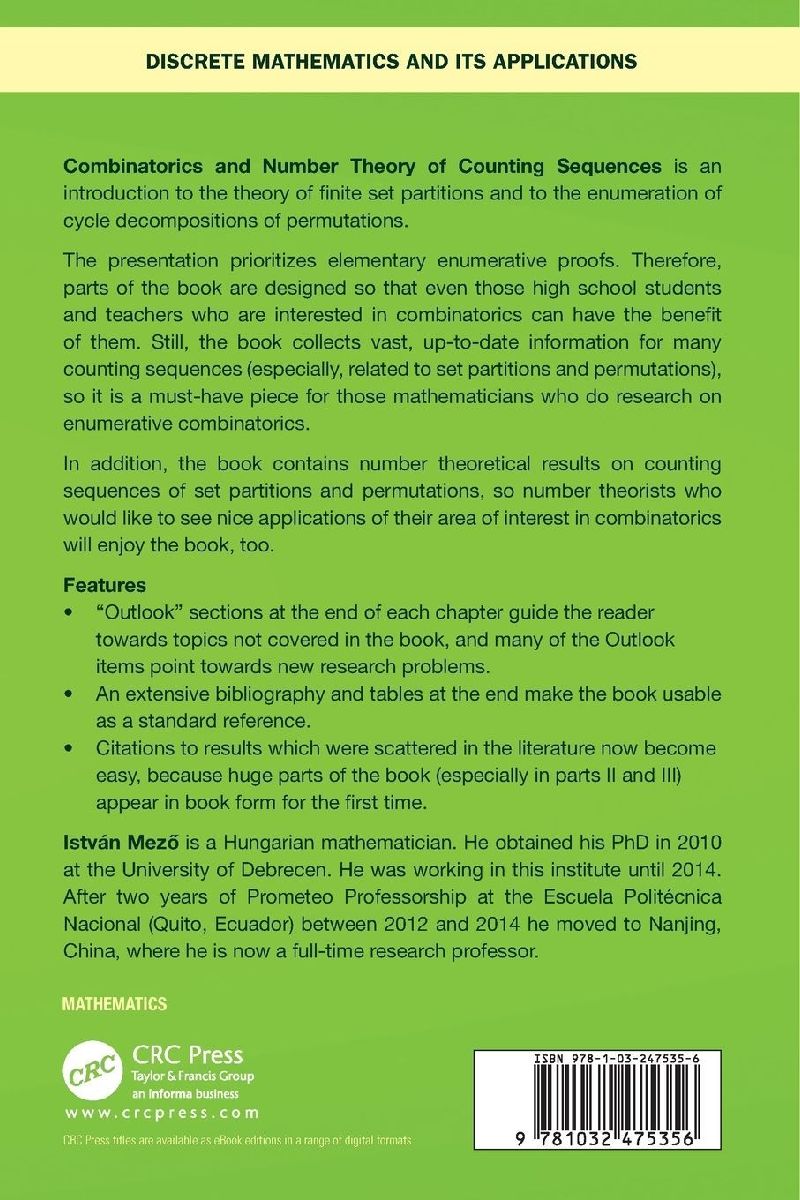
Combinatorics and Number Theory of Counting Sequences is an introduction to the theory of finite set partitions and to the enumeration of cycle decompositions of permutations.
The presentation prioritizes elementary enumerative proofs. Therefore, parts of the book are designed so that even those high school students and teachers who are interested in combinatorics can have the benefit of them. Still, the book collects vast, up-to-date information for many counting sequences (especially, related to set partitions and permutations), so it is a must-have piece for those mathematicians who do research on enumerative combinatorics.
In addition, the book contains number theoretical results on counting sequences of set partitions and permutations, so number theorists who would like to see nice applications of their area of interest in combinatorics will enjoy the book, too.
Features
Inhaltsverzeichnis
I Counting sequences related to set partitions and permutations
Set partitions and permutation cycles.
Generating functions
The Bell polynomials
Unimodality, log concavity and log convexity
The Bernoulli and Cauchy numbers
Ordered partitions
Asymptotics and inequalities
II Generalizations of our counting sequences
Prohibiting elements from being together
Avoidance of big substructures
Prohibiting elements from being together
Avoidance of big substructures
Avoidance of small substructures
III Number theoretical properties
Congurences
Congruences vial finite field methods
Diophantic results
Appendix
This book provides an interesting introduction to combinatorics by employing number-theoretic techniques of counting sequences. The level of the presentation often seems elementary, as the author frequently throws out lagniappes suitable for high school students. The text unfolds in three parts. Part 1 covers set partitions, generating functions, Bell polynomials, log-concavity, log-convexity, Bernoulli and Cauchy numbers, ordered partitions, asymptotes, and related inequalities. Part 2 discusses generalizations of counting sequences in three chapters. The final part considers number theoretical properties, including congruences, by way of finite field methods and Diophantine results. Each chapter concludes with an "Outlook" section that gives suggestions about exploring additional topics not covered in the text. Mathematical proof is used throughout the exposition and tends to be "enumerative," again contributing to a sense that the author hopes to engage mathematical novices through this text. However, the more than 250 exercises included in the book are frequently challenging and always interesting. The bibliography comprises more than 600 entries. Anyone who can follow the text is likely to enjoy working through the book.
-D. P. Turner, Faulkner University
Es wurden noch keine Bewertungen abgegeben. Schreiben Sie die erste Bewertung zu "Combinatorics and Number Theory of Counting Sequences" und helfen Sie damit anderen bei der Kaufentscheidung.











