
Australia has provided an imperfect but nevertheless useful exemplar of how governments may respond effectively to multifarious security challenges from China.
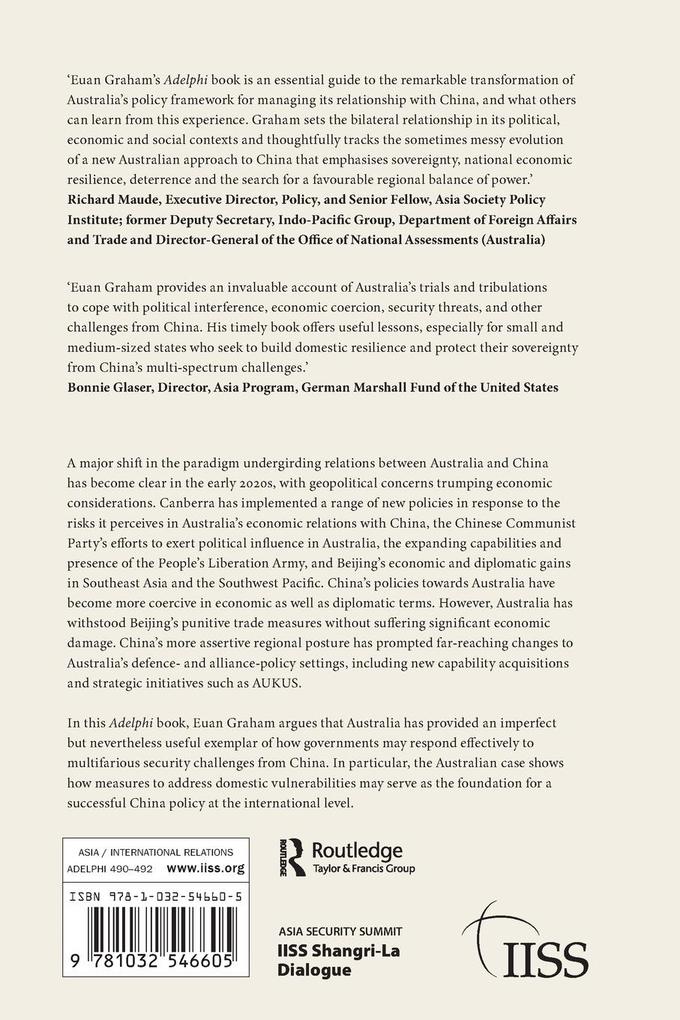
A major shift in the paradigm undergirding relations between Australia and China has become clear in the early 2020s, with geopolitical concerns trumping economic considerations. Canberra has implemented a range of new policies in response to the risks it perceives in Australia's economic relations with China, the Chinese Communist Party's efforts to exert political influence in Australia, the expanding capabilities and presence of the People's Liberation Army, and Beijing's economic and diplomatic gains in Southeast Asia and the Southwest Pacific. China's policies towards Australia have become more coercive in economic as well as diplomatic terms. However, Australia has withstood Beijing's punitive trade measures without suffering significant economic damage. China's more assertive regional posture has prompted far-reaching changes to Australia's defence and alliance policy settings, including new capability acquisitions and strategic initiatives such as AUKUS.
In this Adelphi book, Euan Graham argues that Australia has provided an imperfect but nevertheless useful exemplar of how governments may respond effectively to multifarious security challenges from China. In particular, the Australian case shows how measures to address domestic vulnerabilities may serve as the foundation for a successful China policy at the international level.
Inhaltsverzeichnis
'Euan Graham's Adelphi book is an essential guide to the remarkable transformation of Australia's policy framework for managing its relationship with China, and what others can learn from this experience. Graham sets the bilateral relationship in its political, economic and social contexts and thoughtfully tracks the sometimes messy evolution of a new Australian approach to China that emphasises sovereignty, national economic resilience, deterrence and the search for a favourable regional balance of power.'
Richard Maude, Executive Director, Policy, and Senior Fellow, Asia Society Policy Institute; former Deputy Secretary, Indo-Pacific Group, Department of Foreign Affairs and Trade and Director-General of the Office of National Assessments (Australia)
'Euan Graham provides an invaluable account of Australia's trials and tribulations to cope with political interference, economic coercion, security threats, and other challenges from China. His timely book offers useful lessons, especially for small and medium-sized states who seek to build domestic resilience and protect their sovereignty from China's multi-spectrum challenges.'
Bonnie Glaser, Director, Asia Program, German Marshall Fund of the United States
'This is a contemporary and concise book. It analyses what has happened on the ground, and how things will likely move in the foreseeable future regarding Australia and China but also involving ASEAN and South Pacific states in the wake of the contestation for influence and power by Beijing and Washington. The key takeaway is that foreign policy begins at home, and no quick fix is possible.'
- Ambassador Ong Keng Yong, Executive Deputy Chairman of the S. Rajaratnam School of International Studies (RSIS) at the Nanyang Technological University, Singapore; Ambassador-at-Large, Singapore Ministry of Foreign Affairs; former Secretary-General of ASEAN
Es wurden noch keine Bewertungen abgegeben. Schreiben Sie die erste Bewertung zu "Australia's Security in China's Shadow" und helfen Sie damit anderen bei der Kaufentscheidung.











