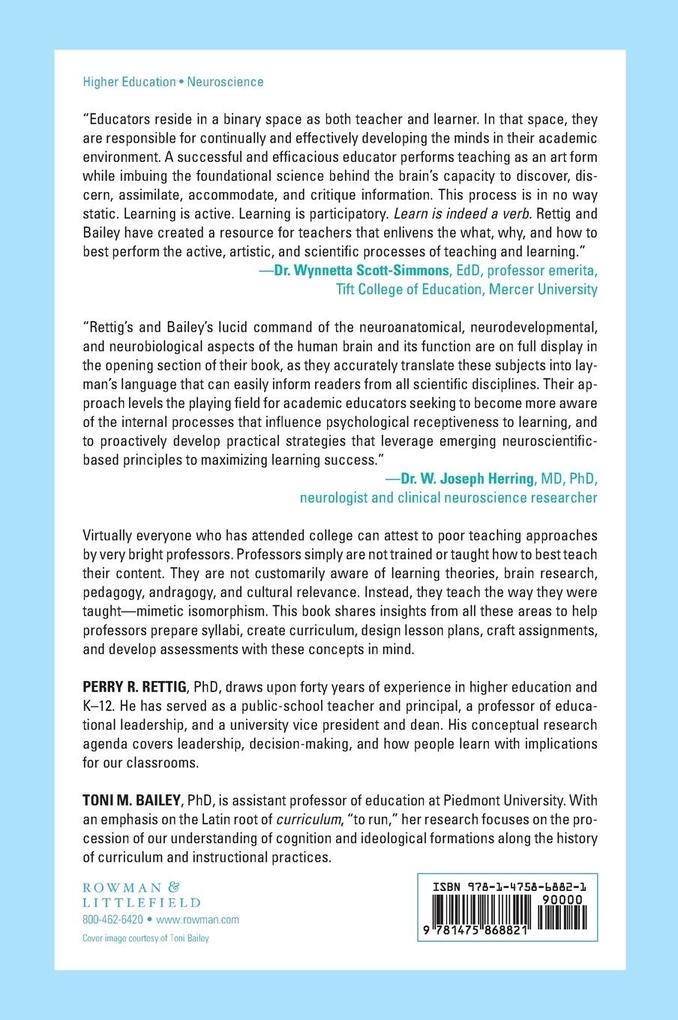
Virtually anyone who has attended college can attest to poor teaching approaches by very bright professors. Professors simply are not trained or taught how to best teach their content. They are not aware of learning theories, brain research, pedagogy and andragogy. They teach the way they were taught—their mimetic isomorphism.Not only will this book share insights from all these areas, but it will also help professors prepare syllabi, create curriculum, prepare lesson plans, create assignments, and develop assessments with these concepts in mind. Further, we will embed differentiation, culturally relevant strategies, and the use of technology to enhance learning.
Inhaltsverzeichnis
DEDICATION< BR> < BR> ACKNOWLEDGEMENTS< BR> < BR> PREFACE< BR> < BR> INTRODUCTION< BR> < BR> LIST OF FIGURES & TABLES< BR> < BR> < BR> PART I THE BRAIN< BR> < BR> Nature and Nurture< BR> The Unified Whole< BR> Neurons< BR> Brain Growth and Development< BR> Regions of the Brain< BR> Genetic Influences< BR> Implications for Professors< BR> The Brain< BR> The Classroom and Its Environment< BR> The Curriculum< BR> Pedagogy< BR> Assessment< BR> Summary< BR> Notes< BR> < BR> PART IILEARNING THEORY< BR> < BR> Behaviorism< BR> Learning According to Behaviorism< BR> Implications of Behaviorism in the College Classroom< BR> Cognitivism< BR> Learning According to Cognitivism< BR> Multiple Intelligences< BR> Culturally Responsive Learning< BR> Implications of Cognitivism for the College Classroom< BR> Constructivism< BR> Learning According to Constructivism< BR> Critical Theory and Critical Pedagogy< BR> Implications of Constructivism for the College Classroom< BR> Summary< BR> Notes< BR> < BR> PART IIIIMPLICATIONS AND APPLICATIONS< BR> < BR> Implications< BR> The Learning Environment < BR> Curriculum and Pedagogy< BR> Assignments< BR> Assessment< BR> Applications< BR> Behaviorism< BR> Cognitivism< BR> Constructivism< BR> Notes< BR> < BR> BIBLIOGRAPHY< BR> < BR> ANNOTATED BIBLIOGRAPHY