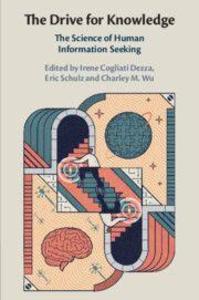
"In this chapter we discuss the psychological function of "the drive for sense-making," or our innate desire to make sense of the world. We start by discussing why sense-making generates a drive, similar to those associated with the primary reinforcers of food, water, sleep, sex, shelter, and air. In our account, the drive for sense-making fills a critical gap in purely goal-oriented cognition by motivating us to continue investing in knowledge even when we cannot foresee exactly how it will benefit us. We then examine three different factors that shape the particular form sense-making takes: (1) the practical utility of holding accurate beliefs for attaining concrete goals, (2) the motivational significance of some beliefs, which generates a desire to make sense of the world in a way that feels good, and (3) the impact of computational limitations on the sense-making process, especially our limited ability to explicitly predict what information will turn out to be useful. Finally, we turn our attention to how these factors help to explain aberrant sense-making phenomena such as conspiracy theories, science denial, and political polarization"--
Inhaltsverzeichnis
Preface Cogliati Dezza ,Schulz and Wu, Part I. What Drives Humans to Seek Information?: 1. The motivational processes of sense-making Zachary Wojtowicz, Nicholas Chater, George Loewenstein; 2. From curiosity to interest: Accumulated knowledge supports long-term persistence of information-seeking behavior Ed Donnellan, Michiko Sakaki, Kou Murayama; 3. Curiosity-driven exploration: diversity of mechanisms and functions Alexander Ten, Pierre-Yves Oudeyer, Clément moulin-Frier; 4. Searching for information, from infancy to adolescence Costanza De Simone and Azzurra Ruggeri; Part II. How do Humans Search for Information?: 5. What makes a good query? Prospects for a comprehensive theory of human information acquisition Björn Meder, Vincenzo Crupi, Jonathan D. Nelson; 6. Active inference, Bayesian optimal design and expected utility Noor Sajid, Lancelot Da Costa, Thomas Parr and Karl Friston; 7. Exploration beyond bandits Franziska Braendle, Marcel Binz and Eric Schulz; 8. Representational exchange in human social learning: Balancing efficiency and flexibility Charley Wu, Natalia Vélez and Fiery Cushman; Part III. Which machinery supports the drive for knowledge?: 9. Information-seeking in the brain Caroline J. Charpentier and Irene Cogliati Dezza; 10. Attention as rational choice Jacqueline Gottlieb; 11. Seeking inner knowledge: Foraging in semantic space Thomas T. Hills, Nancy B. Lundin, Mahi Luthra and Peter M. Todd; 12. Edgework: Viewing curiosity as fundamentally relational Perry Zurn, Dale Zhou, David M Lydon-Staley and Danielle S. Bassett; Future directions Cogliati Dezza, Schulz and Wu.