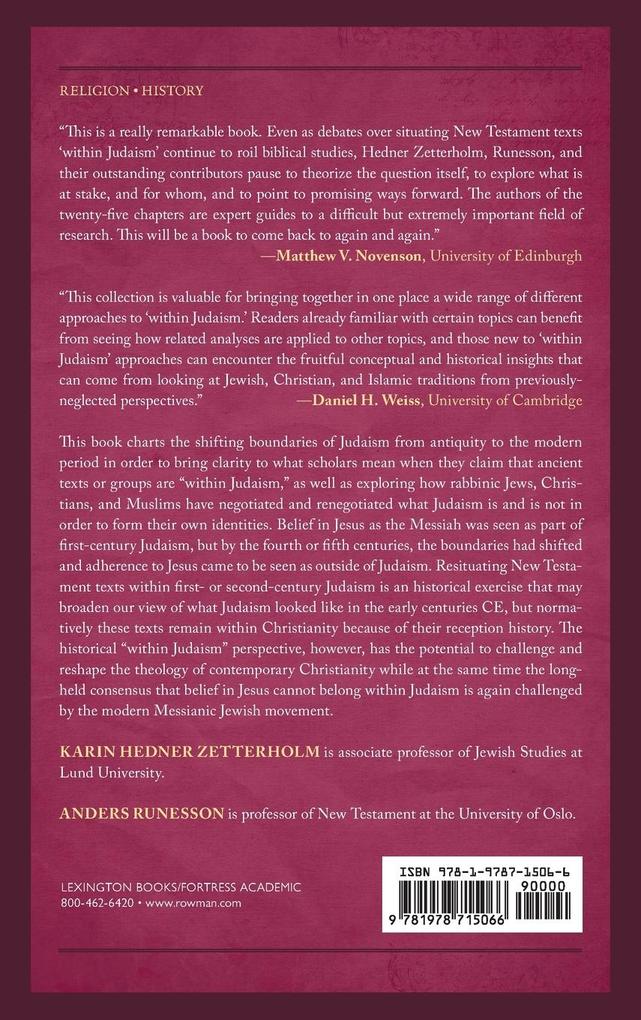
This book charts the shifting boundaries of Judaism from antiquity to the modern period to bring clarity to what scholars mean when they claim that ancient texts or groups are "within Judaism" as well as exploring how rabbinic Jews, Christians, and Muslims have constructed Judaism to form their own identities.
Inhaltsverzeichnis
Part I. The "Within Judaism" Perspective: What's at Stake? < BR> < BR> 1. The "Within Judaism" Perspective: Why Does It Matter? < BR> Magnus Zetterholm< BR> 2. What Does "Within Judaism" Mean? Some Thoughts on Method, History, and Theology< BR> Anders Runesson< BR> 3. What's in a Label? "Jews," "Judaism," and "Jewish" in the Study of Antiquity< BR> Adele Reinhartz< BR> 4. What's in a Translation? < BR> Mark D. Nanos< BR> 5. Gender, Judaism, and the Jesus Movement: What Change Does "Within" Bring? < BR> Kathy Ehrensperger< BR> 6. Attending to Power: "Within Judaism" Scholarship and the Erasure of History< BR> Neil Elliott< BR> < BR> Part II. The First and Second Centuries: Reading New Testament Texts Within Judaism< BR> < BR> 7. Paul Within Judaism< BR> Paula Fredriksen< BR> 8. Mark Within Judaism< BR> John Van Maaren< BR> 9. Matthew Within Judaism< BR> Matthias Konradt< BR> 10. Luke Within Judaism< BR> Joshua Paul Smith and Matthew Thiessen< BR> 11. Acts Within Judaism< BR> Isaac W. Oliver< BR> 12. John Within Judaism< BR> Wally V. Cirafesi< BR> 13. Revelation Within Judaism< BR> Ralph J. Korner< BR> 14. James Within Judaism< BR> Karl-W