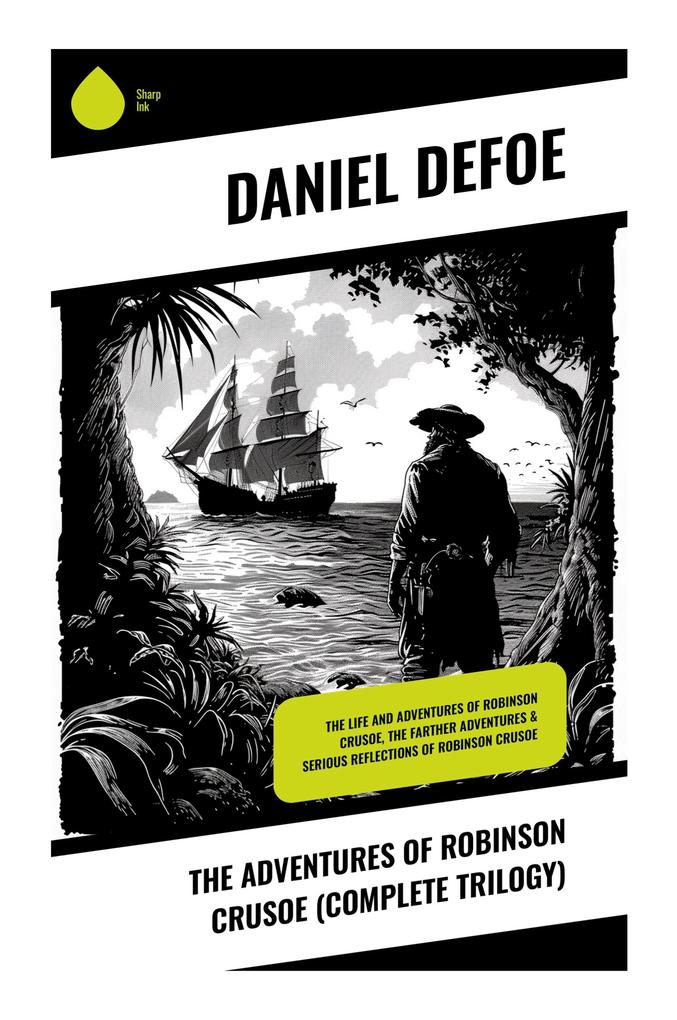
Daniel Defoe's The Adventures of Robinson Crusoe (Complete Trilogy) gathers the foundational castaway narrative with its sequels, extending Crusoe's story from shipwrecked isolation to global wandering and moral retrospection. Written in the plain, circumstantial prose that helped shape the English novel, the trilogy blends adventure, spiritual autobiography, travel writing, economic calculation, and colonial encounter. Its realism lies not merely in incident but in method: inventories, practical labor, providential interpretation, and the disciplined narration of experience. Defoe, a journalist, dissenter, merchant, political pamphleteer, and indefatigable observer of early eighteenth-century Britain, brought to Crusoe the concerns of a world expanding through commerce, empire, Protestant introspection, and social mobility. His own bankruptcies, travels, controversies, and fascination with individual enterprise inform the figure of Crusoe, whose survival depends as much on accounting, labor, and self-examination as on courage. This complete trilogy is recommended for readers who want more than the familiar island adventure. It reveals Crusoe as a cultural myth in formation: a study of solitude, mastery, faith, fear, and restless expansion. Students of the novel, colonial literature, maritime adventure, and moral psychology will find it indispensable.