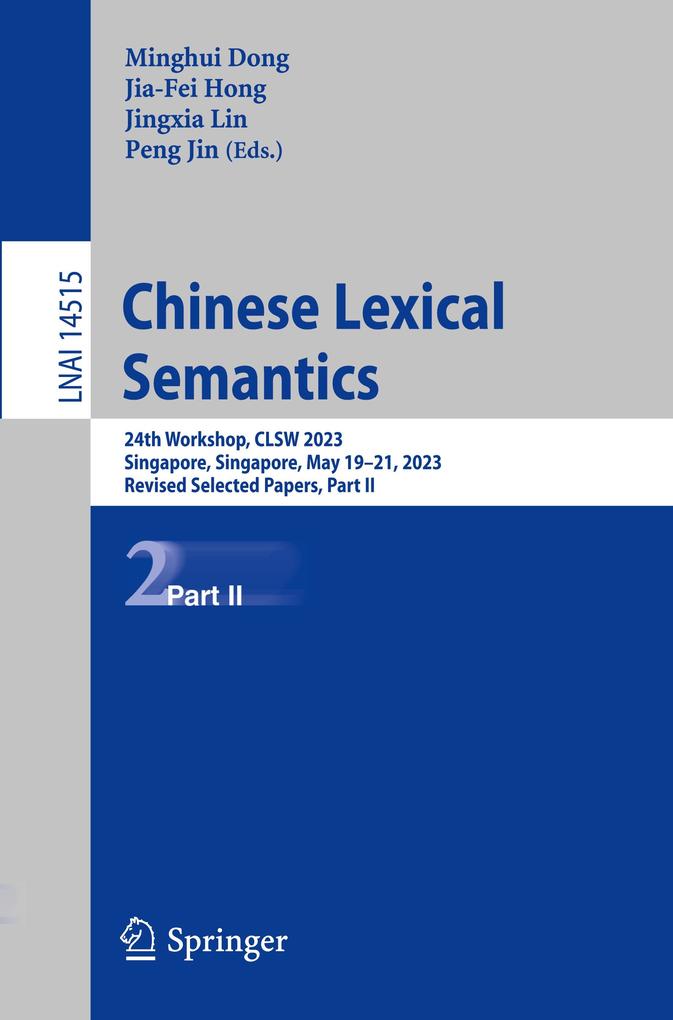
This book constitutes the refereed proceedings of the 24th Workshop on Chinese Lexical Semantics, CLSW 2023, held in Singapore, during May 19-21, 2023.
The 61 full papers and 15 short papers included in this book were carefully reviewed and selected from 215 submissions. They are organized in the following topical sections: lexical semantics and related fields, including Theoretical Linguistics, Applied Linguistics, Computational Linguistics, Computational Lexicography, Phycological Linguistics, and Sociological linguistics.
Inhaltsverzeichnis
Computational Linguistics and Natural Language Processing
. - Teaching Chinese Pattern Extraction and Its Knowledge Base Construction for Specific Domain Texts. - Probability Distribution of Dependency Distance of Mongolian Nouns. - The Use and Evolution of Colors in Written Chinese since the Late Qing Dynasty. - A Study of Identification of Chinese VO Idioms with Statistical Measures. - Sensory Features in Affective Analysis: A Study Based on Neural Network Models. - Corpus construction of critical illness entities and relationships. - Research on the Structure of Pediatric Epilepsy Electronic Medical Records Based on Transfer Learning. - Semantic and Phonological Distances in Free Word Association Tasks. - Suffix 51 in Zhangzhou: An Interdisciplinary Explorations. - Does Bert Know How `Virus' Evolved: Tracking Usage Changes in Chinese Textual Data. - The Evolution of " X huà" in the Press since the Late Qing Dynasty. - Distribution of Motifs in Mongolian Word Length. - Construction of Knowledge Base of Non-core Argument Based on Serial Verb Construction. - The Application of Chinese Word Segmentation to Less-Resourced Language Processing. - Research on Automatic Summary Method for Futures Research Reports Based on TextRank. - Automatic Question Generation for Language Learning Task Based on the Grid-Based Language Structure Parsing Framework. -
Corpus Linguistics
. - What Factors can Facilitate Efficient Propagation of Chinese Neologisms -- a Corpus-Driven Study with Internet Usage Data. - COVID-19 related expressions and their correlation with the pandemic: An Internet-based Study. - Chinese Inter-clausal Anaphora in Causal Relation---A Corpus Study. - Corpus-Based Study on the Evolution of the Lexical Phonetic Forms from Old Chinese to Middle Chinese. - A Corpus-Based Study of Lexical Chunks in Chinese Academic Discourse: Extraction, Classification, and Application. - Gender Variation in Mix-gender Conversations in the Semi-institutional Discourse: The Case of Talk Show. - A Comparative Study of Computational Linguistics Terminology in English Papers by Chinese and American Scholars. - Native Speakers Judgment of the Epistemic Evidentiality of Synonym Verbs of Think in Mandarin: A Corpus-Based Study of Renwei, Yiwei, Juede, Kaolü, and Xiang. - Investigating Acoustic Cues of Emotional Valence in Mandarin Speech Prosody - A Corpus Approach. - Corpus-based Analysis of Lexical Features of Mongolian Language Policy Text. - Offensiveness Analysis of Chinese Group Addressing Terms and Dataset Construction. - Let s Talk About Business: A corpus-based study of ' business' related near-synonyms and their teaching in Chinese as a second language. - Differences in Word Collocations of J nzh ng in Cross-Strait Chinese. - A Corpus-based Comparative Study on the Semantics and Collocations of meili and piaoliang. - Development of a Chinese Tourism Technical Word List Based on Corpus Analysis. -
General Linguistics
. - A Preliminary Study on Japanese CSL Learners Acquisition of Mandarin Potential Expressions. - On the Discourse Functions of Biede Bushuo Based on Pragma-Dialectical Theory. - X-Copying as Metalinguistic Negation in Chengdu Chinese. - Duration Phrases as Fake Nominal Quantifiers: A Functional Account with Corpus Evidence. - A Study on the Position of Preposition-Objects Structures in Kongzijiayu. - A Structural Priming Study of the Information Function of the Chinese Ba Construction. - A Case Study of a Preschool Child s Compliment Expression Based on Schema Theory.