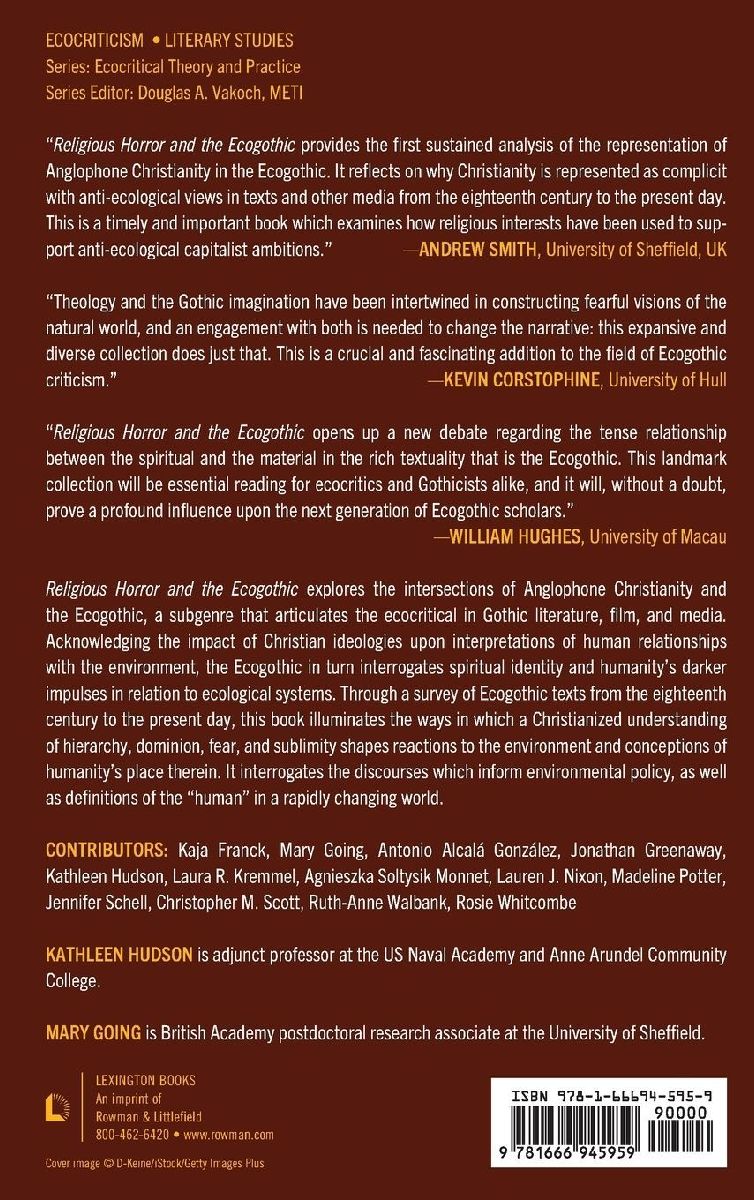
Religious Horror and the Ecogothic explores the intersections of Anglophone Christianity and the Ecogothic, a subgenre that explores the ecocritical in Gothic literature, film, and media. Acknowledging the impact of Christian ideologies upon interpretations of human relationships with the environment, the Ecogothic in turn interrogates spiritual identity and humanity's darker impulses in relation to ecological systems. Through a survey of Ecogothic texts from the eighteenth century to the present day, this book illuminates the ways in which a Christianized understanding of hierarchy, dominion, fear, and sublimity shapes reactions to the environment and conceptions of humanity's place therein. It interrogates the discourses which inform environmental policy, as well as definitions of the "human" in a rapidly changing world.
Inhaltsverzeichnis
Table of Contents< BR> < BR> Acknowledgments< BR> < BR> Introduction< BR> Approaches to Anglophone Religious Horror and the Ecogothic< BR> By Kathleen Hudson and Mary Going< BR> < BR> Part One: Early Gothic Origins< BR> < BR> Chapter One< BR> Biblical Marine Biology: Cotton Mather's Cetological Exegesis and the Oceanic Ecogothic< BR> By Jennifer Schell< BR> < BR> Chapter Two< BR>"The lady's talent for description leads her to excess": Radcliffe, Landscape, and Gender< BR> By Rosemary Whitcombe< BR> < BR> Chapter Three< BR> Sacred Consumption: An Ecocritical Reading of Gothic Cannibalism< BR> By Laura R. Kremmel< BR> < BR> Part Two: Long Nineteenth Century Evolutions< BR> < BR> Chapter Four< BR> Between Domination and Sublimity: The Ecogothic and Moby Dick< BR> By Jonathan Greenaway< BR> < BR> Chapter Five< BR> Occlusive Re-Enchantment: J. S. Le Fanu's Ecogothic< BR> By Madeline Potter< BR> < BR> Chapter Six< BR> Ecological Hellscapes of Religious Doubt: Exploring Gothic Nature and the Horrific Divine in Gerard Manley Hopkins and James Thomson< BR> By Ruth-Anne Walbank< BR> < BR> Chapter Seven< BR> Strange Summits: Christian Hope and Salvation in the Mountain Topography of Algernon Blackwood's "The Glamour of the Snow"< BR> By Christopher M. Scott< BR> < BR> Part Three: Twentieth Century Reimaginings< BR> < BR> Chapter Eight< BR> Anthropocenic anxieties: What humanity should not have summoned in H. P. Lovecraft's "The Call of Cthulhu" and William Hope Hodgson's The Nightland< BR> by Antonio Alcalá González< BR> < BR> Chapter Nine< BR>"Are We Not Men?": Dominionism and the Evolution of The Island of Doctor Moreau< BR> By Mary Going< BR> < BR> Chapter Ten< BR>"A strange green God": Ecocritical Readings of Christian and Cult Sacrifice in Postmodern Folk Horror< BR> By Kathleen Hudson< BR> < BR> Part Four: Contemporary Ecohorrors< BR> < BR> Chapter Eleven< BR> Ecogothic Meets Religious Horror in M. Night Shyamalan's The Happening< BR> Agnieszka< BR> < BR> Chapter Twelve< BR> Oryx and Eve: Geneses, Gender, and the Gothic in Margaret Atwood's Maddaddam trilogy< BR> By Lauren Nixon< BR> < BR> Chapter Thirteen< BR> Atavistic Trolls and Christian Immorality in Nordic Ecogothic< BR> Kaja Franck< BR> < BR> Afterword< BR> Our Burning World< BR> By Kathleen Hudson and Mary Going< BR> < BR> Index< BR> < BR> About the Contributors