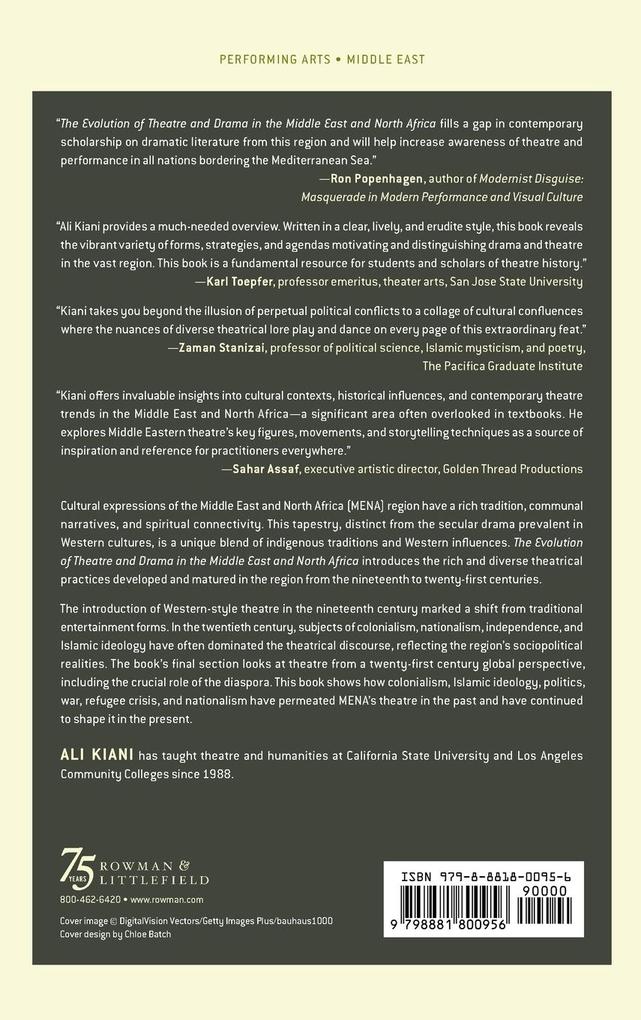
This book introduces rich and diverse theatrical practices developed from the nineteenth to twenty-first centuries in the Middle East and North Africa region. It examines theatre’s development and presents a chronological narrative of its history, showing how colonialism, Islam, politics, war, and nationalism have shaped practices.
Inhaltsverzeichnis
Contents< BR> Preface< BR> Introduction< BR> Part I: Common Ground< BR> < BR> Cultural Myths, Heroic Sagas, and Rituals< BR> Traditional Popular Entertainment< BR> Theatre and Islam< BR> Taziyeh, the Passion Play< BR> The Performers and Women in Literature and Drama< BR> Theatre of Protest: Colonialism, War, and Censorship< BR> < BR> Part II: Playwrights and Plays< BR> Introduction< BR> Theatre in Egypt< BR> Theatre in Iran< BR> Theatre in Iraq< BR> Theatre in Lebanon< BR> Theatre in Palestine< BR> Theatre in Syria< BR> Theatre in Turkey< BR> Maghrebi Theatres: Algeria, Morocco, and Tunisia< BR> Regional Theatres: Afghanistan, Pakistan, Gulf States, and Yemen< BR> < BR> < BR> < BR> Part III: Global Connections< BR> < BR> The Western Influence, Adaptation, and Translation< BR> Experimental Theatres, The Theatre of the Absurd, and Postmodernism< BR> Performing Arts in the Diaspora< BR> Local and International Theatre Festivals< BR> Conclusion Notes< BR> Bibliography