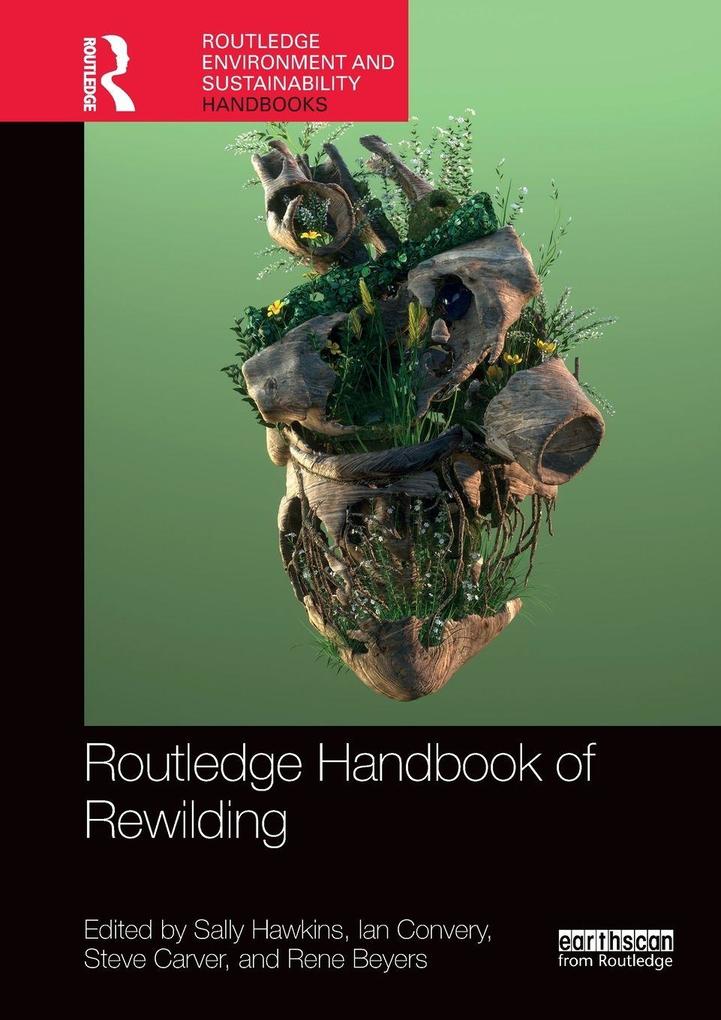
This handbook provides a comprehensive overview of the history, theory, and current practices of rewilding.
Rewilding offers a transformational paradigm shift in conservation thinking, and as such is increasingly of interest to academics, policymakers, and practitioners. However, as a rapidly emerging area of conservation, the term has often been defined and used in a variety of different ways (both temporally and spatially). There is, therefore, the need for a comprehensive assessment of this field, and the Routledge Handbook of Rewilding fills this lacuna. The handbook is organised into four sections to reflect key areas of rewilding theory, practice, and debate: the evolution of rewilding, theoretical and practical underpinnings, applications and impacts, and the ethics and philosophy of rewilding. Drawing on a range of international case studies the handbook addresses many of the key issues, including land acquisition and longer-term planning, transitioning from restoration (human-led, nature enabled) to rewilding (nature-led, human enabled), and the role of political and social transformational change.
Led by an editorial team who have extensive experience researching and practising rewilding, this handbook is essential reading for students, academics and practitioners interested in rewilding, ecological restoration, natural resource management and conservation.
Inhaltsverzeichnis
SECTION 1 THE EVOLUTION OF REWILDING
Sally Hawkins, Rene Beyers, Steve Carver and Ian Convery
Mark Fisher and Steve Carver
Alexandra Locquet and Steve Carver
Cara R. Nelson
SECTION 2 THEORETICAL AND PRACTICAL UNDERPINNINGS OF REWILDING
Mark Stanley-Price
Jonathan Carruthers-Jones, Andrew Gregory and Adrien Guette
Steve Carver
René Beyers and Antony R. E. Sinclair
Lisa Fenton and Zoe Playdon
Adam Eagle, Alex Cooper, Rob Espin, Jack Gould and Elsie Blackshaw-Crosby
SECTION 3 APPLICATION AND IMPACTS OF REWILDING
Jodi Hilty, Charles Chester and Pamela Wright
Stuart Adair and Philip Ashmole
Emiliano Donadio, Talía Zamboni and Sebastián Di Martino
Rob Pringle and Dominique Gonçalves
Ian Kealley and Neil Burrows
Joanna E. Lambert and Joel Berger
Heather VanVolkenburg, Rene Beyers, Cara Nelson, Liette Vasseur, Angela Andrade, Ian Convery and Steve Carver
Heather Prince
SECTION 4 WILDER VALUES: THE ETHICS AND PHILOSOPHY OF REWILDING
Kate Rawles (section editor)
Peter Taylor, Alan Watson Featherstone, Simon Ayres, Adam Griffin and Eric Maddern
Martin Drenthen
'Over the course of three to four decades, rewilding has progressed from a rather obscure concept associated with radical environmentalism to a well-accepted and even mainstream paradigm for comprehensive ecosystem restoration worldwide. This handbook, edited by four founding members of the IUCN Rewilding Thematic Group, is a much-needed overview of the history, theory, practice, and debate surrounding rewilding.'
Reed F. Noss, Ph. D. , Florida Institute for Conservation Science, Conservation Science, Inc.
'A much-needed source of information and inspiration for the growing community of people working to help Nature heal, the Routledge Handbook of Rewilding teaches us how to restore missing species, including large carnivores and other keystone species; reconnect wildlife habitats; expand wilderness and parks; and coexist with all our neighbours, wild and human. "Rewilding" has taken root and ramified widely in the decades since North American wilderness champions coined the term; and this book - which will challenge as well as motivate all readers - shows how the varying branches of work can rewild lands and waters from Scotland to Argentina, from Australia to the Yukon.'
John Davis, Executive Director, The Rewilding Institute (rewilding. org)
'With only 2-3% of land and sea functionally intact, rewilding is as necessary as it is exciting, and presents us with the opportunity to both address the past and current damage done by human "development" as well as to create a new relationship between ourselves and nature. This book comes at a pivotal time, framing the history, practice, practitioners and promise of the rewilding work that is essential to addressing the twin crises of climate breakdown and the extinction emergency. Rewilding is a pathway to a new and hopeful future.'
Magnus Sylvén, Co-Director, Global Rewilding Alliance (GRA) and Vance G. Martin, WILD Foundation; GRA; Wilderness Specialist Group (IUCN/WCPA)
'This book provides rich and diverse contribution to our understanding of the theory, principles and practical application of rewilding from around the world.'
Rebecca Wrigley, Rewilding Britain
Es wurden noch keine Bewertungen abgegeben. Schreiben Sie die erste Bewertung zu "Routledge Handbook of Rewilding" und helfen Sie damit anderen bei der Kaufentscheidung.








