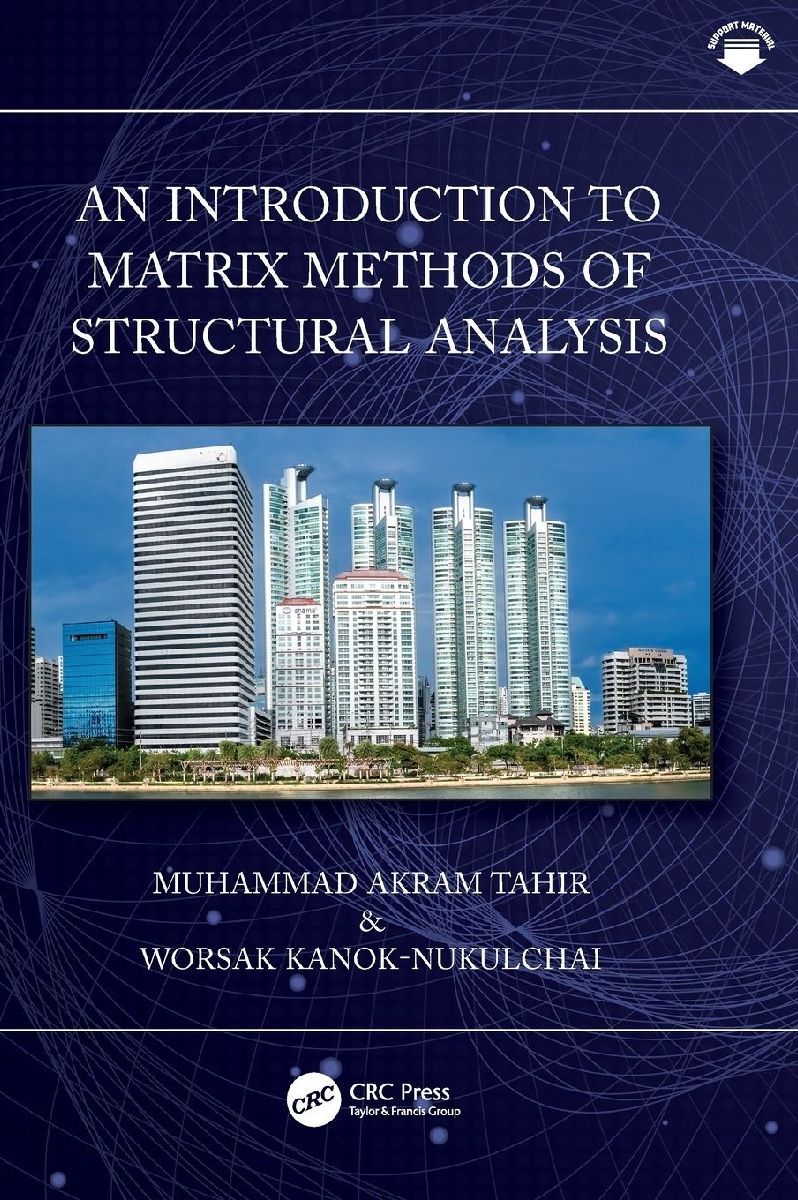
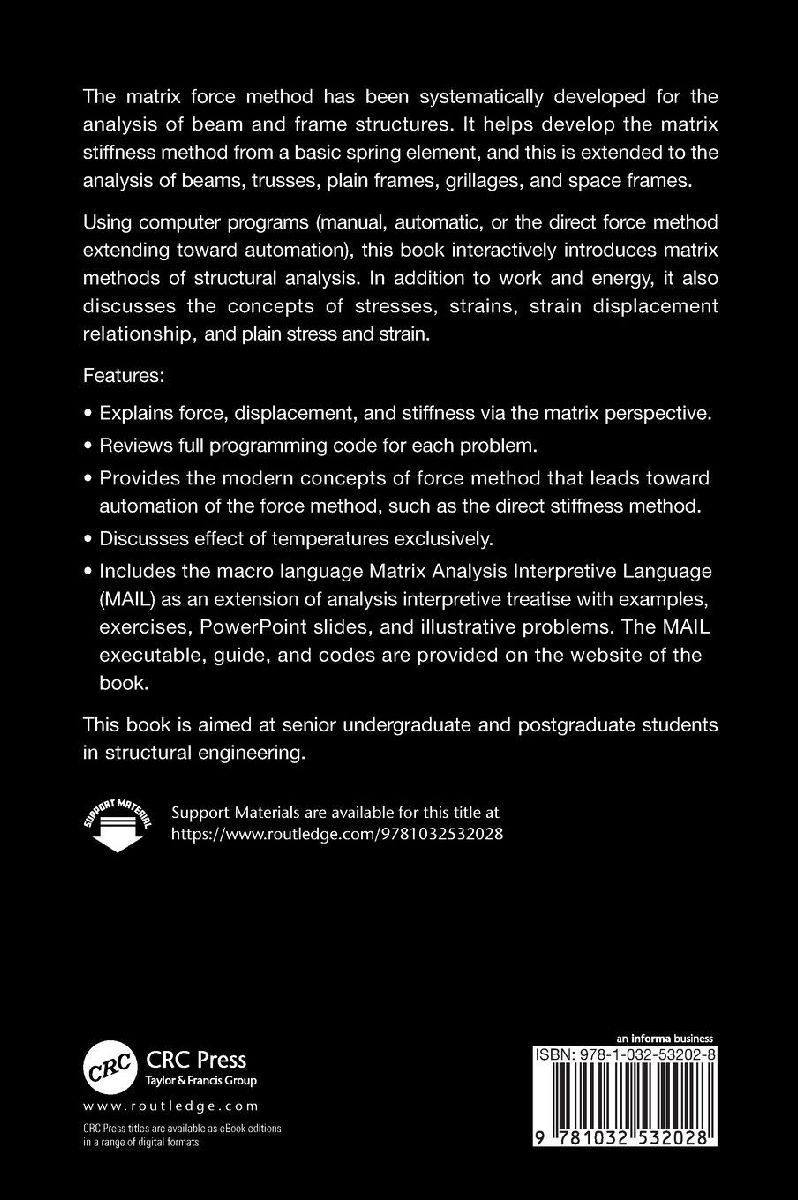
Using computer programs (manual, automatic or direct force method extending towards automation), this book interactively introduces matrix methods of structural analysis. In addition to work and energy, it also discusses the concepts of stresses, strains, strain displacement relationship, and plain stress.
This textbook provides a comprehensive introduction to matrix methods of structural analysis, framed within a discrete modeling approach that is well-suited for digital computation. Two principal procedures-namely, the Matrix Force Method and the Matrix Displacement Method-are thoroughly illustrated for one-dimensional structural systems. Among them, the Matrix Displacement Method is more widely adopted, owing to its straightforward extension to two- and three-dimensional structures.
The book demonstrates how displacements, taken as the primary variables, enable the formation of local element stiffness matrices in the Direct Stiffness Method. In this latter approach, individual element contributions are assembled into a system-level representation, permitting the modeling of virtually any complex structure. This direct stiffness methodology underpins the development of today's general-purpose finite element programs, offering both breadth and depth to structural analysis.
Features
Targeted at senior undergraduate and graduate students in structural engineering, this book serves as an essential prerequisite for the Finite Element Analysis of Structures.
Inhaltsverzeichnis
Es wurden noch keine Bewertungen abgegeben. Schreiben Sie die erste Bewertung zu "An Introduction to Matrix Methods of Structural Analysis" und helfen Sie damit anderen bei der Kaufentscheidung.








