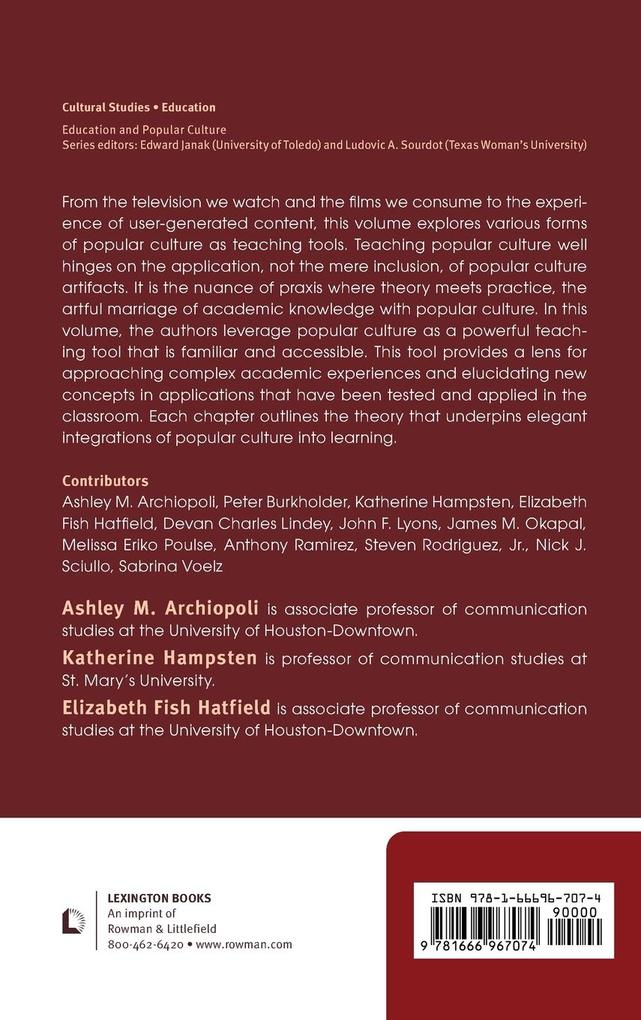
Teaching popular culture well hinges on the application, not the mere inclusion of popular culture artifacts. Each essay outlines the theory that underpins elegant integrations of popular culture into learning.
Inhaltsverzeichnis
Part I: Engaging Students < BR> < BR> Chapter 1< BR> Leveraging Internet Culture for Community Building in Online Classrooms< BR> Ashley M. Archiopoli< BR> < BR> Chapter 2< BR> Create a Comic Book Character: Showcasing Identity, Representation, and DEI Through Critical and Creative Skills< BR> Anthony Ramirez< BR> < BR> Chapter 3< BR> Teaching Person-Environment Fit with the Movie Soul< BR> Steven Rodriguez Jr. < BR> < BR> Part II: Analysis and Applications< BR> < BR> Chapter 4< BR> Exploring and Expanding Moral Philosophy through Science Fiction< BR> James M. Okapal< BR> < BR> Chapter 5< BR> Making Meaning in a Shifting World: Teaching Media Literacy through Everything Everywhere All At Once< BR> Melissa Eriko Poulsen< BR> < BR> Chapter 6< BR> The Numbers Don't Lie - or Do They? An Exercise in Decoding a Historical Film< BR> Peter Burkholder< BR> < BR> Part III: Narrative and Storytelling< BR> < BR> Chapter 7< BR> Teaching Narrative Performance Theory with Disney's Encanto< BR> Elizabeth Fish Hatfield< BR> < BR> Chapter 8< BR> The Many Stories of Hugh Glass: From the Frontier to the Big Screen and Leonardo DiCaprio's First Oscar< BR> Devan Charles Lindey< BR> < BR> Chapter 9< BR> Yesterday: A Beatles Oral History Project< BR> John F. Lyons< BR> < BR> Part IV: Exploring Identity< BR> < BR> Chapter 10< BR> Teaching Black Lives Matter Through Hip-Hop< BR> Nick J. Sciullo< BR> < BR> Chapter 11< BR> Exploring Difficult History Lessons, Identity Construction, the Artistic Expansion of Sitcom< BR> Storytelling Tools in the Black-ish Episode, Juneteenth< BR> Sabrina Voelz< BR> < BR> Chapter 12< BR> Teaching Competent Cross-Cultural Communication with Abbott Elementary< BR> Katherine Hampsten