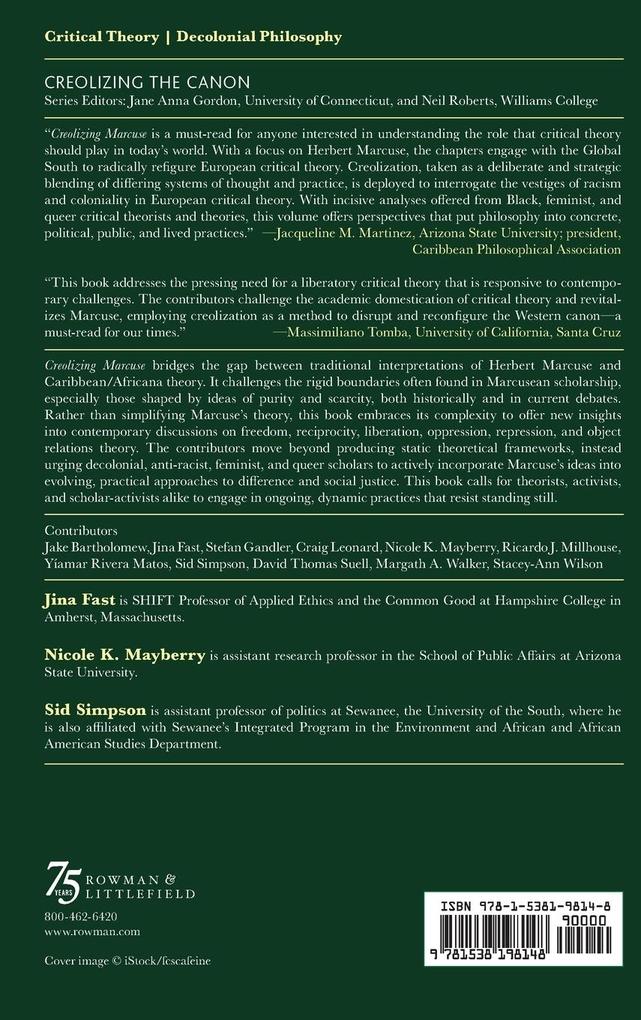
Creolizing Marcuse explores the intersections between Herbert Marcuse's critical theory and Africana and Caribbean theory, revealing the potential for a dynamic interplay of ideas to understand and address contemporary social, political, and ecological challenges amid material, historical realities.
Inhaltsverzeichnis
Acknowledgments
Foreword, Jane Anna Gordon
A Brief Introduction to Creolizing Marcuse, Jina Fast, Nicole K. Mayberry, and Sid Simpson
1 Ghost Lines and Liberation: Haiti, Marcuse, and the Architecture of Freedom, Nicole K. Mayberry
2 Situating Marcuse for Other Worlds: Why (Dis)Placing Marcuse Matters, Margath A. Walker
3 Rastafari Aesthetics and the Quest for Black Liberation, Stacey-Ann Wilson
4 Beyond the Frankfurt School's Colonial Unconscious: Marcuse, Western Reason, and Epistemic Disobedience, Sid Simpson
5 Exploring Energy Democracy from the Bottom Up: Knitting Subaltern Energy Futures, Yíamar Rivera Matos
6 Marcusean Philosophy and Urban Black Queer Public Life, Ricardo J. Millhouse
7 Radical Sense and Sensibility: Reflections on Creolization and Aesthetic Experience, Craig Leonard
8 Zea, Marcuse, and Fanon on the New Man: Situating, Marcuse's Thought in the Global South of the 1960s, Jake Bartholomew
9 The Obsolescence of African Socialism: Nyerere, Kaunda, and Rethinking "Marcusean" Utopia from the Third World, David Thomas Suell
10 Reflections from the Americas on Marcuse's State Philosophy, Stefan Gandler
11 Aesthetics and the Ordinary Notes of Being in Marcuse, Wynter, and Sharpe, Jina Fast
Index
About the Contributors