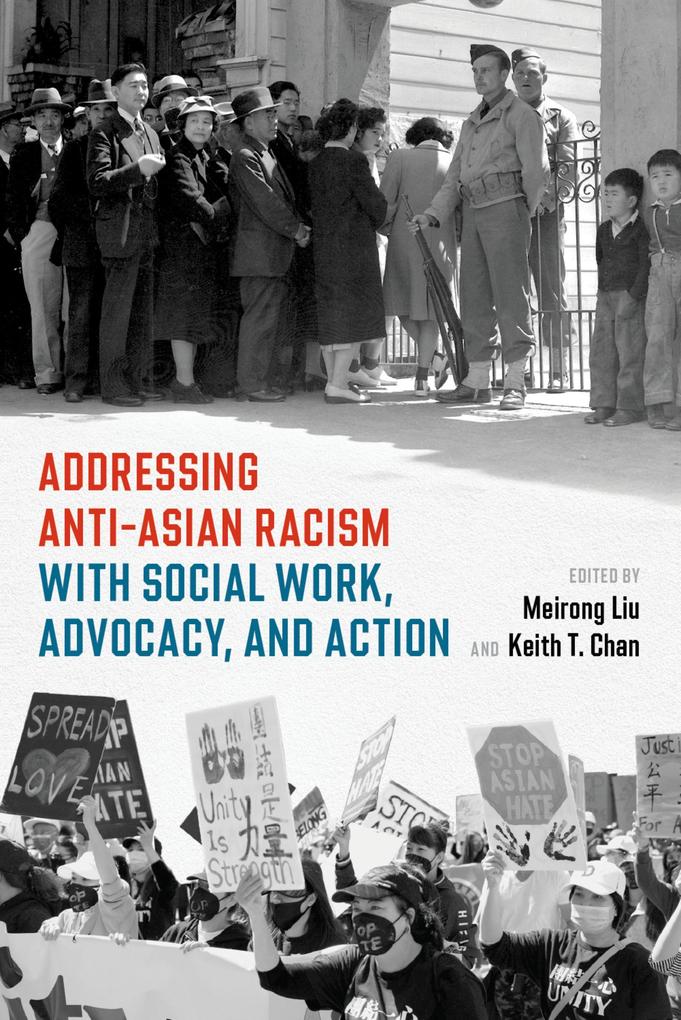
This book fills a critical gap in scholarship from social workers in the effort to eradicate anti-Asian racism through exploration in the historical and current political context. Asian Americans are the fastest growing population among all racial and ethnic groups. Recent events have highlighted incidents of anti-Asian racism which has a long history tied to various marginalized identities in the U.S. This book examines the experiences and impacts of racism from the perspective of Asian Americans and Pacific Islanders, and delves into evidence-based micro, mezzo, and macro solutions. This book intends to serve as a timely and comprehensive resource for social work educators, researchers and practitioners committed to eliminating anti-Asian racism experienced by a population that will no longer accept the label of being "invisible."
This book is the first of its kind to systematically examine the history of anti-Asian racism in the U.S., its impact on the intersectionality of different marginalized identities within Asian American communities, and provides innovative, evidence-based solutions that social work educators, practitioners, and researchers can adopt to dismantle anti-Asian racism.
Inhaltsverzeichnis
- Section I: Deconstructing Anti-Asian Racism: Understanding History, Social Contexts, and Complexities
- 1: The History of Anti-Asian Racism and Violence in the United States
- 2: Racism, Xenophobia, and Violence Against Asian Americans During the COVID-19 PandemicXiaofang Liu, Kam Man, Kenny Kwong, and Qingwen Xu
- 3: Acculturation, the Asian American Identity, and the Impact of Anti-Asian Racism on Health and Mental HealthKeith T. Chan
- 4: The Intersection of Racism and Marginalized Identities Among Asian AmericansJun Sung Hong, Sofie Hana Aaron, Cindy C. Sangalang, Jane J. Lee, and Joong Won Kim
- 5: Understanding and Dismantling the "Model Minority" StereotypeLainey Sevillano and Kirin Macagupa
- 6: Asian American, Racial Solidarity, and Black Lives MatterRobert Cosby, Meirong Liu, and Keith T. Chan
- Section II: Voices of Diverse Communities: Intersectionalities in the Experience of Anti-Asian Racism
- 7: The Perceptions of Korean Americans on the Rise of Anti-Asian Racial Discrimination and the Negative Impact on Psychological DistressShinwoo Choi, Joo Young Hong, Catherine Hawkins, and Hyejoon Park
- 8: Acculturation and Cultural Socialization Practices of Japanese Immigrant and Temporary Resident Families in the United StatesMisa Kayama
- 9: Bahaghari: Visibilizing the Experiences and Resistance of LGBTQ+ Filipinx Americans in the DiasporaDale Dagar Maglalang and Hillary Nicole Peregrina
- 10: Religion and Spirituality as Buffers Against Islamophobia in the Lives of Asian American YouthAltaf Husain, Hannan Hijazi, and Sarah Carlis
- 11: Coping at the Margins: Managing Loneliness for Hmong Older AdultsCindy Vang, Michael Sieng, and Austin Thao
- 12: The Impact of Anti-Asian Racism on the Psychosocial Well-Being of Older Asian Americans: A Systematic ReviewFei Sun, Siyu Gao, Ethan Liu, and Yali Feng
- Section III: Dismantling Anti-Asian Racism: Micro, Mezzo, and Macro-level Strategies
- 13: The Role of Social Work and Storytelling in Eliminating Anti-Asian Racism and Hate CrimesSofie Hana Aaron, Juliann Li Verdugo, Jane J. Lee, Hye-Kyung Kang, Tam Q. Dinh, and Michael S. Spencer
- 14: Reflecting on Racism Within the Social Work Profession and Developing an Anti-Racist WorkforceKenny Kwong
- 15: Service Access to Depression Treatment: Mental Health Help-Seeking Sources Among Asian AmericansPatrick Leung, Monit Cheung, and Carol A. Leung
- 16: Promising, Culturally Sensitive Evidence-Based Interventions for Asian AmericansDhrubodhi Mukherjee
- 17: The Importance of Community-Based Solutions in Addressing Anti-Asian RacismClifford S. Bersamira, Sophia B. Lau, and Yeonjung Jane Lee
- 18: Policy Initiatives on Eliminating Anti-Asian RacismMeirong Liu, Yanfeng Xu, and Zhanjie Si
- Conclusion
- Keith T. Chan and Meirong Liu