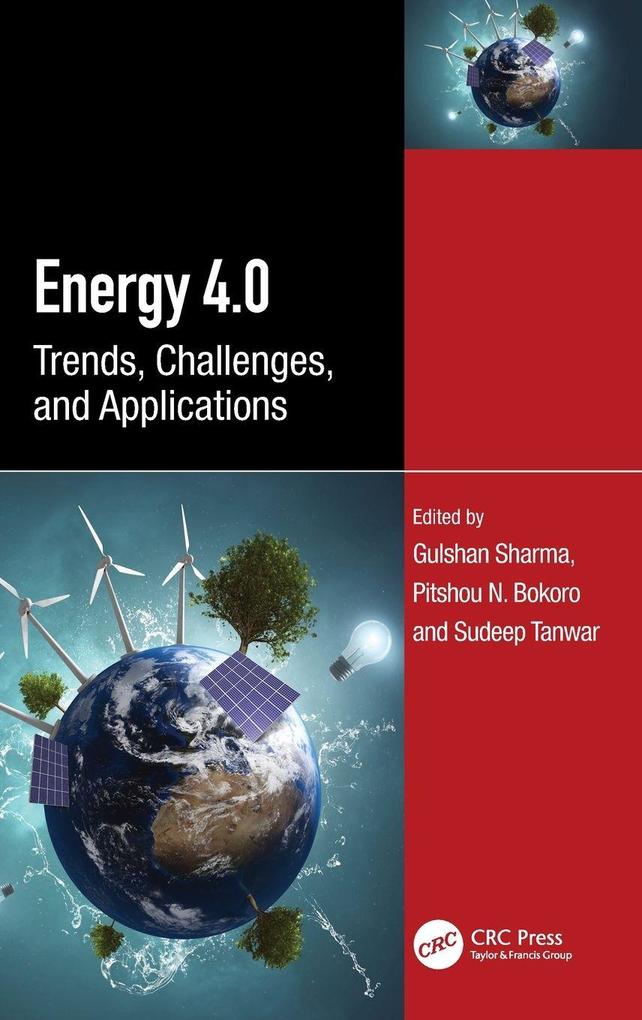

The text comprehensively discusses concepts and principles of modern intelligent techniques in control and management of energy 4. 0, and applications of smart sensors in providing optimal use of energy resources. It further covers the recent advancement in the design of solar power with maximum power point tracking developments.
The text provides insight into renewable technologies, and their challenges in terms of design, efficiency, implementation, and solutions to mitigate the problem of energy crisis. It will help the readers to understand the role of the fourth industrial revolution technologies in developing user-friendly, economic, and implementable solutions to mitigate the present and future energy crisis through cleaner and renewable technologies.
The text is primarily written for senior undergraduates, graduate students, and academic researchers in the fields of electrical engineering, electronics and communications engineering, energy, environmental engineering, computer science, and engineering.
Inhaltsverzeichnis
Section 1: Alternative Energy Sources and Grid Integration
Chapter 1: Power generation at highways using vertical windmill, efficient solar systems and internet of things
Authors: S. Ravikanti, P. Khanwalkar, A. Pune, K. Dasari and B. Neeraja
Chapter 2: Grid interconnection of high step-up DC to AC converter for renewable source
Authors: S. Shukla, D. Pandey and N. Singh
Chapter 3: Amplify and forward based cooperative communication of energy harvesting tags
Authors: M. A. Mulatu, Y. S. Han and L. Chang
Section 2: Converters and Electric Vehicle Charging
Systems
Chapter 4: Solar PV incorporated with boost converter using perturbation and observation method of maximum power point tracking technique for EV charging applications
Authors: S. Panchanathan, P. Vishnuram, M. Bajaj and A. R. Singh
Chapter 5: A comprehensive study on off-grid and hybrid charging system for electric vehicles
Authors: S. K. Almas and N. Singh
Chapter 6: Mathematical modelling and analysis of DC-DC converters for voltage regulation in DC microgrids
Authors: Authors: S. Panchanathan, P. Vishnuram, M. Bajaj and A. R. Singh
Section 3: Intelligent Technologies in Energy Systems
Chapter 7: The impact of IoT on the performance of electric vehicle charging station networks
Authors: S. Nagar, A. Kashiv and N. Singh
Chapter 8: Prediction forecasting and optimisation of energy consumption: An AI-ML based approach
Authors: P. Khanwalkar and S. Ravikanti
Chapter 9: Cyber physical systems related issues and digital twins for power and energy systems
Authors: P. Shekinah and S. R. Mani Sekhar
Chapter 10: Digitally enhanced adaptive security: A solution for power theft in smart cities
Author: P. Pandey and D. Sharma
Section 4: Distribution Systems and Sustainable Energy Infrastructure
Chapter 11: An integrated approach to enhance distribution system reliability: Analysis of load growth dynamics
Authors: G. S. Sivasankar and K. Narayanan
Chapter 12: A review of power trading models between distribution systems: The South African context
Authors: Z. Khumalo, P. N. Bokoro, and G. Sharma
Chapter 13: Modelling and Simulation of three-phase induction motor under faulty conditions
Authors: P. Pohakar, R. Gandhi and B. Champati
Section 5 Conclusions
Chapter 14: Summary of the contributions
Es wurden noch keine Bewertungen abgegeben. Schreiben Sie die erste Bewertung zu "Energy 4.0" und helfen Sie damit anderen bei der Kaufentscheidung.








