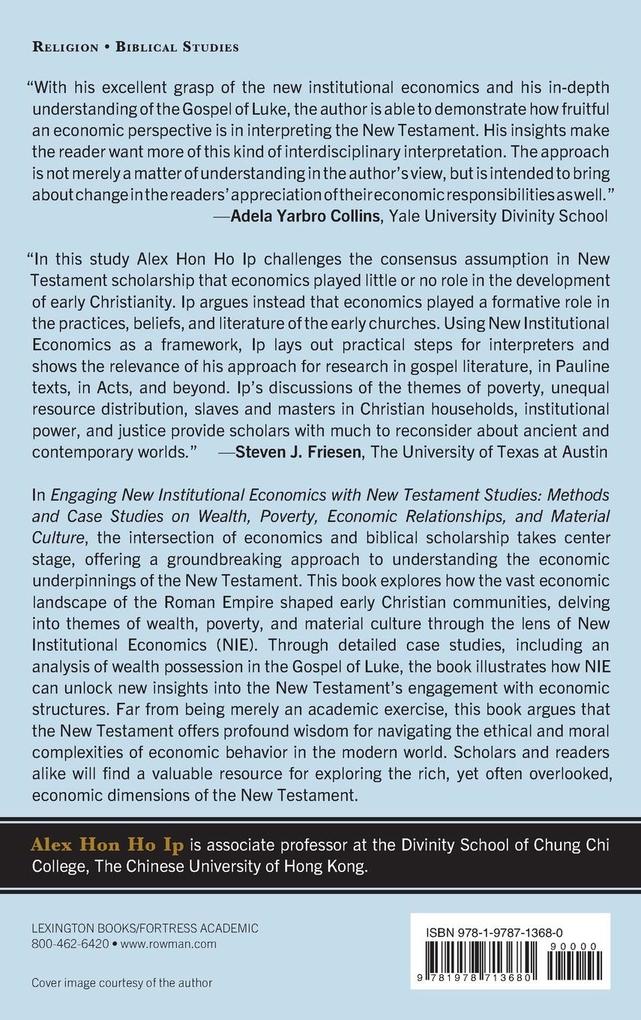
This book bridges economics and biblical scholarship, challenging the misconception that economics is limited to neo-classical models. Through detailed examples, the book demonstrates the value of New Institutional Economics in analyzing the economic landscape of the Roman Empire and its influence on New Testament teachings.
Inhaltsverzeichnis
Acknowledgements
List of Abbreviations
Introduction
Section 1: Methodology and Method
Chapter 1. A Methodological Review of the Relevance of Economics for the Study of the New Testament
Chapter 2. Douglass North's Model and its Relevance to New Testament Investigation
Section 2: Demonstrative Example: Wealth Possession in the Gospel of Luke
Chapter 3. The Contribution of the Institutional Layer to the Discussion of the Poor/Rich and Wealth Possession Motifs
Chapter 4. Institutional Layer of the Wealth Possession Issue in the Early Roman Empire
Chapter 5. A Socio-Rhetorical Interpretation of Luke 10:25-37 in Light of Institutional Layer of Wealth Possession
Section 3: Application of NIE in New Testament Studies
Chapter 6. The Institutional Function of the Agora and its Relevance to New Testament Studies: A New Institutional Economics Approach to the Athenian Agora and the New Testament
Chapter 7. An Economic Analysis of the Perception of 'Grief' in the Letter to Philippians in the Light of New Institutional Economics (NIE)
Chapter 8. A Christian Response to the Conflicting Relationship Between Slave and Master in A Christian Household
Conclusion
Bibliography
About the Author