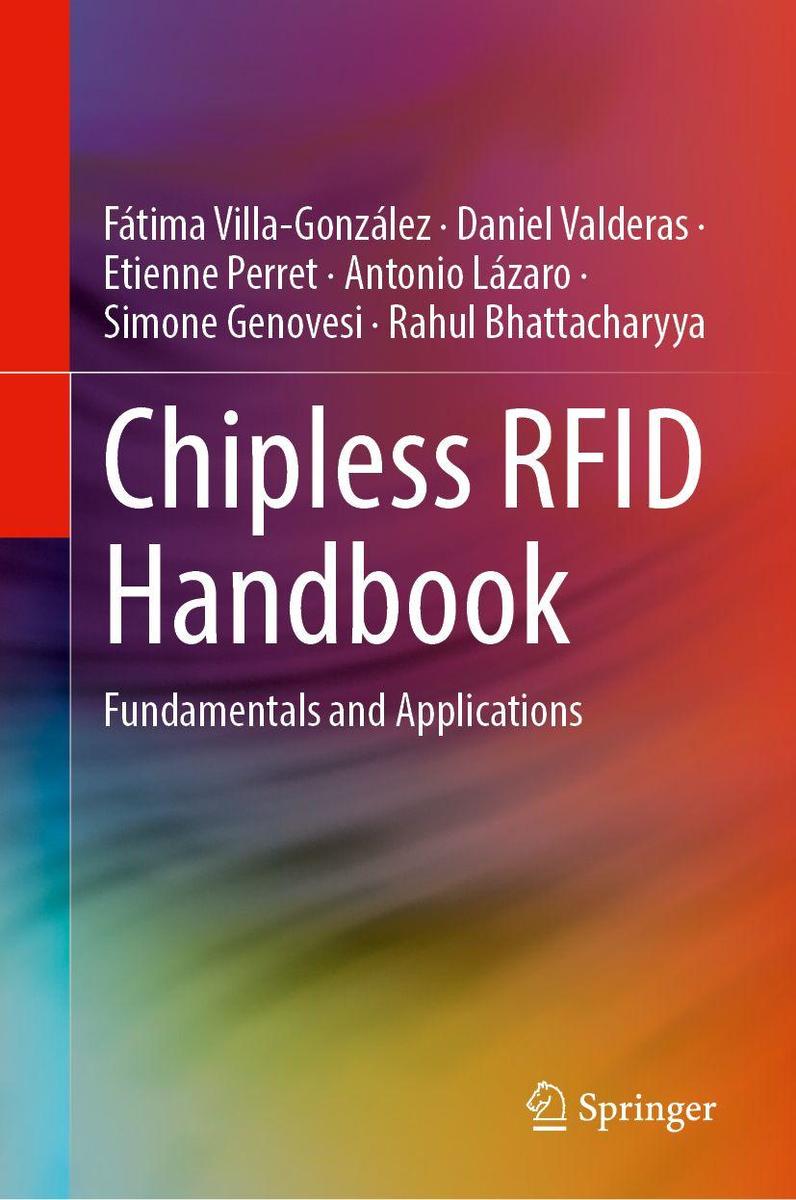
Chipless radio frequency identification (RFID) technology has emerged as a cost-effective alternative to conventional automated identification systems like RFID, QR codes, and barcodes. Simultaneously, it enables a wide array of novel applications, including recycling, structural health monitoring, and food safety, among many others.
In this handbook, the authors provide an in-depth exploration of the design, manufacturing, and implementation guidelines of chipless RFID systems, including information encoding in chipless tags, the design of radar-based ultra-wideband (UWB) readers and antennas, as well as dedicated signal processing in time- and frequency-domain.
This book is not only a practical resource for understanding the core principles and capabilities of chipless RFID, but also a rich source of expert knowledge for those wishing to deepen their understanding or explore particular applications. With real-world examples and detailed guidelines, the Chipless RFID Handbook serves as both a beginner-friendly introduction and an advanced reference on this emerging technology.
Inhaltsverzeichnis
Introduction. - Fundamentals of EM theory. - Fundamentals of Chipless RFID. - Coding using Chipless RFID Tags. - Design of Frequency-Domain Chipless RFID Tags. -Fabrication of Frequency-Domain Chipless RFID Tags. - Backscattered signal pre-processing. - Backscattered signal post-processing and decoding. - Chipless RFID tag readers. - Regulations and licensing. - Chipless RFID sensors. - Applications.
Es wurden noch keine Bewertungen abgegeben. Schreiben Sie die erste Bewertung zu "Chipless RFID Handbook: Fundamentals and Applications" und helfen Sie damit anderen bei der Kaufentscheidung.