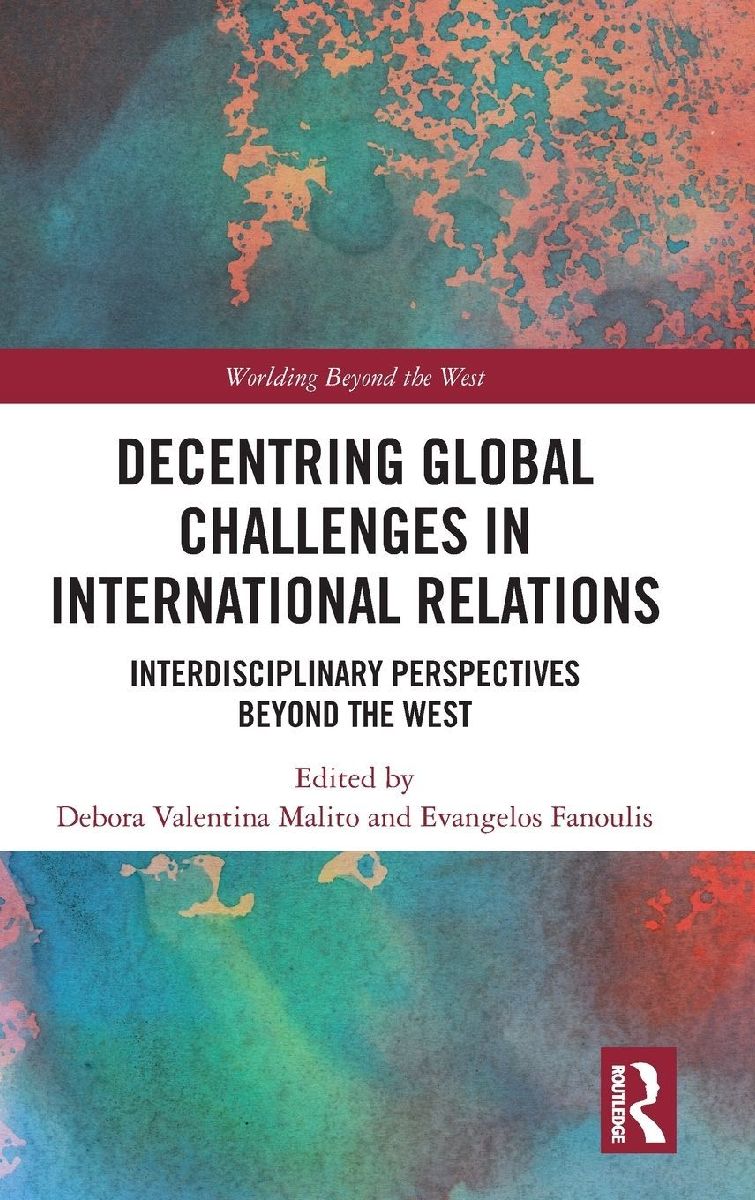

This book examines contemporary global challenges from a decentring perspective, advancing an interdisciplinary conversation. International studies scholarship has become increasingly more interdisciplinary and multifocal, especially as the escalation of systemic ecological and economic crises, as well as social, and political challenges in the 21st century have required comprehensive ways of thinking and taking stock of existing ontological and epistemic limitations. A decentring approach is crucial to account for how interdependent relations across states and societies, regions and the globe, shape modernity and its global manifestations are, in an era of growing and persistent crises. The book explains why traditional hegemonic approaches to global challenges are problematic, and conceptualises what a decentring approach to global challenges entails: a deconstruction of traditional and sedimented epistemic underpinnings (implying a rethinking of agency, time, geographies, norms, topics, and loci of public attention) but also an appreciation of the mutually constructed nature of the international. This book will appeal to students and scholars of international relations (IR) and international studies who are interested in decentring, as well as those working for civil society organisations (CSOs), NGOs, and think tanks.
Inhaltsverzeichnis
1. Introduction: Decentring Global Challenges PART I - WHICH CHALLENGES? 2. Speculation and Flexible Extraction in Northern Madagascar: A View of Global Challenges from Below 3. Inequitable Global Distribution of COVID-19 Vaccines: A Constructivist Critique 4. State-Centrism in Security Discourses: A Gramscian Critique of the US-Japan alliance 5. Epistemic Violence and International Law: Islamic Thought in the Struggle for Epistemic Equivalency PART II - WHOSE GLOBALITY? 6. Neither Eurocentrism, Nor East Asian Exceptionalism: An Epistemic Turn on East Asian Ontology 7. Rethinking Regionalism beyond Eurocentrism 8. Revisiting China-Africa Relations: A Critical Realist Approach to South-South Cooperation 9. Reframing the Global Knowledge Economy: An Afropolitan Approach 10. Questioning International Business and Management Studies: A Decolonial Feminist Critique 11. Conclusion
"This powerful collection of essays speaks eloquently to the importance of who writes and does IR, and on whose behalf. Fifteen years after our earnest but flawed efforts, it also shows that the very theorizing of key concepts in global politics is impoverished by our collective failures to consider who gets to study the world. As such, thinking 'beyond the west,' is not simply an invitation to write from the multiplicity of Global South perspectives but also a method of interrogating how centers of power located in and through the Global North/West shape what counts as a crisis or problem. We are lucky to have the insights and analyses of these scholars and their theoretically sophisticated and substantively rich work. It behooves all of us who call ourselves IR scholars to prioritize such voices."
Eric Selbin and Meghana Nayak, authors of Decentering International Relations
"Born out of a frustration with the gap between the often-abstract epistemological debates on globalizing IR, and the more empirical, policy-oriented work on global challenges, this book links these different literatures by drawing on a plurality of disciplinary approaches and cases that interrogate the power relations inherent in 'globality' and 'challenges.' Through this decentring move, alternative voices and perspectives are brought to the fore, opening up the debate about the nature of contemporary global challenges, how we think about, and attempt to address them."
Karen Smith, Leiden University and Stellenbosch University
"Bringing together critical and non-Western perspectives from both the West and the Global South, this volume highlights the value of diverse approaches for understanding and tackling global challenges: there is much more beyond the 'mainstream' Western IR! A stimulating read for anyone who is interested in the future global challenges."
Shiping Tang, Fudan University
Es wurden noch keine Bewertungen abgegeben. Schreiben Sie die erste Bewertung zu "Decentring Global Challenges in International Relations" und helfen Sie damit anderen bei der Kaufentscheidung.











