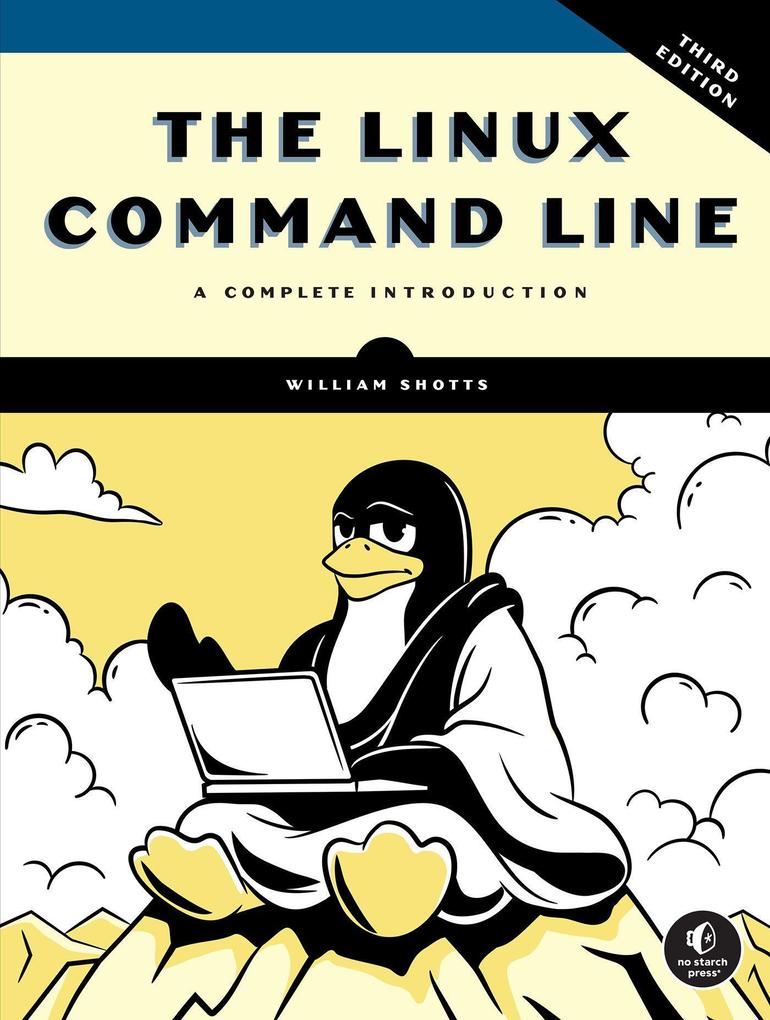
Banish Your Mouse.
The Linux Command Line isn’t just a reference manual. It’s a complete education on how Linux really works. From your first tentative keystrokes to writing powerful shell scripts, you’ll build the confidence and understanding to make your system work for you.
Now in its third edition, this best-selling guide has been fully updated with modern examples, nearly 40 pages of new content, and downloadable scripts from LinuxCommand. Used in more than a thousand classrooms and libraries worldwide, it has helped over 150,000 readers gain fluency and confidence in Linux.
Author and command line guru William Shotts delivers not just commands, but genuine insight, guided by his philosophy: Make everything as simple as possible, but no simpler.
Through short, digestible chapters, you’ll learn to:
- Navigate the filesystem, manage files, and configure your environment
- Chain commands, redirect input/output, and use regular expressions
- Control processes, manage packages, and work with networking tools
- Edit text with Vim
- Write shell scripts to automate tasks and build custom tools
- Use core utilities like grep, cut, sed, and tar to process data
- Manage filesystems and compile programs from source
Whether you’re managing servers, studying cybersecurity, or just curious about your computer, The Linux Command Line gives you the knowledge to command your system with confidence.
Inhaltsverzeichnis
Acknowledgements
Introduction
Part I: Learning the Shell
Chapter 1: What Is the Shell?
Chapter 2: Navigation
Chapter 3: Exploring the System
Chapter 4: Manipulating Files and Directories
Chapter 5: Working with Commands
Chapter 6: Redirection
Chapter 7: Seeing the World as the Shell Sees It
Chapter 8: Advanced Keyboard Tricks
Chapter 9: Permissions
Chapter 10: Processes
Part II: Configuration and the Environment
Chapter 11: The Environment
Chapter 12: A Gentle Introduction to vi(m)
Chapter 13: Customizing the Prompt
Part III: Common Tasks and Essential Tools
Chapter 14: Package Management
Chapter 15: Storage Media
Chapter 16: Networking
Chapter 17: Searching for Files
Chapter 18: Archiving and Backup
Chapter 19: Regular Expressions
Chapter 20: Text Processing
Chapter 21: Formatting Output
Chapter 22: Printing
Chapter 23: Compiling Programs
Part IV: Writing Shell Scripts
Chapter 24: Writing Your First Script
Chapter 25: Starting a Project
Chapter 26: Top-Down Design
Chapter 27: Flow Control: Branching with if
Chapter 28: Reading Keyboard Input
Chapter 29: Flow Control: Looping with while/until
Chapter 30: Troubleshooting
Chapter 31: Flow Control: Branching with case
Chapter 32: Positional Parameters
Chapter 33: Flow Control: Looping with for
Chapter 34: Strings and Numbers
Chapter 35: Arrays
Chapter 36: Exotica
Index