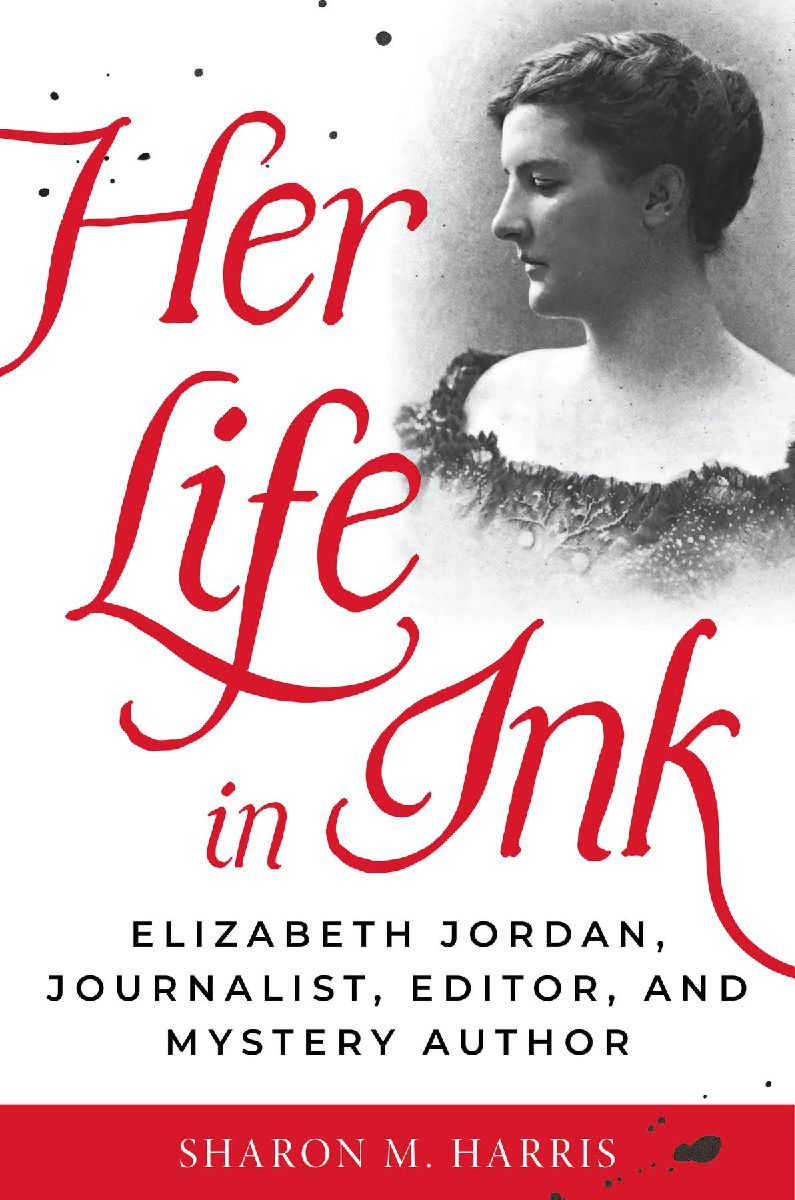
Unravel the intriguing life of a woman who edited the literary greats of her day and forged a path to the golden age of mystery writing.
Elizabeth Garver Jordan was renowned not only for her own writing but also for her influence in journalism and literature. Her love of intrigue started when she was five and made a secret pact with the family cook, who taught her to read. In her first career as a journalist, Jordan climbed the ranks from columnist to an editor of Pulitzer’s prestigious New YorkWorld Sunday edition, where her work as an investigative journalist took her from the Bowery to the mansions of Fifth Avenue. She specialized in covering murder trials, including that of the notorious Lizzie Borden. But while the Borden trial made Jordan famous, it also led to a scandal that would follow her throughout her life.
As editor for Harper’s Bazar, Jordan changed the magazine into the glossy fashion publication for which it remains famous today. She also emphasized fiction, bringing Jack London, Stephen Crane, Henry James, and many suffragists to its pages. When she moved to Harper books as literary editor, she was instrumental to the successful careers of writers such as Sinclair Lewis, Dorothy Canfield Fisher, and Fannie Hurst.
But perhaps the most surprising influence Jordan wielded was in the field of mystery writing, as an author herself. Although erased from histories of the genre until now, she was one of the premier American mystery writers of the early twentieth century. Like Agatha Christie, Jordan’s mysteries were high-quality, innovative stories—ranging from locked rooms to country estates to gothic settings—that helped reshape the genre. Here, for the first time, the full story of her life—including her close relationship with Frances Hodgson Burnett—is finally revealed.
Inhaltsverzeichnis
Preface< BR> < BR> Chapter 1: Life in Milwaukee< BR> < BR> Chapter 2: The Plan< BR> < BR> Chapter 3: A New Kind of Education< BR> < BR> Chapter 4: Making Her Way< BR> < BR> Chapter 5: True Stories< BR> < BR> Chapter 6: Sections Editor< BR> < BR> Chapter 7: Covering the Lizzie Borden Trial< BR> < BR> Chapter 8: Assistant Editor< BR> < BR> Chapter 9: Transitioning< BR> < BR> Chapter 10: Harper’ s Bazar< BR> < BR> Chapter 11: Fashioning Literature< BR> < BR> Chapter 12: Editor and Author< BR> < BR> Chapter 13: Retreats< BR> < BR> Chapter 14: The Whole Darn Family< BR> < BR> Chapter 15: The Progressive Era< BR> < BR> Chapter 16: Harper’ s Publishing< BR> < BR> Chapter 17: A Second Composite Novel< BR> < BR> Chapter 18: New Directions< BR> < BR> Chapter 19: Goldwyn Pictures< BR> < BR> Chapter 20: Mystery Writing< BR> < BR> Chapter 21: The Roaring Twenties< BR> < BR> Chapter 22: America’ s Theater Critic< BR> < BR> Chapter 23: Rebuilding from Loss< BR> < BR> Chapter 24: New Directions< BR> < BR> Chapter 25: Writing Against the Odds< BR> < BR> Chapter 26: Three Rousing Cheers! < BR> < BR> Chapter 27: Passages< BR> < BR> Chapter 28: The Final Years< BR> < BR> Bibliography< BR> < BR> Index