








Das eBook.de Hörbuch Abo - jederzeit, überall, für nur 7,95 € monatlich!
Jetzt entdecken
mehr erfahren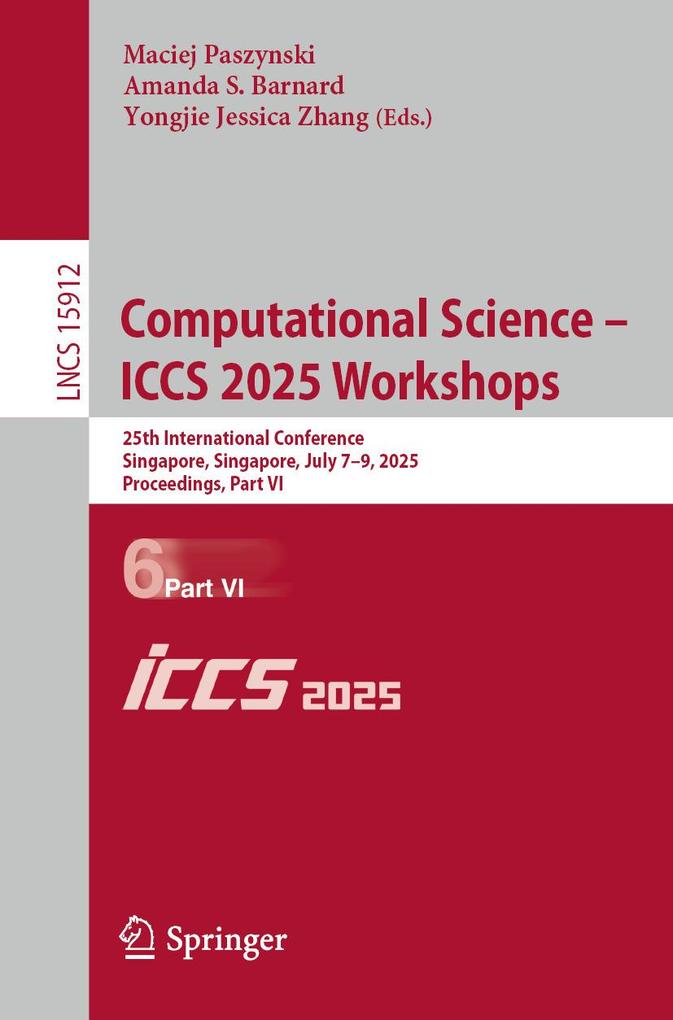
The 6-volume set constitutes the workshop proceedings of the 25th International Conference on Computational Science, ICCS 2025, which took place in Singapore, Singapore, during July 7-9, 2025.
The 137 full papers and 32 short papers presented in these proceedings were carefully reviewed and selected from 322 submissions. The papers are organized in the following topical sections:
Volume I:
Advances in high-performance computational earth sciences: numerical methods, frameworks & applications; artificial intelligence approaches for network analysis; artificial intelligence and high-performance computing for advanced simulations; and biomedical and bioinformatics challenges for computer science.
Volume II:
Computational health; computational modeling and artificial intelligence for social systems; and computational optimization, modelling and simulation.
Volume III:
Computational science and AI for addressing complex and dynamic societal challenges equitably; computer graphics, image processing and artificial intelligence; computing and data science for materials discovery and design; and large language models and intelligent decision-making within the digital economy.
Volume IV:
Machine learning and data assimilation for dynamical systems; and multi-criteria decision-making: methods, applications, and innovations.
Volume V:
(Credible) Multiscale modelling and simulation; numerical algorithms and computer arithmetic for computational science; quantum computing; retrieval-augmented generation; and simulations of flow and transport: modeling, algorithms and computation.
Volume VI:
Smart systems: bringing together computer vision, sensor networks and artificial intelligence; solving problems with uncertainty; and teaching computational science.
Inhaltsverzeichnis
Smart Systems: Bringing Together Computer Vision, Sensor Networks and Artificial Intelligence. -
Formal Security Analysis of the Authentication Protocol in Smart Cities using AVISPA. - Automatic Help Summoning through Speech Analysis on Mobile Devices. - Leveraging Graph Digital Twin for Fault Detection and Improved Power Grid Stability in Smart Cities. - PEMS-API: Malware Classification Using Parameter-Enhanced Multi-dimensional API Sequence Features. - The Effectiveness of Visual Attention Patterns in the Process of Spatial Exploration in a 3D Video Game Environment. - A New Way to Generate Urban Environments for Video Games Using the Architectural Impression Curve Method. - Enhancing Learning in Augmented Reality (AR): A Deep Learning Framework for Predicting Memory Retention in AR Environments. -
Solving Problems with Uncertainty. -
Unified and Diverse Coalition Formation in Dispersed Data Classification A Conflict Analysis Approach with Weighted Decision Trees. - From Uncertainty to Semantics in Self-reported Data: An Empirical Analysis. - Uncertainties in Modeling Psychological Symptom Networks: The Case of Suicide. - Making Astrometric Solver Tractable through In-Situ Visual Analytics. - Scheduling in Workflow-as-a-Service Model with Pre-Parameterized DAG using Inaccurate Estimates. - Global Sensitivity Analysis for a Mathematical Model of the General Escape Theory of Suicide. - Multidimensional Granular Approach to Solving Fuzzy Complex System of Linear Equations. - An Algorithm for Calculating the Multidimensional Solution of the Fuzzy Sylvester Matrix Equation. - Modelling Extreme Uncertainty: Queues with Pareto Inter-Arrival Times and Pareto Service Times. -
Teaching Computational Science. -
Best Practices in Teaching Digitization and Process Automation - A Case Study of Warsaw University of Technology. - Contrast Computation for Improved Visibility and User Experience in Educational Interfaces. - The Role of the Sustainability Competences for IT Systems Engineers. - Smart Product-Service System for Intelligent Welding System. - The Use of Artificial Intelligence and Virtual Computer Laboratories to Develop Computer Science Education. - Exploring AI Applications in Business: Case Studies on Key Competencies for Professionals. - The Use of the Chat GPT to Solve Mathematical Programming Tasks: A Didactic Experiment with the Participation of Warsaw University of Life Sciences Students. - Service-Oriented Architecture: Learning with Generative AI and AWS.
Es wurden noch keine Bewertungen abgegeben. Schreiben Sie die erste Bewertung zu "Computational Science - ICCS 2025 Workshops" und helfen Sie damit anderen bei der Kaufentscheidung.