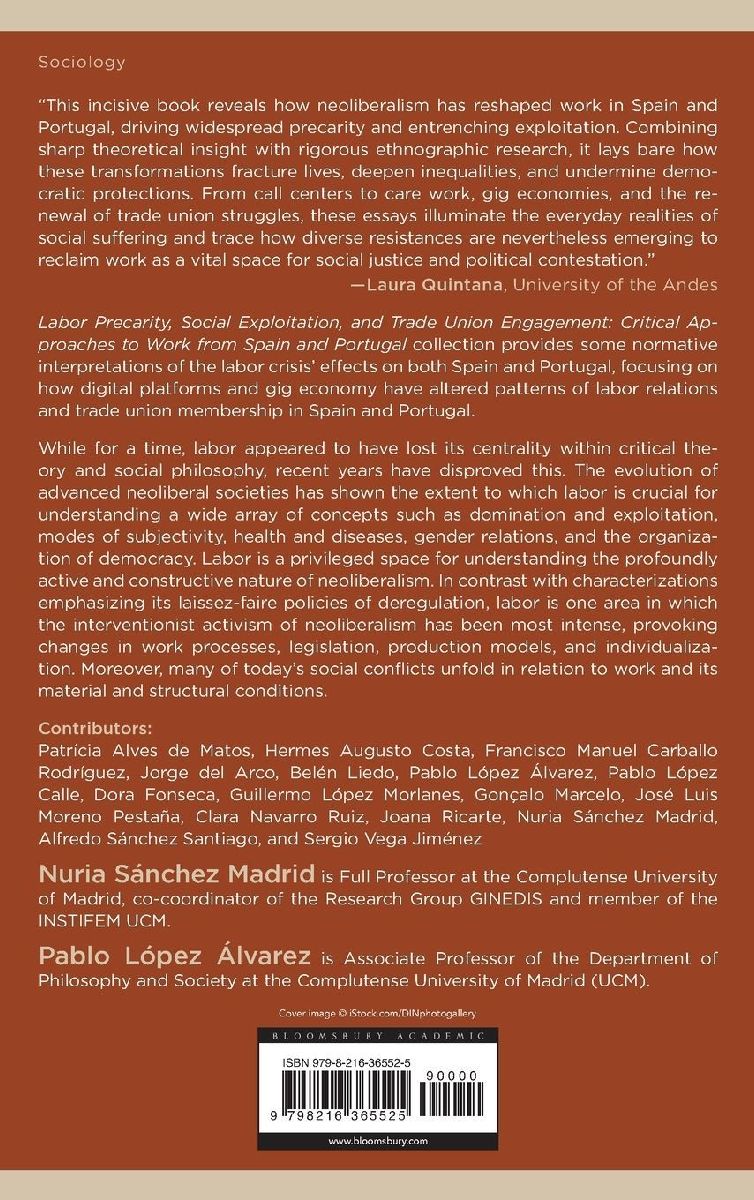
Labor Precarity, Social Exploitation, and Trade Union Engagement: Critical Approaches to Work from Spain and Portugalcollection provides some normative interpretations of the labor crisis' effects on both Spain and Portugal, focusing on how digital platforms and gig economy have altered patterns of labor relations and trade union membership in Spain and Portugal. While for a time, labor appeared to have lost its centrality within critical theory and social philosophy, recent years have disproved this. The evolution of advanced neoliberal societies has shown the extent to which labor is crucial for understanding a wide array of concepts such as domination and exploitation, modes of subjectivity, health and diseases, gender relations, and the organization of democracy. Labor is a privileged space for understanding the profoundly active and constructive nature of neoliberalism. In contrast with characterizations emphasizing its laissez-faire policies of deregulation, labor is one area in which the interventionist activism of neoliberalism has been most intense, provoking changes in work processes, legislation, production models, and individualization. Moreover, many of today's social conflicts unfold in relation to work and its conditions: new forms of trade unionism, associationism and activism renew the language and practices of resistance in a situation demonstrating a new relationship between business corporations, trade unions and the State.
Inhaltsverzeichnis
Introduction< BR> Nuria Sánchez Madrid and Pablo López Álvarez< BR> < BR> SECTION 1: NEOLIBERAL TRANSFORMATIONS OF WORK< BR> < BR> Chapter 1: "Work without Future": Neoliberal Precarity, Horizons of Worthy Living and Generational Dispossession in the Portuguese Call Center Sector< BR> Patrícia Alves Fonseca< BR> < BR> Chapter 2: Producing the Subject "Delivery". Spanish Migrant Workers and Central-European Platformized Work< BR> Pablo López Calle< BR> < BR> Chapter 3: Precarity and New Forms of Labor: The Recent Transformation of Spanish Labor Legislation and the Question of Autonomy< BR> Jorge del Arco and Alfredo Sánchez< BR> < BR> SECTION 2: CRITICAL ACCOUNTS OF DOMINATION AT WORK< BR> < BR> Chapter 4: Body, Erotic Capital, and Union Resistance in Spain < BR> José Luis Moreno Pestaña and Francisco Carballo< BR> < BR> Chapter 5: Revisiting the Housing Question. Work, Race, Gender and Real Estate Violence in Spain< BR> Nuria Sánchez Madrid and Guillermo López Morlanes< BR> < BR> Chapter 6: Researching on a Thin Line: the Precarity of Researchers in Portugal and Its Consequences< BR> Gonçalo Marcelo and Joana Ricarte< BR> < BR> Chapter 7: The Long Path to Recognition: Remarks on the Spanish Situation of Care Work and Technologization< BR> Belén Liedo and Clara Navarro< BR> < BR> SECTION 3: NORMATIVE PERSPECTIVES ABOUT THE CRISIS OF WORK< BR> < BR> Chapter 8: Governing Work. Legal Reforms, Intensification of Work and Strategic Precarization in Spain (2008-2022)< BR> Pablo López Álvarez and Sergio Vega< BR> < BR> Chapter 9: Labor Precariousness in Portugal: Themes, Actors and Challenges of Labor Regulation< BR> Hermes Augusto Costa< BR> < BR> Chapter 10: Trade Unions in the Age of Digitalization: Challenges and Opportunities in the Transport and Food Delivery Sectors< BR> Dora Fonseca < BR> < BR> About the Contributors