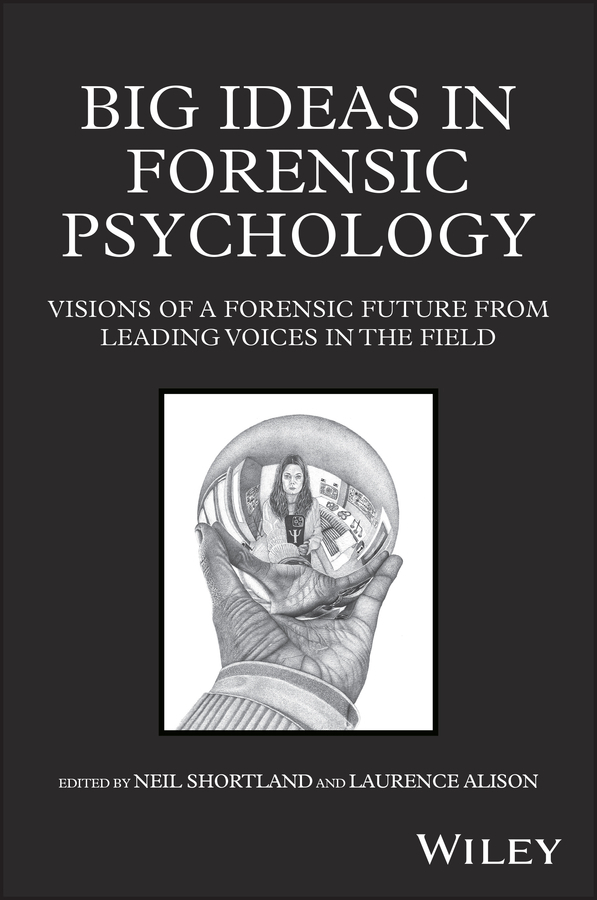
A field guide to the next decade of forensic psychology-40 innovative ideas that will influence investigations, courts, and correctional decision-making
In Big Ideas in Forensic Psychology: 40 Innovations that will Define the Future of the Field, Professors Neil Shortland (Director, Centre for Terrorism and Security Studies, UMass Lowell) and Laurence Alison MBE (Director, CAMI Research, University of Liverpool) curate an insightful and provocative look at what's coming next in policing, corrections, and criminal law decision-making. Drawing on contributors who span policing, courts, corrections, intelligence, and security, the book tackles the hard problems practitioners face - false confessions, biased decision rules, digital crime, AI-enabled workflows - and shows how to address them with defensible, research-anchored methods.
Organized as a fast, "annual question"-style collection, each chapter answers: What big idea will change the field in the next ten years? The result is a panoramic and rigorous map of near-term shifts: science-based interviewing beyond confession seeking, rights-consistent detention and oversight, digital-trace analytics for threat assessment, simulation-driven training, and the governance of frontier AI. As the launch title in the refreshed Wiley Series in the Psychology of Crime, Policing and Law, it situates these ideas within the series' broad focus - from courtroom psychology to extreme-team decision support - giving readers both immediate takeaways and a durable research agenda for practice.
A deliberately cross-sector view - chapters from senior detectives, trial consultants, clinical evaluators, intelligence specialists, and methodologists - distills what will actually change interviews, hearings, and field operations on Monday morning
This resource offers:
- Concrete, testable advances: SUE-informed questioning, verbal baselining 2. 0, rapport-based interrogation, and live-time intelligence provenance-each framed with constraints, failure modes, and implementation steps
- Technology with guardrails: practical blueprints for using AI in investigations, risk triage, and simulation training-paired with governance principles to avoid rights violations and model-drift harms
- Law and policy integration: chapters on virtual courts, prosecutorial communication with CSA survivors, plea validity, and judicial decision-making research pipelines-bridging bench, bar, and behavioral science
- Threat and prevention, not just post-incident response: leakage analysis, grievance-fueled violence models, and environmental harm-reduction strategies grounded in transparent data practices
Perfect for investigative leaders, interview trainers, forensic clinicians, courtroom psychologists, threat assessment teams, and methodologists responsible for evidence standards, Big Ideas in Forensic Psychology will also benefit policy makers, prosecutors/defense, judicial researchers, and graduate programs aligning curricula to real-world constraints. The compresses state-of-the-art, field-tested ideas into actionable, defensible guidance that anticipates the technology and governance pressures already reshaping practice in the real world.
Inhaltsverzeichnis
Editor Bios xi
Contributor Bios xii
Preface Wiley Series in the Psychology of Crime Policing and Law xxxiii
AI Disclosure xxxvii
Acknowledgments xxxviii
1 Introduction: Big Ideas in Forensic Psychology 1
Neil Shortland and Laurence Alison
Criminal Behavior
2 Bringing the Individual into Research on Forensic Psychology 9
Erik MacGiolla and Timothy J. Luke
3 Moral Psychology and the Decision to Offend 13
Lisa M. Thompson Lee
4 Online Access to Sexualized Material and Indecent Images of Children Will Affect Young People's Sexual Development and the Future of Sexual Offending 18
Amy Wood, Susan Giles, Hayley Rhodes, and Gayle Brewer
5 Addressing the Gaps: The Need for Digital, Legal, and Educational Reform to Protect Young People Online 24
Amy Wood, Susan Giles, Hayley Rhodes, and Gayle Brewer
6 Buried in Evidence: The Case for an AI Revolution in Criminal Investigations 29
Ivar Fahsing
7 Disinformation and the Challenge for Forensic Psychology 34
Brandon May, Marek Palace, and Janelle Jacobson
8 Bipartisan Change in Perspectives on Pedophilia Could (Eventually) Improve Child Protection Policy 41
Ian A. Elliott
9 Lie Detection at an Individual Level 46
Aldert Vrij, Sharon Leal, Tzachi Ashkenazi, and Ronald P. Fisher
10 Integrating Neuroscientific Evidence into Correctional Assessment and Rehabilitation: Toward a Multisystem Approach to Offending 51
Lilia A. Psalta and Anthony R. Beech
11 The Future of Verbal Baselining: A Three-Step Approach 56
Frédéric Tomas and Liam Satchell
Law and Legal
12 Virtual Courts: A Step Forward or a Step Too Far? 63
Brandon May and Rebecca Milne
13 Rethinking Detention: A Psychological, Rights-Based Future? 73
Gavin E. Oxburgh
14 Exploring Effective Legal Communication in Child Sex Abuse Cases: A Developmental Context 82
Stephanie D. Block and Deborah Goldfarb
15 Highlighting the Complexities of Best Practices for Prosecutors in Communicating With Child Sexual Assault Survivors: Future Thinking 87
Deborah Goldfarb and Stephanie D. Block
16 The Need to Expose the Legal System's Dangerous Mindreading Claims 91
Saul M. Kassin and Tirza Z. Ben-Ari
17 Restorative Intelligence: The Role of AI in Shaping the Future of Restorative Justice 98
Lilia A. Psalta, Sofia Sideridou, and Theo Gavrielides
18 Knowledge Is Power: Assessing the Knowing Component of Plea Validity 103
Miko M. Wilford and Keely M. Allain
19 Judges on Trial: Artificial Intelligence and the Future of Research on Judicial Decision-Making 109
Mandeep K. Dhami, Tomasz Kajdanowicz, David Windridge, and Cherifa Boukacem-Zeghmouri
20 Adopting Social Justice Research and Practice to Advance Forensic Psychology 114
Jennifer Brown
21 Integrating Cultural Frameworks into Competencyto-Stand-Trial Evaluations: Emerging Tools and Persisting Complexities 118
Lynsey K. Randolph, A.J. Gurley-Green, Katharine A. McIntyre, and Jude Bergkamp
Interrogation
22 Forensic Clinical Psychology and the Science of False Confessions 125
Gisli H. Gudjonsson
23 Intelligence Provenance: Enhancing Interviewers via Live-Time Analysis 130
Jordan Nunan
24 Moving From Confessions to Contradictions: Reevaluating the Goal of Interrogation: A Thought Experiment on the Future of Investigations 135
Christian Cory and Maria Hartwig
25 Artificial Intelligence and Interrogation: Current State and Future Prospects 139
Mats Dahl
26 Forensic Interviews Will Remain, but AI Will Change Everything 146
Pekka Santtila and Pär Anders Granhag
27 The Questioning of Suspects and Human Rights: A Letter to Juan Méndez 150
Asbjørn Rachlew
28 The Best Interviewer Might Not Be Human: AI and the Future of Forensic Psychology 165
Børge Hansen
Threat Assessment
29 Increased Demands and Diminished Resources 177
Michael Humann
30 Grievance-Fueled Violence 181
Emily Corner
31 Advancing Threat Assessment: Exploring Meaning and Context in Mass Shooter Leakage 186
Emily A. Greene-Colozzi, Valli Rajah, and Mikayla Padilla
32 Difficult Risks, Difficult Decisions, and Complex Communications 191
Laurence Alisonx
33 Digital Trace Data in Forensic Psychology 194
Olivia Brown
34 Big Data and the Movement Toward, and Away From Extremist Violence 199
Sophia Moskalenko
Decision-Making and Training
35 Knowing Me, Knowing You: How Aligned Algorithms Can Make Decisions in Dynamic Least-Worst Situations 205
Neil Shortland
36 How AI Is Reshaping Extreme Teamwork 209
Nicola Power
37 Innovative Approaches in Forensic Psychology Education: Integrating Technology and Virtual Simulation-Based Learning 214
F. Jeane Gerard
38 Reducing the Risks of Frontier AI Models 220
Anna Wetzel, Gary Ackerman, Jenna LaTourette, and Hayley Peterson
39 Protecting the Protectors: Expanding our Understanding of Role-Based Trauma in the Forensic Field 226
Matthew P. Crayne and Neil Shortland
40 The Big Idea Changing the Future of Emergency Responder Training Research: Adaptive, Immersive Simulation Environments 230
Sara Waring
41 One Last Idea ... Where Do We Go From Here? 237
Laurence Alison and Neil Shortland
Index 242