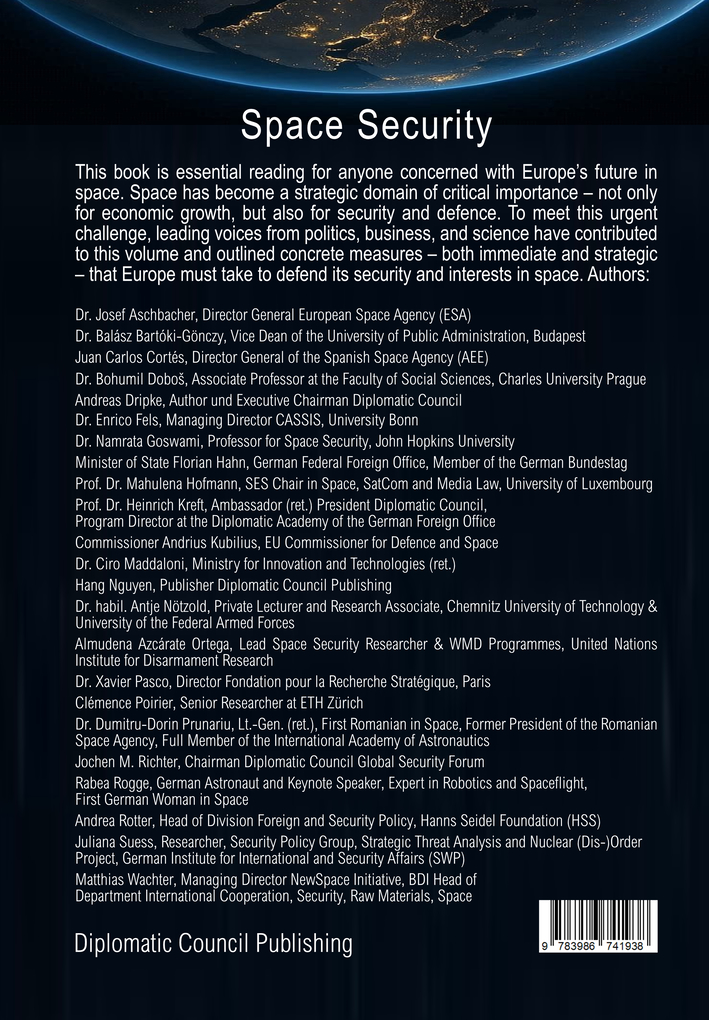
Commissioner Andrius Kubilius is a Member of the European Commission responsible for Defence and Space (since December 2024). He was a member of the Lithuanian Parliament from 1992 to 2019 and served twice as Prime Minister, from 1999 to 2000 and from 2008 to 2012. Andrius Kubilius was a Member of the European Parliament from 2019 until December 2024, during which he chaired the Delegation to the Euronest Parliamentary Assembly (until July 2024).
Dr. Josef Aschbacher is the Director General of the European Space Agency (ESA) since March 2021. In 2023, his mandate was extended for a further period of four years until March 2029.
Matthias Wachter is the Managing Director of the German NewSpace Initiative and Head of International Cooperation, Security Policy, Raw Materials and Space at the Federation of German Industries (BDI). He is also a member of the Space Program Committee of the German Aerospace Center (DLR). He studied Business Administration in Coburg, Paris, and New York, earning B. Sc. degrees from Coburg University and INSEEC Paris. As a Fulbright Scholar, he completed an M. Sc. in Global Political Economy at Rutgers University in New Jersey in 2007. In 2022, he earned an Executive MBA from the European School of Management and Technology (ESMT). After returning to Germany from the US, he joined the Executive Management Program at Axel Springer before moving to the BDI in 2008 as Executive Assistant to the CEO. In 2010, he became Head of Strategic Planning, Policy and Coordination; since 2012, he has led the department for Security, Raw Materials and Africa.
Florian Hahn has been Minister of State at the German Federal Foreign Office since 6 May 2025. Grounded in the new government s foreign policy principles of promoting Security, Freedom and Prosperity, his regional responsibilities encompass transatlantic relations; relations with Belarus, Moldova, Russia, and Ukraine; and the Asia-Pacific, South Asia, and Near East Regions. In addition, his policy portfolio includes external trade and economic security as well as security policy issues, the promotion of a rules-based order, United Nations and Arms Control, and energy policy.
Dr. Dumitru-Dorin Prunariu is the first Romanian cosmonaut and a leading international authority on space policy, planetary defense, and sustainable space exploration. Born on 27 September 1952 in Bra ov, Romania, he completed an eight-day space mission in May 1981 aboard Soyuz-40 and the Salyut-6 orbital station an achievement that placed Romania among the spacefaring nations and shaped his lifelong diplomatic, scientific, and strategic engagement in global space governance. A founding member of the Association of Space Explorers (ASE), Dumitru-Dorin Prunariu served as ASE International President (2011-2014) and ASE Europe President for six years, and has been a key member of the ASE Committee on Near-Earth Objects since 2005. Dumitru-Dorin Prunariu has held several top national and international positions: President of the Romanian Space Agency (1998-2004); Romania s Ambassador to the Russian Federation (2004-2005); Chair of the UN Committee on the Peaceful Uses of Outer Space (UN COPUOS) from 2010 to 2012; and co-vice-chair of the Working Group that delivered the UN Space2030 Agenda in 2021. He has been appointed twice by the UN General Assembly to high-level Groups of Governmental Experts on space security (TCBMs and PAROS) and contributed to the EU Institute for Security Studies report on European space security. Within Europe, Dr. Prunariu served as Vice-Chair of the International Relations Committee of the European Space Agency (2014-2017). In recognition of his leadership in planetary defense and his key role in establishing the UN-recognized Asteroid Day, asteroid 10707 Prunariu was named in his honor. He is the Vice-Chairman of the Asteroid Foundation Board in Luxembourg and a member of the Advisory Board of the Moon Village Association (MVA). In 2021, he was elected Chair of the Global Expert Group on Sustainable Lunar Activities (GEGSLA), coordinating 37 international experts in producing the landmark study on a global framework for peaceful and sustainable lunar operations. He also initiated and negotiated, on behalf of Romania, the creation of the Action Team for Lunar Activities Consultations (ATLAC), adopted by COPUOS in 2024. Dumitru-Dorin Prunariu is a member of the International Academy of Astronautics (IAA) Board of Directors, an honorary member of the Romanian Academy and the Academy of Sciences of Moldova, and a recipient of multiple Doctor Honoris Causa titles across Romania, Moldova, and the United States. An aerospace engineer by training, Dr. Prunariu graduated from the Politehnica University of Bucharest in 1976 and holds a PhD in space flight dynamics. As co-author of several books and numerous scientific papers, he remains an active global advocate for space education and public outreach.
Andrea Rotter is Deputy Director of the Academy for Politics and Current Affairs at the Hanns Seidel Foundation in Munich, where she heads the Division for Foreign and Security Policy. Since July 2025, she has also served as a Non-Resident Fellow at the American-German Institute (AGI) at Johns Hopkins University in Washington, D. C. Her research focuses on transatlantic security cooperation as well as German and European security and defense policy. Currently, she examines the evolution of Germany s strategic culture, the transformation of NATO in response to Russia s war of aggression against Ukraine, as well as space security and the impact of disruptive technologies. Previously, she worked in the Americas research division at the German Institute for International and Security Affairs (SWP) and taught at the University of Regensburg. She contributed to the CDU/CSU parliamentary commission on Peace and Security in Europe , was a Visiting Fellow at GMF and AGI, and a member of the Young Foreign Policy Experts working group at the Federal Academy for Security Policy (BAKS). Andrea Rotter is an alumna of the IVLP (U. S. Department of State) and the Manfred Wörner Seminar, and serves on the extended board of WIIS Germany.
Dr. habil. Antje Nötzold is PD Senior Researcher in the research project "Support for Arms Control in Space (SACS)" at the University of the German Armed Forces in Munich and private lecturer at the Chair of International Politics at Chemnitz University of Technology; Non-Resident Fellow at the American-German Institute (AGI) at Johns Hopkins University, Washington DC; Associate Fellow at the Center for Advanced Security, Strategic and Integration Studies (CASSIS) at the University of Bonn and Vice President of the Society for Security Policy (GSP).
Juliana Suess is an Associate with the STAND Project (Strategic Threat Analysis and Nuclear (Dis-)Order) within the Research Group International Security at the German Institute for International and Security Affairs (SWP), where she researches space security, deterrence and arms control. She is a current PhD Student in War Studies at King s College London and also the host of the podcast War in Space, which discusses the intersection of international security and space. Juliana Suess is an Associate Fellow at the Royal United Services Institute (RUSI), where she was previously Research Fellow for Space Security.
Dr. Namrata Goswami is an author and educator who specializes in space policy, international relations, and ethnic identity. Currently, she teaches at the Schriever and West Space Scholar Programs, the School of Advanced International Studies at Johns Hopkins University, and the Thunderbird School of Global Management at Arizona State University.
Dr. Ciro Maddaloni worked 40 years for the private sector (IBM) and public sector (Italian Government and EU Institutions), moving from consulting positions to managerial roles, mastering meetings with EU Member States stakeholders in the area of Security and Border Management. Nowadays he writes as a Geo-political Opinionist for the Giornale Diplomatico .
Thi Thai Hang Nguyen founded the Diplomatic Council with a group of Ambassadors more than twelve years ago. The organization links diplomacy, business leaders, science s leading minds and society s front-runners on resolving mankind s biggest challenges. For this purpose, it was admitted by the United Nations to its closest advisory circle with UN Consultative Status.
Dr. Xavier Pasco (Doct. In Pol. Sc. - Univ. of Paris-Sorbonne) has been Director of the Fondation pour la Recherche Strategique (FRS) in Paris since October 2016. Prior to this position, Dr. Pasco has been in charge of space, high technology and security related studies since the late eighties at FRS and CREST (Center for Research and Evaluation of the relationships between Strategies and Technology) close to Ecole Polytechnique. Dr. Xavier Pasco has conducted several projects related to the use of space for security in support of national and international organizations. He has also coordinated several projects supported by the European Union (EC and EDA) and the European Space Agency. He has published numerous works (books and more than 100 articles or papers) on these topics. He has been giving lectures in the French Military School as well as at the Institute of Political Studies in Paris. He is the European Editor of the international academic review Space Policy and has been elected in 2012 as a full member of the International Academy of Astronautics. He has also been a member of the U. S. based Secure World Foundation (SWF) Advisory Committee.
Dr. Balazs Bartoki-Gönczy is Associate Professor of Law and Director of the Institute of Aerospace and Telecommunications Law of the Ludovika University of Public Service (Budapest, Hungary).
Juan Carlos Cortes has been the Director of the Spanish Space Agency (AEE), overseen by the Ministries of Science, Innovation and Universities and of Defense, since May 2024. He also holds the positions of Head of the Spanish Delegation to the European Space Agency (ESA) and Vice President-elect of the ESA Council, Head of the Spanish Delegation to the Administrative Board of the European Union Agency for the Space Programme (EUSPA), and representative on the Horizontal Committee of the European Space Programme. With over 35 years of professional experience, Cortés is an expert in R&D management and a specialist in the aerospace sector and dual-use programs. Since 2004, he has been responsible for promoting Spain s contribution and leadership in space programs, catalyzing the sector s development in all its areas.
Dr. Bohumil Dobos is an Associate Professor at the Faculty of Social Sciences, Charles University. He serves as the coordinator of the Geopolitical Studies Master s Programme. In his research, he focuses on topics related to geopolitics and space security, specifically astropolitics, the geopolitics of Sub-Saharan Africa, and the territoriality of non-state actors.
Dr. Enrico Fels is the Managing Director of the Center for Advanced Security, Strategic and Integration Studies (CASSIS) at the University of Bonn (Rheinische Friedrich-Wilhelms-Universität Bonn). His research spans traditional and non-traditional security studies especially space policy, the technology-security-society nexus, and crisis resilience along with international political economy (IPE) and the strategic implications of Asia s rise for Europe. As an expert, he regularly analyzes strategic developments particularly in the areas of space and security for both non-academic audiences and the media.
Prof. Dr. Mahulena Hofmann is Professor of Space and Telecommunication Law at the University of Luxembourg since 2011, after having worked as research fellow at the Max Planck Institute for Public International and Comparative Law in Heidelberg and at the University of Giessen (holder of Jean Monnet Chair for European Law). As holder of the SES Chair in Space, SatCom and Media Law in Luxembourg, she directly participated in drafting the Luxembourg space legislation.
Clemence Poirier is a Senior Cyberdefense Researcher at the Center for Security Studies (CSS) at ETH Zurich, Switzerland. Prior to joining CSS, she was a Research Fellow seconded by CNES (the French Space Agency) at the European Space Policy Institute (ESPI) in Vienna, Austria, where she conducted multidisciplinary research on space affairs. She also worked as a Researcher for Flinders University in Adelaide, Australia, where she carried out policy and legal research on the cybersecurity of the Australian space infrastructure. She is a guest lecturer at the NATO Defense College, the University of Oxford, the Lucerne University of Applied Sciences and Arts, and ETH Zurich. She is also a Board Member of the CyberSat Summit and Women4Cyber Switzerland. She is affiliated with the Open Lunar Foundation and the Jeff Bleich Centre for Democracy and Disruptive Technologies (JBC). Her research interests focus on space cybersecurity, cyber conflict in outer space, and electronic warfare on space systems.