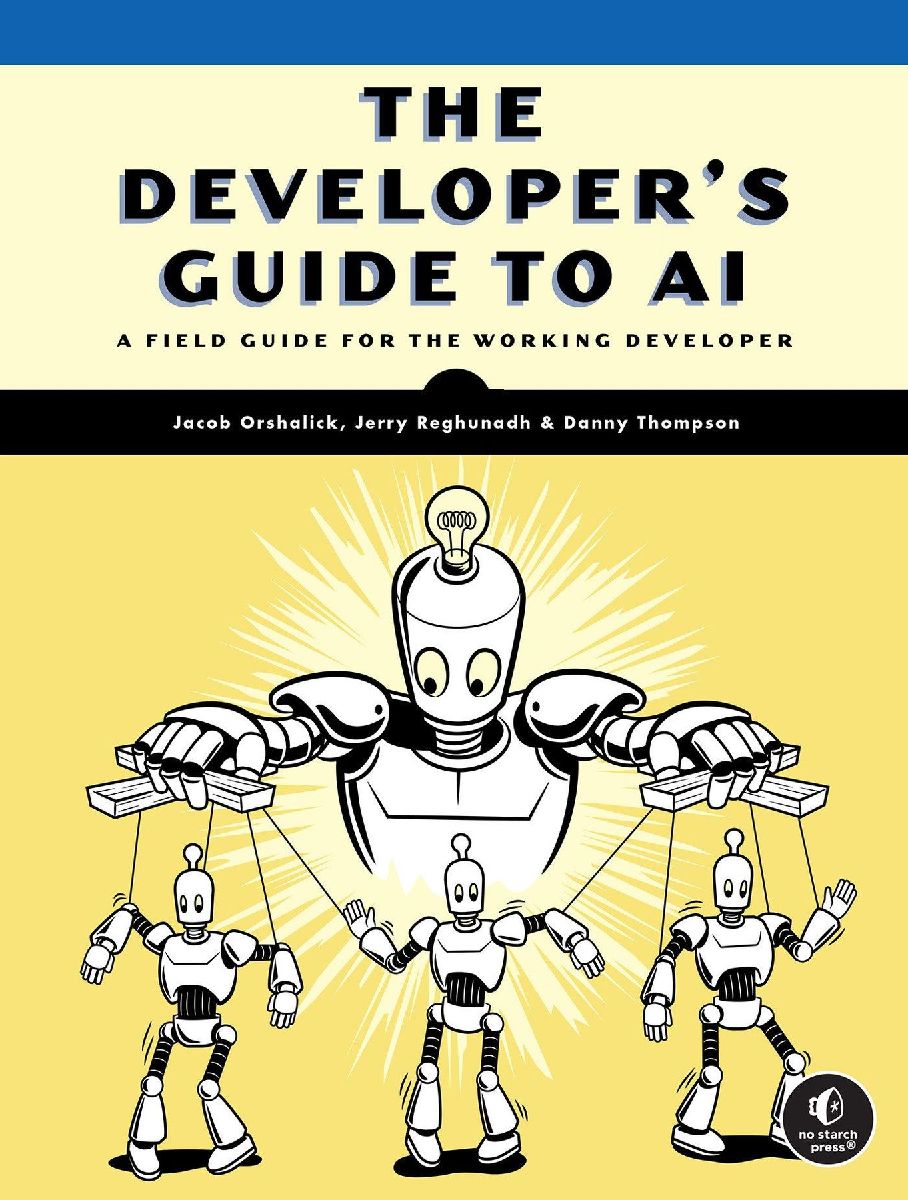
Build intelligent applications—no data science degree required.
Your boss is pitching new AI features. Your team is buzzing about MCP servers. Job postings are asking for AI experience with RAG, vector databases, fine-tuning, and agents. You can feel the excitement. You see the potential. You may be wondering how to get started in AI without a data science degree. You’re in the right place.
The Developer’s Guide to AI gives working developers a practical path through the terminology, tools, and implementation patterns that matter. It shows you how to build with AI using the tools you already know: JavaScript, Python, APIs, SDKs, and databases.
By the end of this book, you’ll know how to:
- Call LLM APIs and stream intelligent responses directly to your UI.
- Engineer prompts that produce reliable, production-ready results.
- Build RAG pipelines using vector databases to give AI access to your private data.
- Fine-tune models with LoRA for specialized tasks like classification.
- Deploy AI agents using tool-calling and the Model Context Protocol (MCP) to reason and act inside real workflows.
LLMs, RAG, LoRA, MCP, embeddings, and agents are not just intimidating buzzwords. They are the building blocks for the next generation of software.
Grab your code editor, bring your engineering instincts, and let’s build what’s next!
Inhaltsverzeichnis
Acknowledgments< BR> Preface< BR> Introduction< BR> < BR> PART I: GETTING STARTED WITH AI< BR> Chapter 1: Understanding Large Language Models< BR> Chapter 2: Building Your First LLM-Powered Application< BR> Chapter 3: Python Essentials for LLMs and APIs< BR> < BR> PART II: PROMPT ENGINEERING< BR> Chapter 4: Fundamentals of Prompt Engineering< BR> Chapter 5: Prompt Engineering Techniques< BR> Chapter 6: Prompt Engineering in Code< BR> < BR> PART III: VECTOR DATABASES AND RAG< BR> Chapter 7: Vector Databases in Practice< BR> Chapter 8: Designing a Retrieval-Augmented Generation System< BR> < BR> PART IV: ADAPTING MODELS TO REAL-WORLD TASKS< BR> Chapter 9: Why and When to Customize a Model< BR> Chapter 10: Preparing Data for Fine-tuning< BR> Chapter 11: Fine-Tuning Models in Practice< BR> < BR> PART V: BUILDING AGENTIC SYSTEMS< BR> Chapter 12: From Workflows to Autonomous Agents< BR> Chapter 13: Building an Autonomous Agent< BR> Chapter 14: Extending Agents with Tools< BR> < BR> Afterword< BR> Index