









Das eBook.de Hörbuch Abo - jederzeit, überall, für nur 7,95 € monatlich!
Jetzt entdecken
mehr erfahren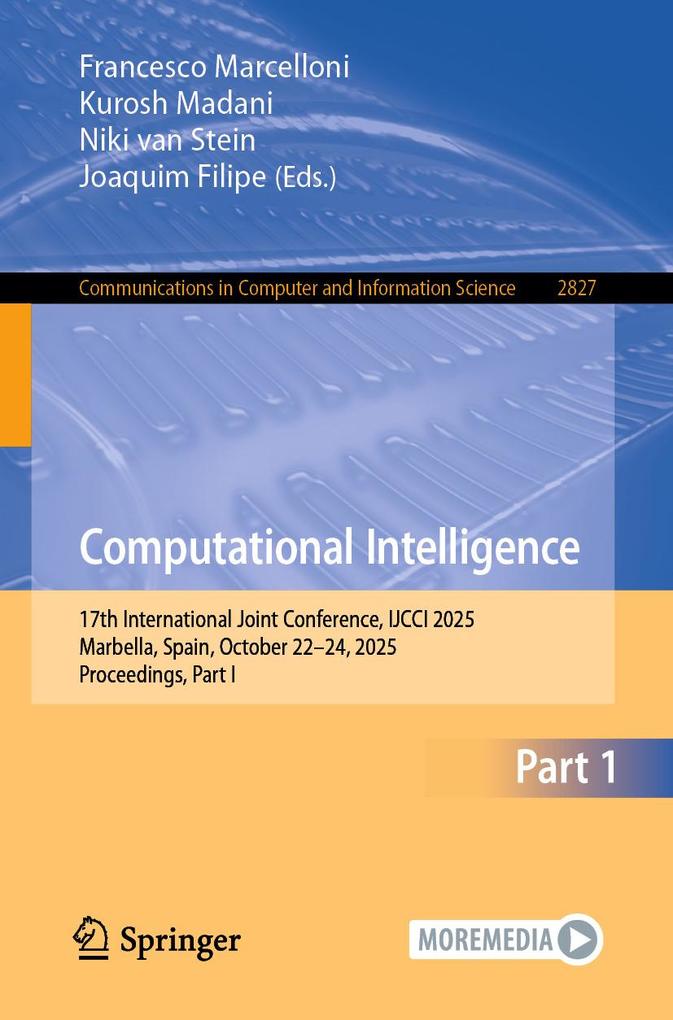
This three-volume set CCIS 2827-2829 constitutes the refereed proceedings of the 17th International Joint Conference on Computational Intelligence, IJCCI 2025, held in Marbella, Spain, during October 22-24, 2025.
The 36 full papers and 83 short papers included in these volumes were carefully reviewed and selected from 146 submissions. They are organized into the following topical sections:
Part I: International Conference on Agentic and Generative Techniques in Intelligent Computational Systems; International Conference on Fuzzy Computation Theory and Applications.
Part II: International Conference on Evolutionary Computation Theory and Applications.
Part III: International Conference on Explainable AI for Neural and Symbolic Methods; International Conference on Neural Computation Theory and Applications.
Inhaltsverzeichnis
. - International Conference on Agentic and Generative Techniques in Intelligent Computational Systems.
. - Rawlsian Agents: An Application of Large Language Models (LLM) to Forge Fairer Bilateral Agreements.
. - ScaleMCP: Dynamic and Auto-Synchronizing Model Context Protocol Tools for LLM Agents.
. - Towards SAFE AI Agentic System.
. - Baba Is LLM: Reasoning in a Game with Dynamic Rules.
. - HADA: Human-AI Agent Decision Alignment Architecture.
. - A Cascaded Deep Generative Model for Audio-to-Sign Language Translation.
. - AStudy on Multi-Agent Collaboration for Business Process Automation in Enterprise Resource Planning Systems.
. - Protocol-Driven Agentic Integration of LLMs: A Multi-Tool Use Case.
. - LLM-based Multi-Agent Systems: Frameworks, Evaluation, Open Challenges, and Research Frontiers.
. - Towards Interpretable Automated Question Answering Model Evaluation and Comparison.
. - Evaluating Agentic AI Through a Geopolitical Simulation Sandbox.
. - Prompt-Augmentation for Evolving Heuristics for a Niche Optimization Problem.
. - Energy-Aware Routing in Sensor Networks Using Static and Dynamic Agent Selection.
. - Analysis of Strategies for Interacting with Large Language Models in Meeting Time Optimization.
. - LLM-Based Risk Scenario Generation and Mitigation for AI Systems: A Case Study Approach.
. - Trustworthy AI in Design: Introducing Explainable Agent Systems.
. - Solidity Meets LLMs: A Transformer-Based Approach to Smart Contract Vulnerability Detection.
. - NoRMA: A Multi-Agent Communication-Centric Dataset for Enhanced Customs Nomenclature Classification.
. - Memory Strategies for LLM Agents: A Comparative Study of In-Context and Episodic Architectures.
. - TE-CTABGAN+: A Unified GAN Framework for Generating Synthetic Electronic Health Records.
. - Data-Driven Insights for Crowdfunding Success in the Developing World.
. - Agent-Based Business Process Design: A Declarative Approach Beyond Procedural Workflows.
. - Enhancing Debunking Effectiveness Through LLM-Based Personality Adaptation.
. - Leveraging LLM Reflection to Improve Small Language Model Agents Capabilities.
. - Enhancing the A2A Protocol with Blockchain-Based Identities and x402 Micropayments for Agentic AI.
. - Artificial Intelligence in Emotional Induction: A VR and Electronic Music Approach.
. - DermETAS-SNA LLM: A Dermatology Focused Evolutionary Transformer Architecture Search with StackNet Augmented LLM Assistant.
. - International Conference on Fuzzy Computation Theory and Applications.
. - Fuzzy Interval-Valued Real Options in Supply Chain Acquisition under Geopolitical Risk.
. - Quantum Genetic Algorithm Tuning of Interval Type-2 Fuzzy State Feedback Controllers for MAGLEV Servosystems.
. - Linguistic Interpretation of Natural Data Using Intermediate Quantifiers Relate to Graded Cube of Opposition.
. - The Limits of Crispness: A Systematic Evaluation and New Perspective for Open Government Data (OGD) Taxonomies.
. - Image Denoising Using a Gerchberg-Saxton Based Data-Set and Fuzzy Logic Reasoning.
. - Fuzzy Cognitive Maps Modeling for Robotics Control.
. - Selection of Fuzzy Regression Models by AIC.
. - Haemoproteus: Infected Cells Detection in Pigeon Blood Smears Using a Fuzzy Logic-Based Framework.
. - Predicting Slump, Slump Flow and Compressive Strength of Concrete Using Type-1 TSK Fuzzy System.
. - An Explainable Histopathological Nuclei Classification System Based on Fuzzy Decision Trees.
. - An Elliptic Intuitionistic Fuzzy Model for Evaluating Habilitated Academic Staff Productivity in Higher Education.
. - Comparison of Fully Electric SUV Cars by Using Interval-Valued Proportional Spherical Fuzzy Analytic Hierarchy Process.
. - Fuzzy Implications Recursively Defined via Disjunction and Conjunction.
Es wurden noch keine Bewertungen abgegeben. Schreiben Sie die erste Bewertung zu "Computational Intelligence" und helfen Sie damit anderen bei der Kaufentscheidung.