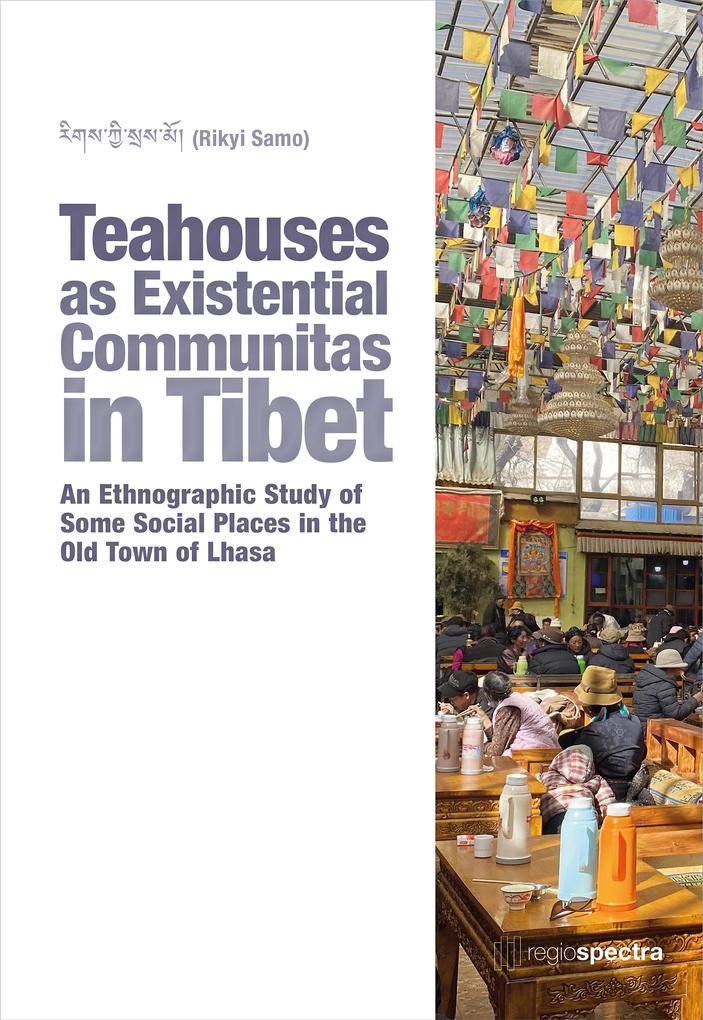
This book is an ethnography of Lhasa's teahouse culture, told through long wooden tables and benches from the commune era, worn teapots, oil-stained door curtains, concrete floors, brick tea and sugar, courtyards, monasteries, pilgrims and travelers, beggars and vendors, wandering performers, and local residents. Through these ordinary yet resonant things, it traces the entanglement of histories, memories, stories, and institutions as they have unfolded amid social transformations since the late 1980s. Opening the book is like lifting a teahouse curtain and stepping inside. By sharing tea and time with the author, readers encounter a lifeworld that quietly resists grand narratives of development, where political concerns surface as naturally as they do in everyday conversation.
Teahouses here are not simply sites of slowness. They are warm, open spaces of encounter in which relations unfold in the sense of Ich und Du (Martin Buber). Drawing on Soja's concept of Thirdspace and Victor Turner's Communitas, the book uses the teahouse as a lens for an earthbound account of social life and sociopolitical change in Lhasa. Through stories with her tea friends, the author reflects on primordial intersubjective connections among humans and their importance for intercultural understanding and anthropological practice.
In a world increasingly shaped by regional wars and cultural conflict, this ethnography suggests that it is within such modest, shared spaces of encounter that confidence, trust, and a sense of agency can be renewed. For travelers to Tibet, the book pairs well with any guidebook-best read slowly, with time enough to linger in its teahouses.
Inhaltsverzeichnis
Abstract v
Preface vii
Acknowledgement ix
Glossary of Names xiii
1. Introduction 1
2. Theoretical Frameworks 5
2. 1 Teahouses as Existential Communitas 5
2. 2 The Thirdspace 11
2. 3 Understanding Things through the Lens of Communitas 12
3. The Field Settings 15
3. 1 The Sociopolitical Context 15
3. 2 The Old Town of Lhasa 18
3. 3 Life in Barkor Streets 21
3. 4 Tea-drinking in Tibet 27
4. Analyzing Teahouses with the Thirdspace 33
4. 1 Teahouses as Firstspace 33
4. 1. 1 An Overlook of Teahouses in Lhasa 33
4. 1. 2 The Courtyards and Teahouses 38
4. 1. 3 The Names of Teahouses 44
4. 1. 4 The Decoration of Teahouses 45
4. 2 Teahouses as Secondspace 49
4. 2. 1 Teahouses and their History 49
4. 2. 2 Teahouses in Memory 53
4. 2. 3 Teahouses in Representation 57
4. 3 Teahouses as Thirdspace 59
4. 3. 1 The Communes and Teahouses 59
4. 3. 2 Teahouses as Relational Places 61
5. The Dwellings in Teahouses 65
5. 1 The Tea-Goers 65
5. 1. 1 The Pilgrims, Buddhist Practitioners, and the Tourists 66
5. 1. 2 The Traders and Vendors 69
5. 1. 3 Beggars, Itinerant Vendors, and Street Performers 71
5. 2 The Things in Teahouses 73
5. 2. 1 Door Curtains, a Welcome 73
5. 2. 2 The Things from the Commune Era 74
5. 2. 3 Prayers Beads and Other Personal Belongings 78
5. 2. 4 Other Things in Teahouses 80
5. 2. 5 The Taste of the Sweet Tea 81
5. 3 The Tea Rituals in Teahouses 84
5. 4 Playing in Teahouses 88
6. Teahouses as Existential Communitas 93
6. 1 Ajala, Bola, and Mola 94
6. 2 My Tea-friends in Lhasa 96
6. 3 My Experience of Communitas in Teahouses 100
6. 3. 1 Beyond Gyamo ( ) 100
6. 3. 2 The Book Reveals the Co-humanity 107
6. 4 The Meanings of Communitas 118
7. Methods and Methodology 125
7. 1 Interviews 126
7. 2 Participant Observation 127
7. 3 Beyond Home and Field 128
8. Conclusion 131
Literature 137