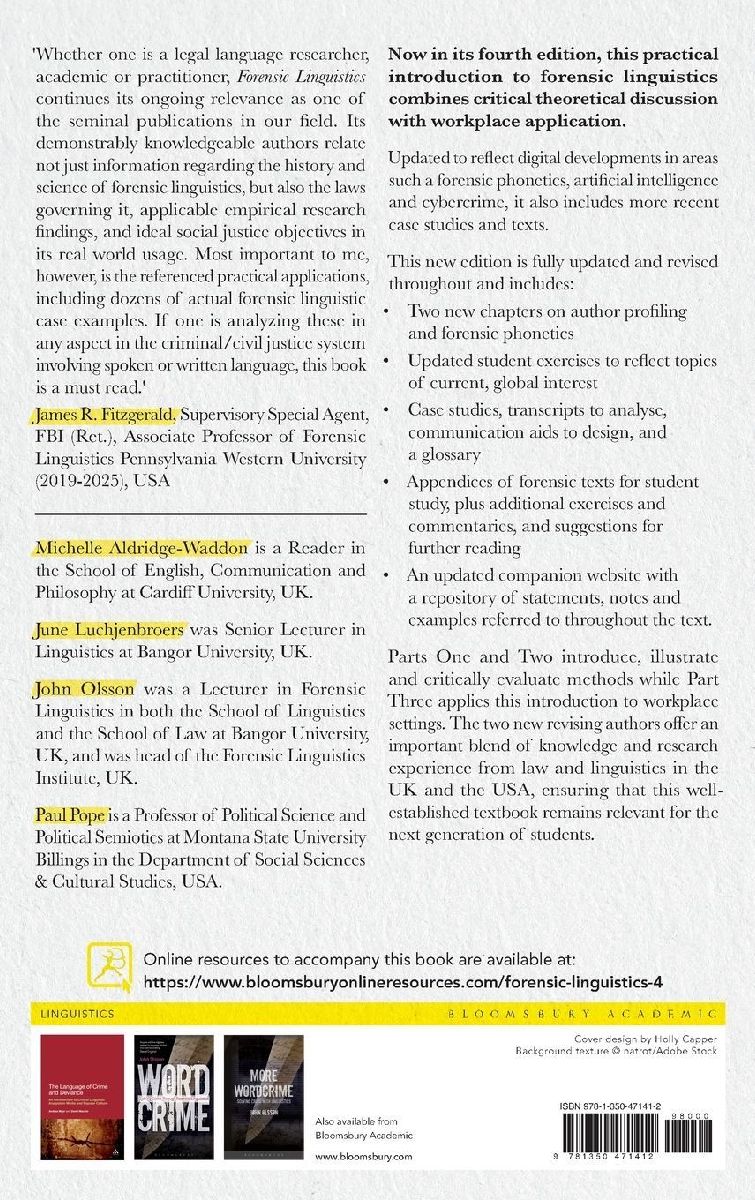
Now in its fourth edition, this practical introduction to forensic linguistics combines critical theoretical discussion with workplace application. This updated version reflects digital developments in areas such a forensic phonetics, artificial intelligence, and cybercrime, and includes more recent case studies and texts. Student exercises also reflect topics of current, global interest.
This new edition is fully updated and revised throughout and includes:
- a new chapter on author profiling
- a new chapter on forensic phonetics written by Ricky Chan (Hong Kong University)
- the expertise of two new co-authors
- case studies, transcripts to analyse, communication aids to design, and a glossary
- appendices of forensic texts for student study, plus additional exercises and commentaries, and suggestions for further reading
- an updated companion website with a repository of statements, notes and examples referred to throughout the text.
Parts One and Two introduce, illustrate and critically evaluate methods while Part Three applies this introduction to workplace settings. The new revising authors offer an important blend of knowledge and research experience from law and linguistics in the UK and the USA ensuring that this well-established textbook remains relevant for the next generation of students.
Inhaltsverzeichnis
List of figures < BR> List of tables < BR> Foreword < BR> Acknowledgements< BR> < BR> PART ONE: Language as forensic evidence < BR> 1. Introduction to Forensic Linguistics< BR> 2. The author constructed < BR> 3. Time, variation and genre < BR> 4. Range of variation < BR> 5. Textual variation < BR> 6. Forensic phonetics: An introduction by Harry Hollien < BR> 7. Cybercrime < BR> < BR> < BR> PART TWO: Dealing with linguistic evidence< BR> 8. Forensic texts< BR> 9. Forensic transcription < BR> 10. Forensic authorship in practice < BR> 11. Investigating author variation in naturalistic data < BR> 12. Forensic linguistic evidence in court < BR> The texts in the case < BR> The features in the texts < BR> Excerpts from prosecution reports < BR> Conclusion < BR> < BR> PART THREE: The legal process: Language and the law< BR> 13. Power in legal contexts: The courts < BR> 14. Power in legal contexts: The police < BR> 15. Vulnerable witnesses < BR> < BR> < BR> PART FOUR: Language of the law < BR> 16. The law and us < BR> 17. The language of statutes < BR> < BR> Appendix 1. Forensic texts < BR> Appendix 2. Exercises and exercise commentaries < BR> Appendix 3. Active researchers in the field of forensic linguistics < BR> < BR> Bibliography < BR> Author Index < BR> Subject Index