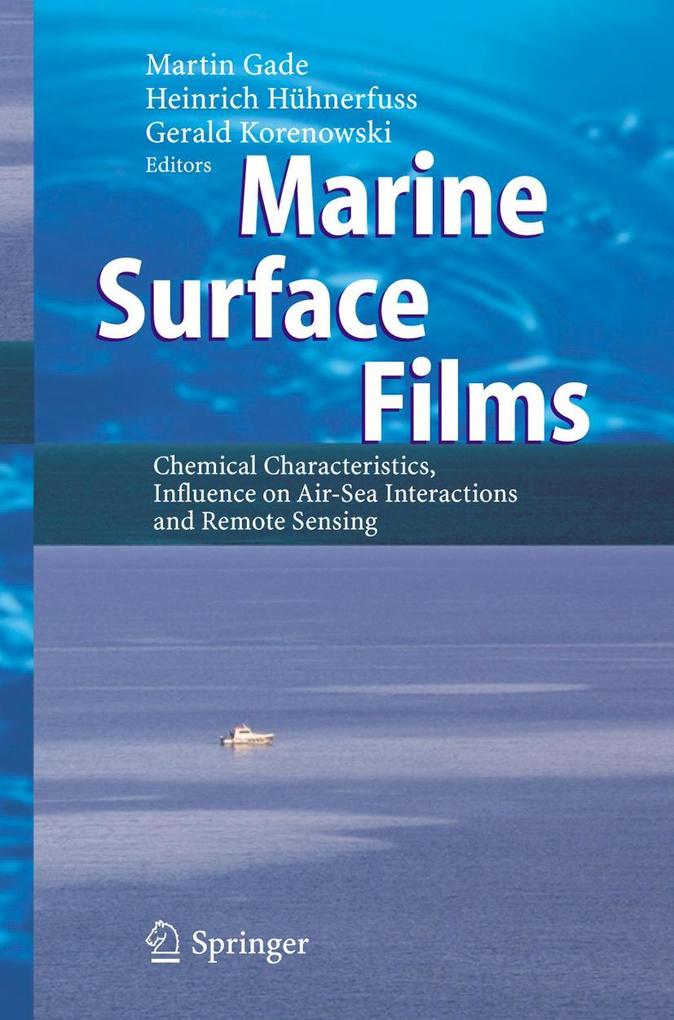
Since the late 1960s, various groups have investigated the influence of marine surface films on mechanisms dominating energy and mass transfer across the ocean/atmosphere interface. However, a compendium summarizing the state-of-the-art research in this field is still missing. The book fills this gap and transfers the accumulated knowledge to the scientific community. After a brief historical chapter basic chemical insights are presented, followed by theoretical and experimental approaches carried out in laboratory facilities. Air-sea interaction experiments are then described and finally, remote sensing applications with sea slicks and crude oil spills are presented.
Inhaltsverzeichnis
General Section. - Oil on troubled waters a historical survey. - Carlo Marangoni and the Laboratory of Physics at the High School Liceo Classico Dante in Firenze (Italy). - Tribute to Erik John Bock. - Chemical Characteristics of Sea Slicks and Oil Spills. - Basic physicochemical principles of monomolecular sea slicks and crude oil spills. - New chemical insights into the structure and morphology of sea slicks and their geophysical interpretations. - Sea slicks: variability in chemical composition and surface elasticity. - Correlation studies of mass spectral patterns and elasticity of sea-slick materials. - On surface renewal and sea slicks. - Chemical Characteristics. - Physicochemical effects of the marine microlayer on air-sea gas transport. - Static and dynamic surface tension of marine water: onshore or platform-based measurements by the oscillating bubble tensiometer. - Multiple scattering of surface waves by two-dimensional colloid systems. - Laboratory study of the damping of parametric ripples due to surfactant films. - Wave tank study of phase velocities and damping of gravity-capillary wind waves in the presence of surface films. - Laboratory measurements of artificial rain impinging on slick-free and slick-covered water surfaces. - Imaging surfactant concentration distribution at the air/water interface. - Imaging surfactant concentration distributions at the air/water interface. - Modelling and Air-Sea Interactions. - Variability of the wave number spectra of short surface waves in the ocean and their modulation due to internal waves and natural slicks. - On the imaging of biogenic and anthropogenic surface films on the sea by radar sensors. - Slick radar image modelling with an extended VIERS-1 wave spectrum. - Thermal imagery of surface renewal phenomena. -Infrared imaging: a novel tool to investigate the influence of surface slicks on air-sea gas transfer. - Remote Sensing Applications. - Detection of oil spills by airborne sensors. - Satellite monitoring of accidental and deliberate marine oil pollution. - Long-term microwave radar monitoring of ocean slicks at low grazing angles. - Oil spills on ALMAZ-1 and ERS-1 SAR images: results from the DOSE-91 experiment. - Estimation of average surface currents from ERS SAR images of oil-tank cleaning spills.