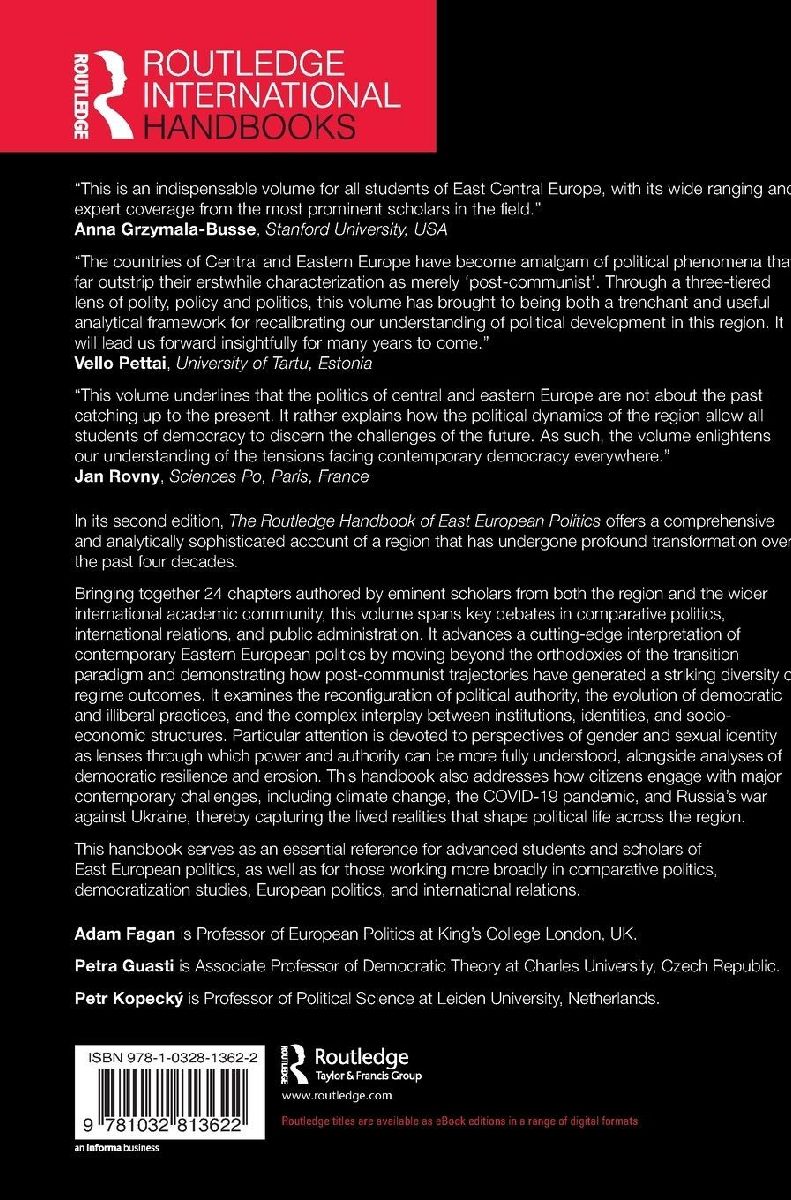
In its second edition, The Routledge Handbook of East European Politics offers a comprehensive and analytically sophisticated account of a region that has undergone profound transformation over the past four decades.
Bringing together 24 chapters authored by eminent scholars from both the region and the wider international academic community, the volume spans key debates in comparative politics, international relations, and public administration. It advances a cutting-edge interpretation of contemporary Eastern European politics by moving beyond the orthodoxies of the transition paradigm and demonstrating how post-communist trajectories have generated a striking diversity of regime outcomes. It examines the reconfiguration of political authority, the evolution of democratic and illiberal practices, and the complex interplay between institutions, identities, and socio-economic structures. Particular attention is devoted to perspectives of gender and sexual identity as lenses through which power and authority can be more fully understood, alongside analyses of democratic resilience and erosion. The handbook also addresses how citizens engage with major contemporary challenges, including climate change, the COVID-19 pandemic, and Russia's war against Ukraine, thereby capturing the lived realities that shape political life across the region.
This handbook serves as an essential reference for advanced students and scholars of East European politics, as well as for those working more broadly in comparative politics, democratization studies, European politics, and international relations.
Inhaltsverzeichnis
Introduction: Polity, Policy and Politics in Central and Eastern Europe Beyond the Transition Paradigm Part I: Regime Dynamics 1. Variety of Eastern European Regimes 2. Democratic Regression and Resilience in Central and Eastern Europe after 1989 3. The Post-Soviet Autocracies 4. Varieties of Capitalism and Welfare States in Post-Socialist Europe: Dependency, Financialization, and Post-Global Financial Crisis Transformations Part II: Political Institutions and Processes 5. Presidents, Governments, and Parliaments in Eastern Europe 6. The Adaptation and Transformation of Political Parties in Central and Eastern Europe 7. Electoral Behaviour in Eastern Europe: Voter Turnout and Vote Choice 8. Electoral Clientelism in Central and Eastern Europe 9. The Rule of Law and Judicial Politics in Central and Eastern Europe 10. Bureaucracies between Reform and Autocratisation in Central and Eastern Europe and the Western Balkans: Towards 'Bureaucracies with Adjectives'? 11. Center-Periphery Relations and Regional Politics in Central and Eastern Europe 12. Media Politics in Central Eastern Europe Part III: Society, Identity and Culture 13. Social Movements, Civil Society, Protest Mobilization, and Contentious Politics in post-1989 Central and Eastern Europe 14. Politics of Gender in East-Central Europe 15. LGBTIQ Politics after Communism 6. Disinformation in Eastern Europe: Mapping the State of Research 17. The Politics of the Environment in Eastern Europe 18. Corruption and Anti-corruption in Post-communist Europe 19. Poverty and Income Inequality in Central and Eastern Europe Part IV: International Relations and Geopolitics 20. Eastern Europe in the World 21. Eastern Europe in the EU 22. The Future of EU Enlargement 23. Russia's war against Ukraine 24. Contested Borders in Central and Eastern Europe: Kin-State Politics, De Facto States, and Conflicts over Sovereignty