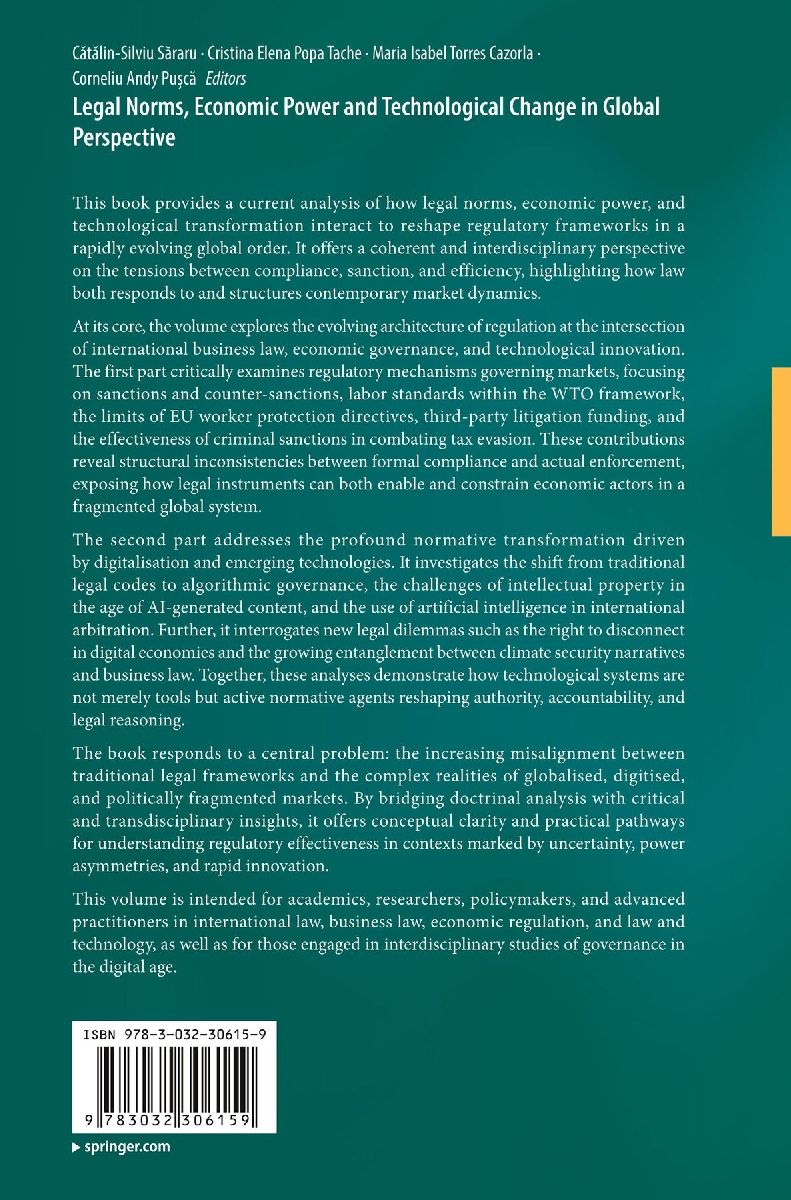
This book provides a current analysis of how legal norms, economic power, and technological transformation interact to reshape regulatory frameworks in a rapidly evolving global order. It offers a coherent and interdisciplinary perspective on the tensions between compliance, sanction, and efficiency, highlighting how law both responds to and structures contemporary market dynamics.
At its core, the volume explores the evolving architecture of regulation at the intersection of international business law, economic governance, and technological innovation. The first part critically examines regulatory mechanisms governing markets, focusing on sanctions and counter-sanctions, labor standards within the WTO framework, the limits of EU worker protection directives, third-party litigation funding, and the effectiveness of criminal sanctions in combating tax evasion. These contributions reveal structural inconsistencies between formal compliance and actual enforcement, exposing how legal instruments can both enable and constrain economic actors in a fragmented global system.
The second part addresses the profound normative transformation driven by digitalisation and emerging technologies. It investigates the shift from traditional legal codes to algorithmic governance, the challenges of intellectual property in the age of AI-generated content, and the use of artificial intelligence in international arbitration. Further, it interrogates new legal dilemmas such as the right to disconnect in digital economies and the growing entanglement between climate security narratives and business law. Together, these analyses demonstrate how technological systems are not merely tools but active normative agents reshaping authority, accountability, and legal reasoning.
The book responds to a central problem: the increasing misalignment between traditional legal frameworks and the complex realities of globalised, digitised, and politically fragmented markets. By bridging doctrinal analysis with critical and transdisciplinary insights, it offers conceptual clarity and practical pathways for understanding regulatory effectiveness in contexts marked by uncertainty, power asymmetries, and rapid innovation.
This volume is intended for academics, researchers, policymakers, and advanced practitioners in international law, business law, economic regulation, and law and technology, as well as for those engaged in interdisciplinary studies of governance in the digital age.
Inhaltsverzeichnis
Regulation markets and legal economic mechanisms between compliance sanction and efficiency. -Between compliance and conflict the impact of sanctions and counter sanctions on international business law. -Labor standards and the wto legal avenues and discursive framing. -Beyond compliancehow organizational practices challenge the effectiveness of eu worker protection directives. -Financing of disputes by third-party traders the mechanism of financial profitability but also the premise of unfair practices. -The effectiveness of criminal sanctions in combating tax evasion between prevention, deterrence, and recovery of budgetary losses. -The 2025 ecj ruling on irap implications for eu fiscal neutrality and italian tax law. -From legal codes to algorithmic codes authority, norm and governance in the digital age. -Assessing copyrightability of aigc an analysis through the lens of cybernetics. - International arbitration assisted by artificial intelligence between the imperative of efficiency and the requirements of procedural guarantees. - The right to be offline - a challenge or an obstacle for the business? . - Climate security, conceptual confusion and the militarisation of the climate crisis: implications for business law.
Es wurden noch keine Bewertungen abgegeben. Schreiben Sie die erste Bewertung zu "Legal Norms, Economic Power and Technological Change in Global Perspective" und helfen Sie damit anderen bei der Kaufentscheidung.