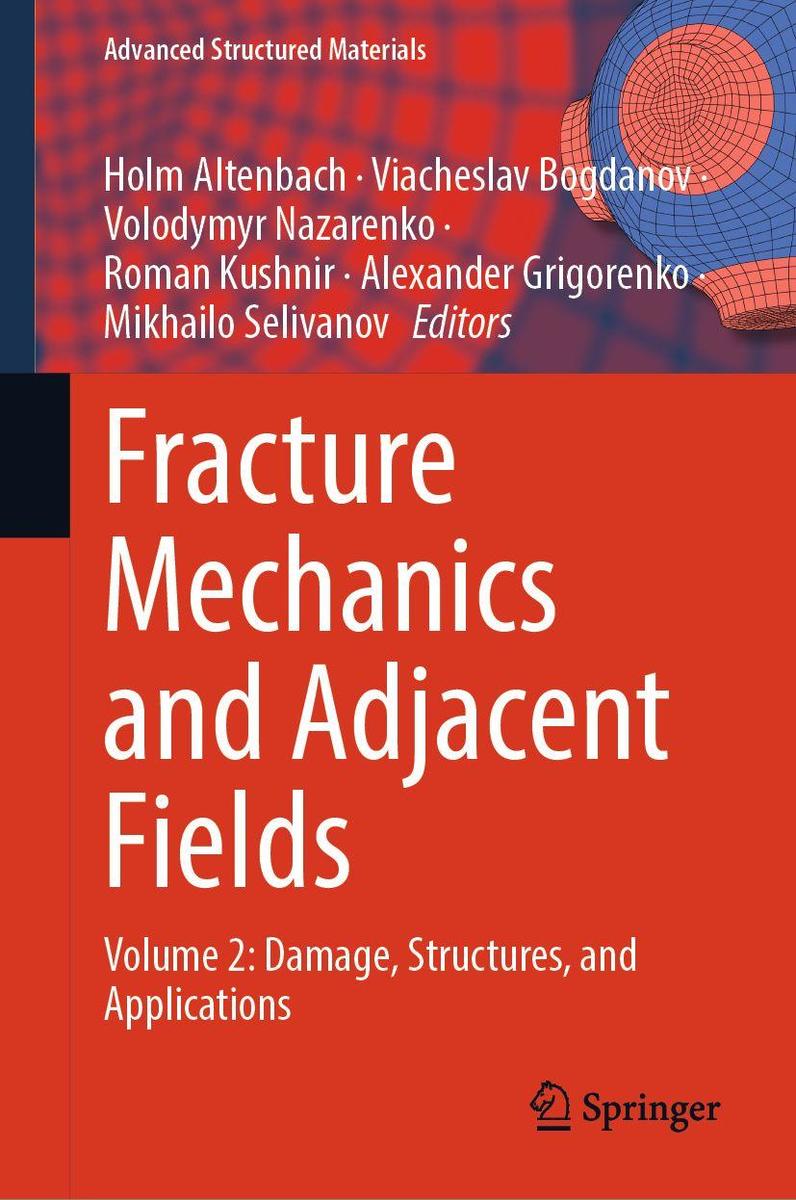
This book brings together studies on fracture mechanics and its related disciplines, contributed by leading Ukrainian researchers. The book explores analytical, numerical, and experimental approaches to crack behavior, damage accumulation, and structural integrity across a range of materials and loading conditions. Topics include computational modeling of fracture processes, stability analysis of composite and piezoelectric materials, fatigue and residual stress effects, and the influence of environmental factors on crack propagation. By integrating theoretical advancements with practical applications, this book provides valuable insights for researchers, engineers, and professionals in structural mechanics and materials science.
Inhaltsverzeichnis
Methods for Determining the Residual Life of Structural Elements under Cyclic Loading, Corrosive, and Hydrogen EnDamage and the Limit State of Structural Elementsvironments. - Analysis of Fatigue Crack Growth in Thin Isotropic Plates with Stress Concentrators. - Microstructure Based Model of Fatigue Fracture of Metal Materials. - Advanced Calculation Method for Assessing Crack Development Under Cyclic Loading Using Scattered Damage Parameters. - Efficiency of HFMI Treatment in Postponing Fatigue Failure of Welded Joints of Low Alloy Steel S355 under Corrosive Environment Conditions. - Energy Characteristics of Fracture and Crack Propagation Velocities in Heat Resistant Nuclear Power Plant Steels. - Advanced Probabilistic Methods for Evaluating Failure of Welded Structures. - Damage and Failure of Inelastic Bodies under Complex Loading. - Prediction of Structural Materials Failure under Creep Considering Damage and Hardening. - Delayed Crack Initiation and Quasi Static Propagation in Viscoelastic Plates with Stress Concentrators. - Analysis of Modern Gas Turbine Engines Rotor Blades Fatigue Strength Parameters. - Loss of Stability of a Thin Film on a Semibounded Substrate under Compression along Interfacial Defects. - Justification of Mechanical Properties for Modern Polymer Materials to Ensure Stability and Insulation of Dual Purpose Underground Structures. - Numerical Analysis of Stability Loss in Structure of Layered Composite Material under Compression by Surface Load Based on Representative Element. - Experimental Research on the Loss of Load Bearing Capacity of Cylindrical Shells Under Accumulation of Through Surface Damage. - Application of Semianalytical Finite Element Method for Stability Analysis of Laminated Plates with Delamination in Three Dimensional Formulation. - Efficient Numerical Methods for Prediction of the State and Operating Life of Critical Structures Using Modern Supercomputer Technologies. - Strength of Layered Shells in the Presence of Damage at the Interfaces. - Fracture and Strength of Structural Low Alloyed Steels of Hydrogen Energy Infrastructure: Role of Hydrogen Concentration Factor in Metal. - Prediction of Parameters of Destructive Pulse Electromagnetic Loading During the Manufacture and Operation of Plate Structural Elements. - Mechanics of Rock Bolt Arch Formation in Roadways with Large Cross Section. - Mathematical Modeling of Residual Stresses in the Anticorrosive Cladding of the WWER 1000 Reactor Pressure Vessel and Their Influence on Brittle Fracture Assessment. - Numerical simulation in fracture mechanics of short fiber sliding interfaced composites. - Modeling Crack Propagation in Power Machine Units by Finite and Boundary Element Techniques. - Hydrodynamic Impact on Coal Rock Massif. - Effect of Carbochrome Coating on Steel Microhardness. - Influence of Hydrogen Embrittlement on the Fracture Resistance of Gas Transit Pipeline Steel Considering In Service Degradation.
Es wurden noch keine Bewertungen abgegeben. Schreiben Sie die erste Bewertung zu "Fracture Mechanics and Adjacent Fields" und helfen Sie damit anderen bei der Kaufentscheidung.











